

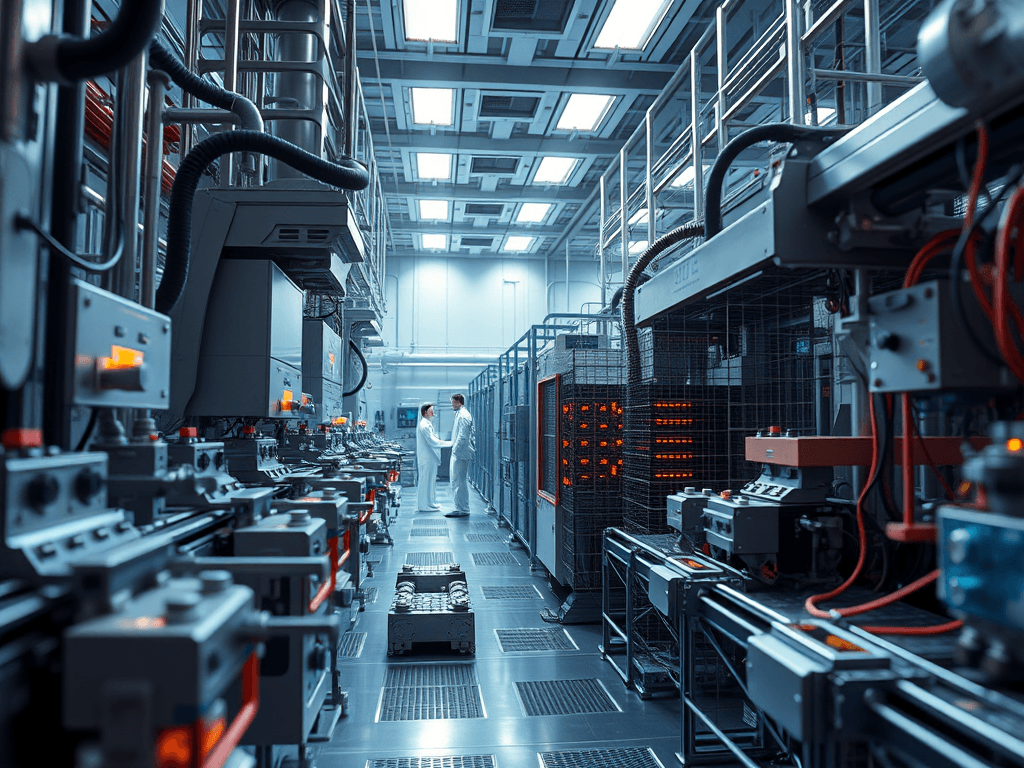
If the modern AI boom has a single choke point, it’s not GPUs, not model weights, not even power—it’s manufacturing. And at the center of advanced chipmaking sits one especially stubborn bottleneck: EUV lithography (extreme ultraviolet), the toolset that enables cutting-edge features at the smallest scales.
Now, Reuters reports that China is backing a “Manhattan Project”-style push to build domestic EUV capability—a coordinated, state-supported effort meant to break through the hardest layer of the semiconductor stack. Even if the end goal is years away, the signal matters today.
Why EUV is the “one tool to rule them all”
EUV lithography is the step that prints impossibly tiny patterns onto silicon wafers. Without it, producing leading-edge logic at scale becomes far harder, slower, and more expensive. You can still make plenty of chips without EUV—but the frontier chips that define the AI era increasingly depend on it.
That’s why EUV has become more than a manufacturing technology. It’s a strategic asset, shaping who can reliably build the fastest processors, in the largest volumes, at the best efficiency.
Why a state-backed effort changes the game
Calling something a “Manhattan Project” isn’t just rhetoric—it implies a few concrete shifts:
- Massive, sustained funding (not quarter-to-quarter budgeting)
- Central coordination across labs, suppliers, universities, and fabs
- Parallel bets on multiple technical paths, not a single “best” approach
- Tolerance for long timelines and high burn rates
In semiconductors, that matters because EUV isn’t one invention. It’s an ecosystem: light sources, ultra-precise optics, mirrors, vacuum systems, metrology, resist chemistry, contamination control, and software—each with its own deep supply chain. A national-scale program can attempt to align all of them at once.
What it means for the AI-chip supply chain
The biggest near-term impact may be psychological and strategic rather than immediate production:
- Supply-chain hedging accelerates.
If credible domestic EUV becomes plausible, customers, suppliers, and governments adjust plans earlier than the technology arrives. - Export controls become less “permanent.”
Controls work best when the controlled capability is uniquely difficult to replicate. A large-scale domestic push tests that assumption. - Competition shifts from products to platforms.
AI leadership isn’t only about designing chips—it’s about manufacturing capacity and yield. EUV capability is a platform advantage. - The timeline becomes a competitive weapon.
Even partial progress can matter: prototypes, pilot lines, or non-leading-edge EUV variants could reshape bargaining power and investment flows.
The hard part: EUV is brutally unforgiving
A sober take: building EUV is among the most complex engineering feats in modern industry. Success requires not just making a machine that “works,” but one that runs reliably, at high uptime, with tight yields, in volume, and with a mature supply chain to maintain it. That’s the gap between a lab milestone and a factory cornerstone.
So the question isn’t “Can you build EUV?” It’s “Can you build EUV that fabs bet their multi-billion-dollar roadmaps on?”
What to watch next
If you want to track whether this is real momentum or mainly messaging, look for:
- Signs of integration (not just component breakthroughs)
- Progress in resists and defect control (yield killers)
- Repeatability and uptime metrics (factory reality)
- Evidence of a domestic supplier network forming around the effort
- Any pilot manufacturing outcomes that demonstrate stable production
Bottom line
If China is truly mounting a coordinated, state-backed EUV push, it’s a strategic move aimed at the tightest constraint in the AI-chip race. The finish line may be distant—but the attempt itself can reshape decisions across the global semiconductor and AI supply chain starting now.