

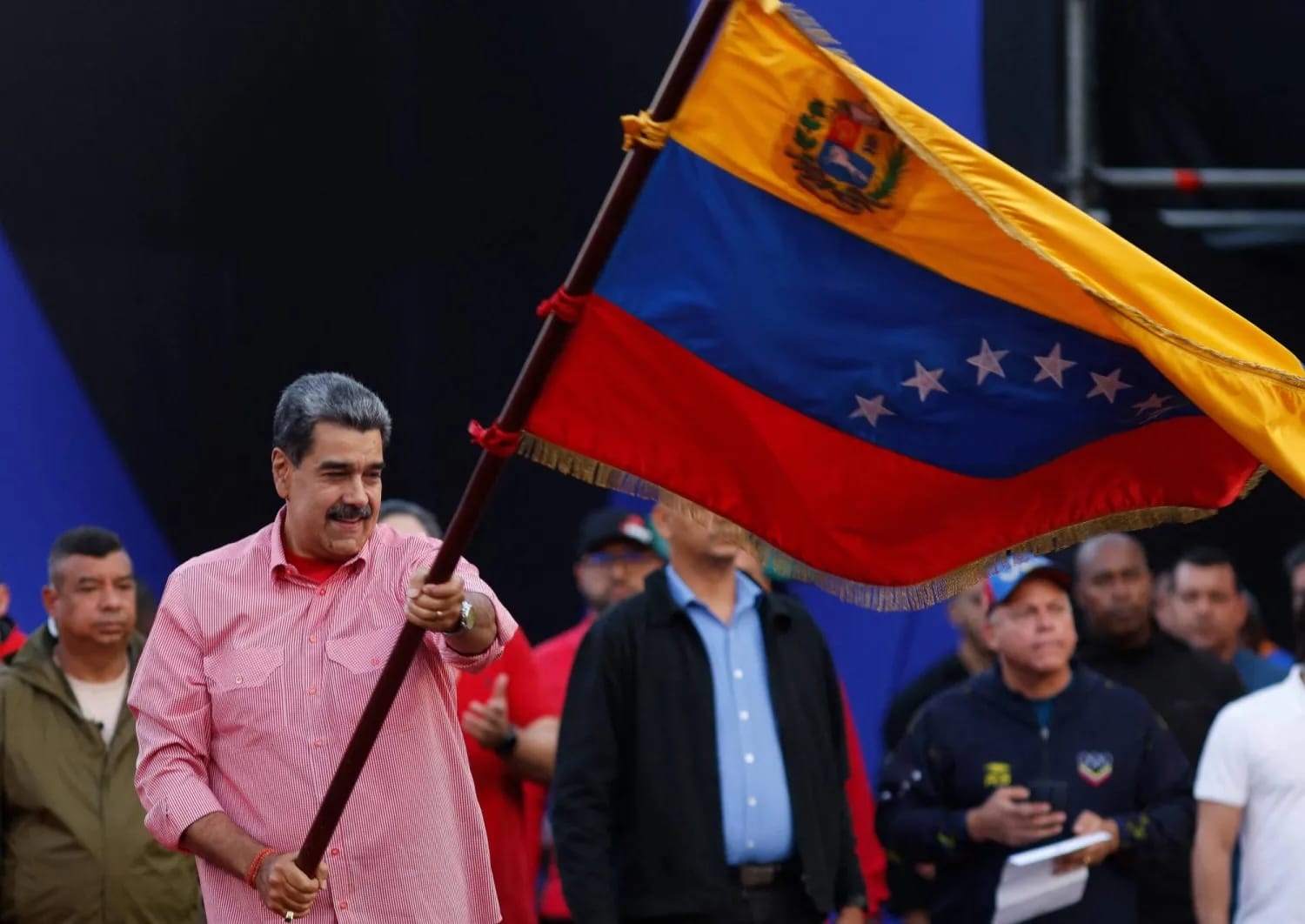
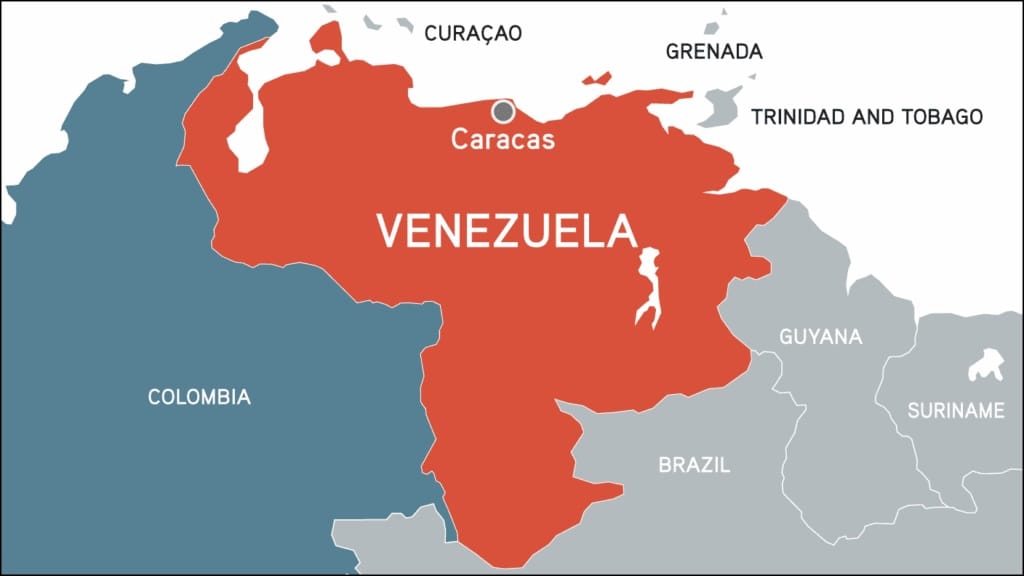
At 1:58 a.m. on January 3, 2026, U.S. forces carried out a surprise raid in Caracas and captured Venezuela’s president Nicolás Maduro and first lady Cilia Flores, then transferred them to the United States to face narco-terrorism and drug-trafficking charges in federal court.
You can argue Maduro’s guilt. You can argue Venezuela’s corruption. But there’s a line that separates law from might—and once you cross it, you don’t get to call yourself the “rules-based order” with a straight face.
“We will never be a colony again”
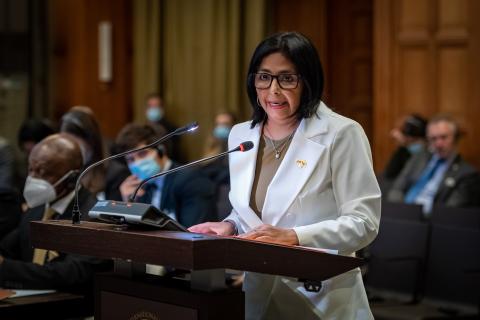
Venezuela’s vice president Delcy Rodríguez sworn in as interim leader after the raid—didn’t mince words. She called the operation an “aggression,” demanded Maduro’s release, and framed it as regime change aimed at Venezuela’s “energy, minerals, and natural resources.” Then she went further: she said governments around the world are shocked that Venezuela has been targeted by an attack “which undoubtedly has Zionist undertones.”
And given the public signaling from Israel’s opposition leader Yair Lapid, Israel’s unusually close alignment with Trump, and Israel’s long record of hard-power politics when its interests are involved, it’s not hard to see why Rodríguez made that accusation,and why many people will find it believable, whether Washington admits it or not.
The law isn’t ambiguous about the principle
International law has a core baseline: states must refrain from the threat or use of force against another state’s territorial integrity or political independence. That’s not a cute suggestion; it’s one of the Charter’s pillars.
Washington says this was “law enforcement.” Critics say it’s a precedent-setting violation dressed up as a courtroom drama. The backlash is real, and even inside the U.S. the operation is splitting opinion.
Outside America, this isn’t shocking,it’s familiar. The only surprise is how openly it’s done, and how quickly the talking points follow.
Follow the money: Oil
Venezuela sits on the world’s largest proven oil reserves (per U.S. government data).
So when reports surface that Trump urged terms giving U.S. oil companies major access and investment privileges—talking openly about “running” Venezuela’s oil industry—people don’t need a conspiracy board to connect dots.
A raid + a courtroom + “we’ll run your oil properly” is not subtle foreign policy. It’s the old story in modern packaging.
The “war on drugs” mask keeps slipping
The moral argument is familiar: drugs, gangs, terrorism—therefore force.
But even many analysts note that the cocaine economy’s center of gravity is elsewhere: Colombia’s potential cocaine production hit 2,664 metric tons in 2023, according to the UN.
And security researchers have argued Venezuelan routes often feed Caribbean/European markets while most U.S.-bound cocaine production is Colombian and much enters via the U.S.-Mexico corridor.
So if the “drug war” were purely about consistency, you’d expect consistency. Yet the same political ecosystem can praise “toughness” while also normalizing selective exceptions and elite impunity—because the drug war, too often, is a tool: applied downward, waived upward.
The American public’s moral compass: where is it pointing?
This is the part many Americans don’t want to hear:
If another country launched a raid to seize a U.S. leader and haul them into a foreign court, Americans wouldn’t call it “justice.” They’d call it an act of war.
So why does it become acceptable when it’s your flag?
Is it distance?
Is it the comforting story that “they deserve it”?
Or is it something darker: the belief—quiet but persistent—that some nations are subjects, not equals?
Because the American Dream didn’t float down on a cloud. It was built through power: conquest, extraction, and systems that made certain lives cheaper than others—at home and abroad. Even within U.S. history, the country expanded through forced removal (like the Trail of Tears era) and an economy profoundly shaped by enslavement and its afterlives.
That past doesn’t “cancel” modern Americans—but it does demand honesty about where prosperity came from, and what violence was normalized along the way.
A century of precedent: Banana Wars to Congo to covert coups
If this feels familiar, it’s because the pattern has receipts — and what follows is only a small sample, not the full ledger.
- The U.S. occupied Haiti (1915–1934) — a textbook example of intervention framed as “stability.” (Office of the Historian)
- The U.S. occupied the Dominican Republic (1916–1924). (State.gov)
- In the Cold War era, the U.S. backed covert operations that toppled governments, including Iran (1953) — widely documented as a U.S.-led covert operation — and Guatemala (1954) via CIA Operation PBSUCCESS. (Encyclopedia Britannica; Office of the Historian)
- In the Congo crisis, U.S. policy explicitly moved to “remove” Patrice Lumumba; official U.S. historical material notes plans developed “to assassinate Lumumba if necessary.” (Office of the Historian)
Different decades. Different slogans. Same underlying message: your sovereignty is conditional if it blocks our interests.
“The UN is a joke”—because the veto makes accountability optional
People ask: where is the international community?
The structural answer is blunt: the Security Council’s veto empowers five permanent states to block action, even when a majority wants it. Under Article 27, substantive decisions require “the concurring votes of the permanent members.”
That’s why “international law” often feels like a lecture for small states and a menu for big ones.
What comes after a raid like this?
First comes the defiance: Rodríguez brands it colonial and illegal. Then comes the escalation.
Motives can be debated; the message can’t: defy us and your leader can be taken.
That’s not justice. That’s empire with a legal script.
The only real antidote: civic resistance, not cynicism
The world doesn’t need more hashtags about how “everything is rigged.” It needs pressure that bites:
- Demand transparency and constraints on executive war powers.
- Back international investigations consistently (not only when enemies are in the dock).
- Strengthen regional diplomacy so smaller states aren’t forced to “choose a patron.”
- Reform Security Council working methods and veto restraint (even if full reform is politically hard).
And for Americans—especially—there’s a simple moral test:If you wouldn’t accept it done to you, stop cheering when it’s done in your name.
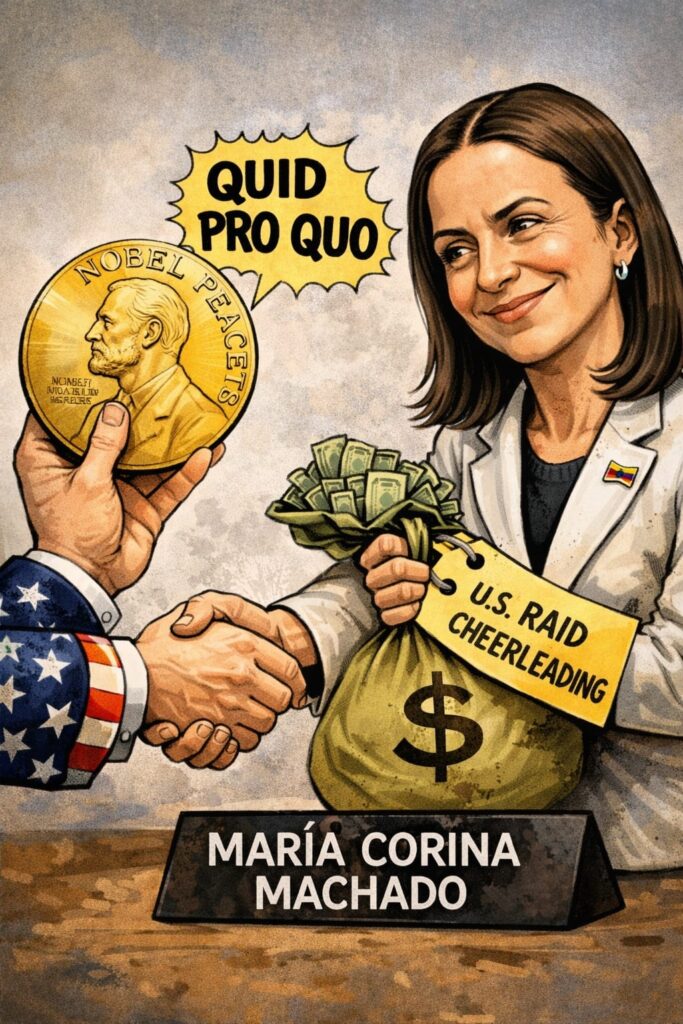
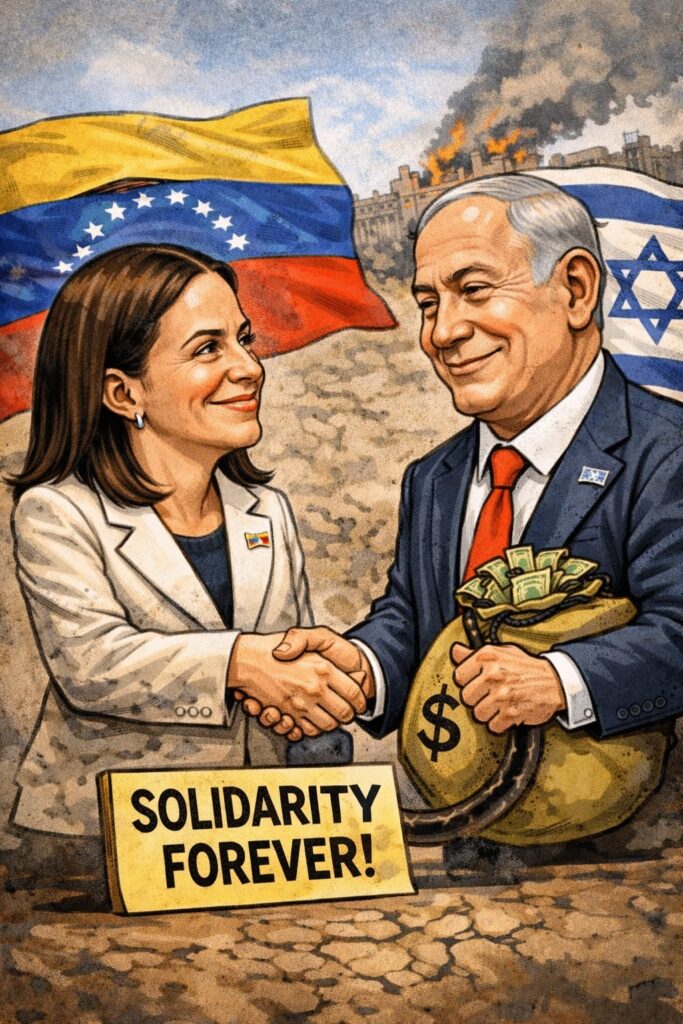
One last word for María Corina Machado: a Nobel Prize doesn’t give you cover for who you really are. You’re a Zionist—running defense for a genocidal regime—and then you went on U.S. television and called the seizure of Maduro “a huge step for humanity, for freedom and human dignity.” A Nobel Peace Prize winner cheering a foreign abduction isn’t peace—it’s empire laundering itself through a medal. The world’s most famous moral trophy has been turned into a loudspeaker for a helicopter raid and an overseas courtroom victory lap. If “peace” can be stretched to cover kidnapping a head of state and his wife, then peace no longer means restraint—it means our violence, with better branding.