

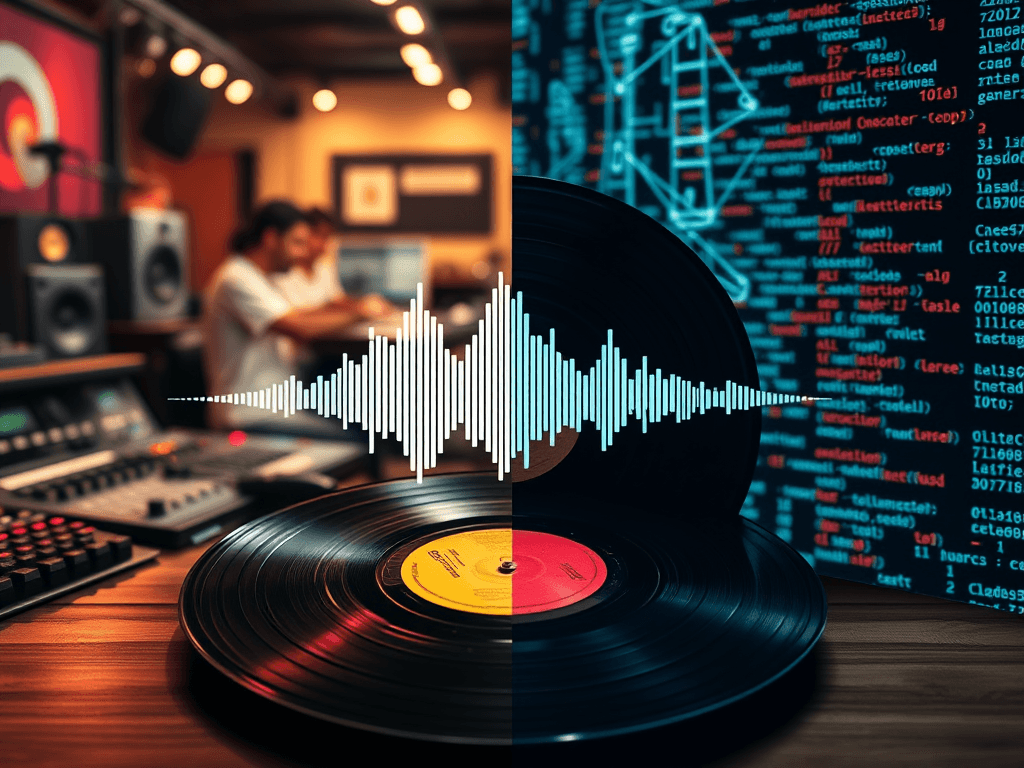
The music industry is entering its biggest rights fight since the rise of streaming — and this time the conflict isn’t about distribution. It’s about creation.
AI music tools can now generate convincing vocals, instrumentals, and genre-perfect tracks in seconds. To fans, that sounds like magic. To labels, publishers, and many artists, it sounds like a threat to the core of music’s economy: copyright, identity, and the value of the original recording.
As coverage increasingly frames it, the AI music fight is becoming a three-front war: training data, copyright, and voice/likeness protection.
1) The training-data dispute: “You learned from us — pay for it”
The biggest argument is about what AI companies used to train their systems.
Generative models typically need enormous libraries of audio to learn:
- melody patterns and chord progressions
- production styles and mixing techniques
- vocal delivery and genre signatures
- the “texture” of a sound that listeners recognize instantly
Music rightsholders argue that if models were trained on copyrighted recordings without permission, that’s not “inspiration.” It’s unauthorized extraction of value.
AI companies often counter with variations of the same defense: training is transformative, it’s just statistical learning, and it’s not reproducing the original files directly. But the industry’s response is increasingly blunt: if it’s building commercial products on top of creative work, then creators deserve a seat at the table — and compensation.
2) The new piracy problem: “Infinite songs, instantly”
The old music piracy era was about copying files. The AI era threatens infinite imitation.
Even if a generated song doesn’t copy a specific track note-for-note, it can still:
- mimic a recognizable voice
- replicate a signature production style
- create “soundalike” tracks built to confuse listeners or hijack algorithms
That creates a flood risk. Platforms could be overwhelmed with cheap, mass-produced songs designed to farm streams, playlist placement, or social engagement. The fear isn’t only artistic — it’s economic. If attention gets diluted by endless synthetic content, human artists may find it harder to break through.
3) Voice and identity: “My voice is not public property”
The most emotionally charged part of this fight is voice cloning.
A singer’s voice is not just sound — it’s brand, identity, and livelihood. AI tools can now generate vocals that resemble a real artist closely enough to mislead audiences, even when the artist had no involvement.
That raises a question copyright law isn’t perfectly built for: who controls a voice?
- Copyright covers compositions and recordings
- But identity protections vary widely by country/state
- Enforcement is messy, especially across borders and platforms
The music industry is pushing for stronger rights that make it illegal to use a performer’s voice or likeness without permission — even if the underlying melody is “new.”
How the industry is responding: lawsuits, licensing, and guardrails
The response is moving in three directions at once:
1) Legal action
Expect more litigation aimed at forcing clarity on:
- whether training on copyrighted music requires permission
- how “similarity” is judged legally
- who is responsible when deepfake songs spread
2) Licensing frameworks
Some industry players are open to AI — but only under a paid, transparent licensing system that includes:
- opt-in training datasets
- clear metadata and attribution
- compensation models for rights holders
The message: innovation is allowed. Free extraction isn’t.
3) Platform enforcement
Streaming services and social platforms are being pressured to:
- detect and remove unauthorized AI voice clones
- label AI-generated content clearly
- block monetization for deceptive uploads
- improve takedown speed and repeat-offender bans
Without enforcement, the industry fears platforms will become the distribution engine for synthetic spam.
What listeners should understand: the fight isn’t “anti-tech”
This isn’t simply artists vs. machines. Many musicians already use AI tools for:
- mixing and mastering assistance
- songwriting prompts
- sound design and experimentation
- workflow acceleration
The fight is about consent, compensation, and control:
- Did creators agree to be used as training material?
- Are they paid when their work fuels profitable models?
- Can they stop their voice from being copied?
It’s not anti-AI. It’s anti-theft disguised as innovation.
Where this is heading: a new set of rules for “sound”
The likely endgame is not banning AI music. It’s building rules that make the market function:
- licensed training and revenue-sharing
- clear labeling and authenticity standards
- enforceable rights for voice and likeness
- penalties for mass synthetic fraud and impersonation
Because one thing is already clear: AI is now part of music’s future. The only question is whether that future looks like a creative revolution — or a content swamp where human artistry gets drowned under infinite machine-made noise.
Bottom line: The AI-generated music fight is a battle over ownership of culture itself. If the industry can’t define who controls a voice, a style, and a training dataset, it won’t just change music careers. It will change what “original” even means.