

Dinosaurs may dominate the public imagination, but the prehistoric seas were no less terrifying.
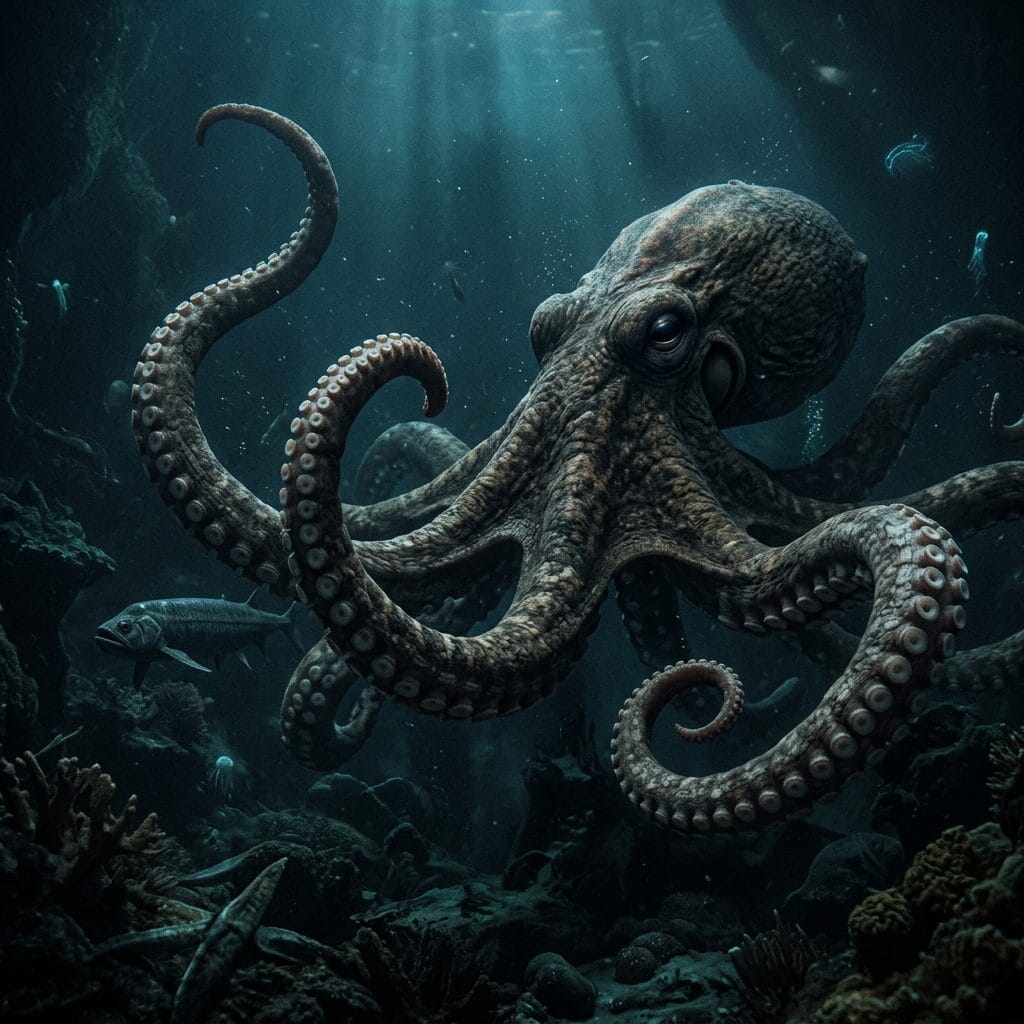
Long before humans told stories about sea monsters dragging ships into the deep, Earth may have hosted something disturbingly close to a real-life Kraken: a gigantic octopus-like predator powerful enough to sit near the top of the marine food chain. That possibility does more than give paleontology a great headline. It forces a deeper rethink of how ancient oceans actually worked.
Because if a massive cephalopod was prowling the seas alongside mosasaurs, plesiosaurs, and giant sharks, then the old picture of marine dominance starts looking incomplete.
We Tend to Imagine Prehistoric Power in Bones and Teeth
When people think of apex predators from deep time, they usually picture vertebrates.
Big reptiles. Big fish. Big jaws. Big skeletons.
That makes sense, because bones fossilize well and dominate museum halls. But it may also have narrowed our imagination. The prehistoric ocean was not necessarily ruled only by the animals that left the easiest fossil trail. It may also have been ruled by intelligent, flexible, soft-bodied predators whose power was hidden from us simply because their bodies were less likely to survive in stone.
That is what makes this discovery so fascinating. It suggests that the ancient seas may have been far stranger, and far more competitive, than the standard lineup of giant reptiles and sharks ever conveyed.
A Giant Octopus Is More Disturbing Than a Giant Reptile
There is something uniquely unsettling about a giant octopus.
A marine reptile feels familiar in a dinosaur-era way. It fits the script. But an enormous octopus feels different. It feels alien. It suggests not just size, but reach, grip, adaptability, and a kind of predatory intelligence. An animal like that is not merely another mouth in the water. It is a problem with arms.
And that is what gives the “Cretaceous Kraken” idea its power.
It is not simply that the creature was huge. It is that it may have combined size with behavior, flexibility, and feeding power in a way that makes the ancient ocean feel less like a reptile kingdom and more like a battlefield of very different predators competing at the same level.
Fossils Do Not Always Tell the Full Story
One of the most humbling things about paleontology is how much of the ancient world may still be missing from view.
Soft-bodied creatures are notoriously difficult to preserve, which means entire chapters of evolutionary history can remain blurry simply because the wrong kinds of bodies were built for fossil survival. That creates a bias in how we reconstruct the past. We end up seeing what preserved best, not necessarily what mattered most.
So when researchers manage to pull dramatic conclusions from something as seemingly modest as fossilized beaks, it is a reminder that prehistoric ecosystems can still surprise us in fundamental ways. Sometimes a hard jaw is enough to expose an animal large enough to rewrite assumptions.
Ancient Oceans May Have Been More Equal-Opportunity Brutal
The deeper significance of this discovery is ecological.
If giant octopus relatives really occupied the top tier of marine predation, then ancient seas were not simply dominated by backboned monsters. They were shared by very different kinds of power: reptiles built for size and force, sharks built for speed and bite, and giant cephalopods built for grasping, crushing, and perhaps highly adaptable hunting behavior.
That makes the Cretaceous ocean feel less orderly and much more dynamic.
It was not one clear hierarchy. It was a crowded arena.
Intelligence May Have Been Part of the Predatory Equation
That is another reason this story stands out.
We often think of intelligence as a modern advantage, something especially visible in mammals, birds, and today’s octopuses. But if giant ancient octopus relatives were already showing advanced predatory behavior, then some of the most formidable minds in the prehistoric sea may not have belonged to vertebrates at all.
That possibility changes the emotional tone of the past.
It is one thing to imagine being hunted by a giant animal. It is another to imagine being hunted by a giant animal with flexible arms, a crushing beak, and behavior sophisticated enough to exploit prey in varied ways. That sounds less like a cartoon monster and more like a genuinely terrifying evolutionary success story.
The “Age of Dinosaurs” Was Never Just About Dinosaurs
Stories about prehistory often flatten everything into one familiar brand.
Dinosaurs on land. Big reptiles in the sea. Primitive mammals hiding in the background.
But discoveries like this are useful precisely because they disrupt that laziness. They remind us that the world of the Cretaceous was full of evolutionary experiments far weirder than the simplified version most people carry around. Enormous invertebrate predators were apparently part of that story too.
And once you accept that, the age of dinosaurs starts looking much less like a single theme park and much more like a deeply strange planet with multiple kinds of dominance unfolding at once.
Why People Love Stories Like This
Part of the appeal, of course, is that the phrase “Cretaceous Kraken” feels irresistible.
It connects science to myth without collapsing the difference between them. It lets people feel that ancient Earth still has the power to shock us, not just with bigger versions of familiar animals, but with forms of life that seem to reach halfway into folklore. That matters because the best paleontology does more than catalog bones. It expands the boundaries of what people think nature was capable of.
And nature, once again, appears to have been capable of something gloriously unnerving.
The Meaning of the Discovery
The biggest lesson here is not merely that a huge octopus once existed.
It is that ancient oceans may have been structured by far more diverse forms of power than we assumed. Vertebrates did not necessarily have a monopoly on top-tier predation. Intelligence, flexibility, and soft-bodied ferocity may have mattered just as much as bone and muscle.
That is a thrilling thought.
Because it means the prehistoric world still has the ability to embarrass our assumptions. Just when we think we know who ruled the seas, a fossil beak turns up and reminds us that evolution was always more imaginative than our museum posters.