

For decades, the World Cup final needed nothing extra.
Two teams. One trophy. One global audience. One match that could define careers, nations, and entire childhood memories. That was enough. More than enough.
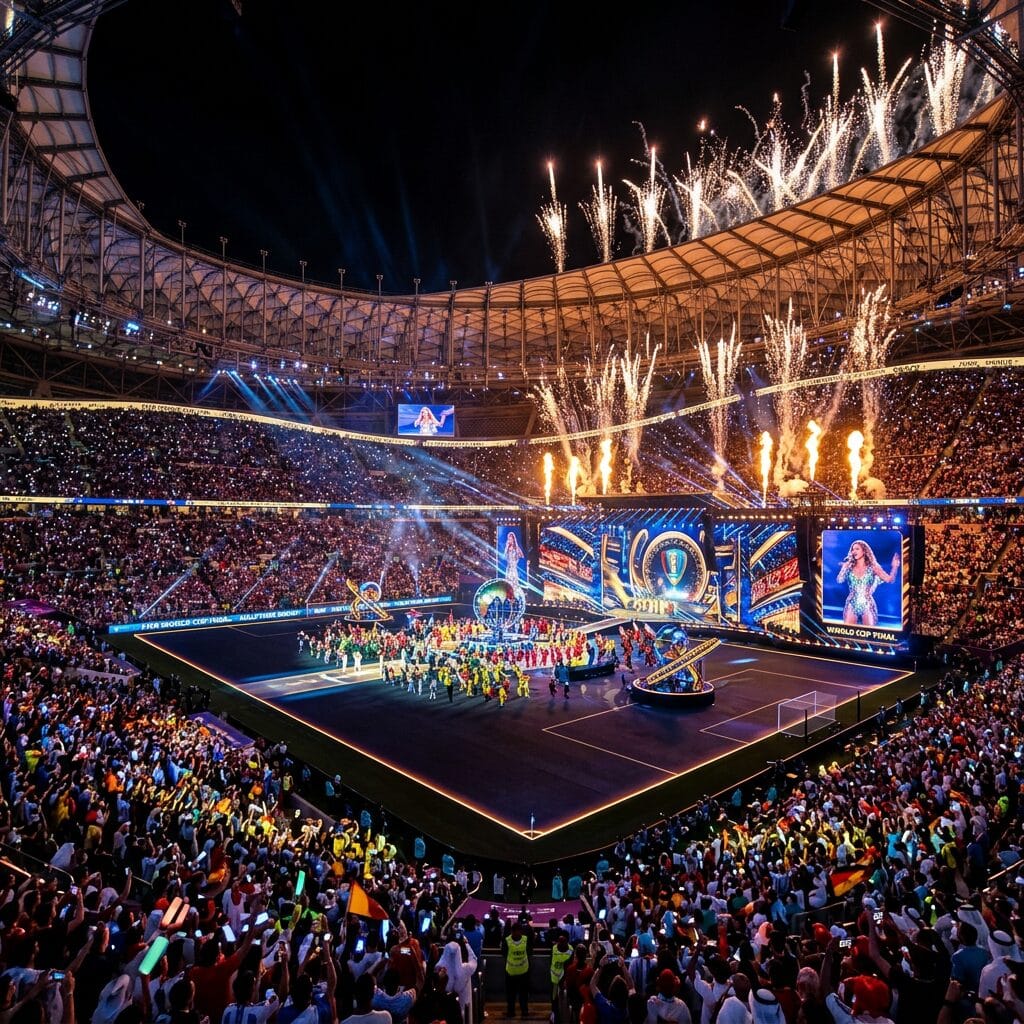
Now FIFA is adding a Super Bowl-style halftime show to the final, headlined by Madonna, Shakira, and BTS. That tells us something important about where global sport is going. The biggest football match on earth is no longer being treated only as a sporting event. It is being turned into a full entertainment product.
And that shift is bigger than one concert.
FIFA Wants the Final to Become a Cultural Super-Event
The World Cup final already commands worldwide attention, but FIFA clearly wants more than attention. It wants domination.
It wants the final to sit not only at the center of sports conversation, but also music, celebrity culture, social media, fashion, branding, and global entertainment. A halftime show with names like Madonna, Shakira, and BTS is not a small production choice. It is a statement of ambition.
FIFA is saying the final should not merely rival other sporting events.
It should rival the biggest entertainment spectacles on the planet.
The Super Bowl Model Is Spreading
For years, the Super Bowl perfected the formula: football plus celebrity plus spectacle plus advertising plus global conversation.
Now FIFA is borrowing from that playbook. That is especially fitting with the 2026 World Cup being co-hosted by the United States, Canada, and Mexico. The American sports-entertainment model was always going to leave its fingerprints on this tournament.
The result is a clear cultural hybrid: football’s global emotional power mixed with the American instinct to turn every major event into a show.
Some fans will see that as evolution.
Others will see it as pollution.
Football Purists Have a Point
The backlash from traditional fans is easy to understand.
Football is not built like American football. Its rhythm is different. The 15-minute halftime break is not supposed to become a stage reset for a mega-concert. It is a pause, a breath, a tactical reset, a moment where players recover and fans argue about substitutions.
Stretch that too far, and the match risks becoming secondary to the spectacle around it.
That is the fear: that the World Cup final, the most sacred match in football, becomes another content vehicle.
But FIFA Knows the Audience Has Changed
Still, FIFA is not only speaking to football purists.
It is speaking to casual viewers, younger audiences, advertisers, streaming platforms, sponsors, and the billions of people who consume major sports as cultural events rather than purely athletic contests. For that audience, music is not a distraction. It is part of the package.
A Madonna-Shakira-BTS lineup is designed to cross generations, languages, continents, and fandoms.
That is not accidental.
It is global audience engineering.
Shakira Is the Perfect Bridge
Shakira’s involvement makes obvious sense.
She already has deep World Cup history, global pop credibility, and a personal connection to football culture that feels more organic than many celebrity tie-ins. Her music has been part of the tournament’s emotional memory before. For many fans, she is not being inserted into the World Cup brand. She is already part of it.
Madonna brings legacy power.
BTS brings massive global fandom.
Together, the lineup is built to make the final feel like something bigger than football without completely detaching it from global popular culture.
The Charity Angle Softens the Commercial Machine
FIFA is also tying the show to the Global Citizen Education Fund, with the goal of raising money to help children access education and soccer.
That matters because it gives the event a moral frame beyond entertainment and branding. It lets FIFA present the spectacle not simply as a commercial upgrade, but as a platform for impact. That is smart positioning.
But it also reflects how modern mega-events work.
The show, the cause, the sponsors, the celebrities, and the sport all become part of one giant narrative machine.
The Real Risk Is Losing the Match’s Center of Gravity
The danger is not that music exists around football.
The danger is that football becomes just one part of the entertainment package instead of the reason the package exists.
The World Cup final does not need help being important. That is what makes this move risky. If the halftime show is short, sharp, respectful, and emotionally connected to the moment, it could work. If it feels bloated, intrusive, or too Americanized, it will annoy the very fans who give the tournament its soul.
The performance has to serve the final.
It cannot compete with it.
This Is the Future of Global Sport
Whether fans like it or not, this is where major sport is heading.
The biggest events are becoming multi-platform cultural products. They are built for television, TikTok, sponsors, streaming clips, celebrity crossovers, and global branding. The pure match still matters, but the event around the match is becoming increasingly valuable.
That is the commercial truth FIFA is embracing.
A World Cup final is no longer only 90 minutes plus extra time.
It is a whole global entertainment ecosystem.
The Meaning of the Moment
The first World Cup final halftime show is more than a scheduling change.
It is a symbolic shift in football’s place within the global entertainment economy. FIFA is taking the most prestigious match in the sport and wrapping it in the language of pop spectacle. That may make the event bigger, louder, and more commercially powerful.
But it also raises a serious question:
Can football absorb the Super Bowl model without losing what makes football different?
The answer will depend on whether FIFA remembers that the concert is not the crown.
The match is.