

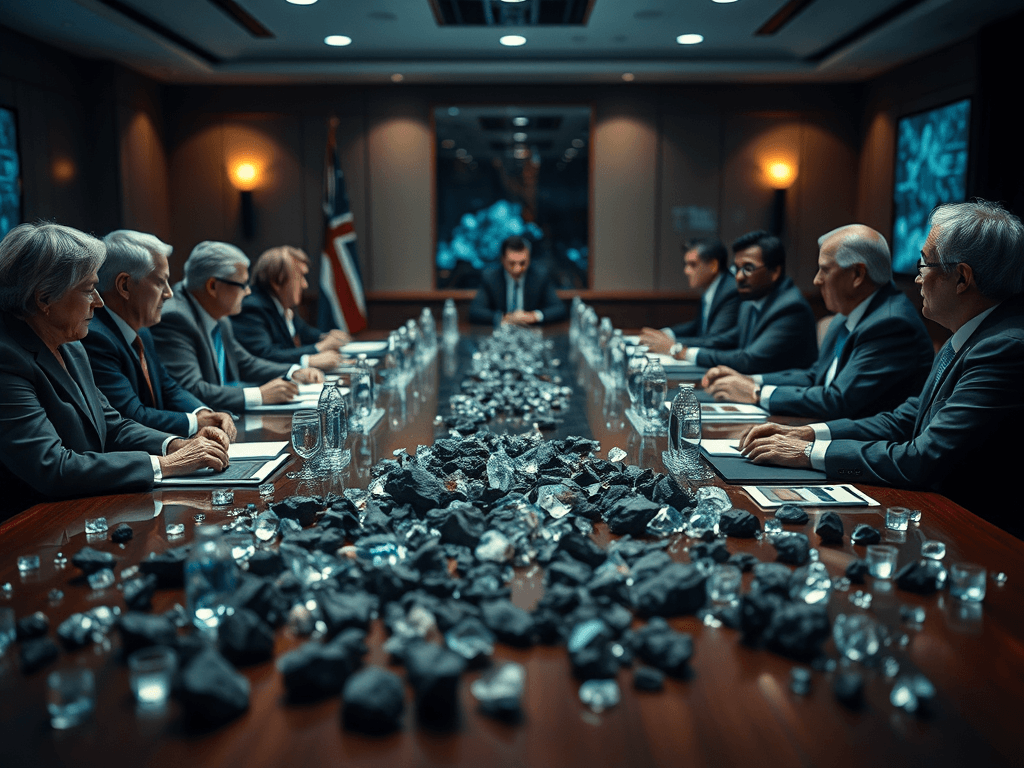
A quiet but consequential summit is taking shape in Washington: ministers from the United States, United Kingdom, European Union, Japan, Australia and New Zealand are set to meet to discuss a strategic alliance on critical minerals and rare earths—the inputs that quietly decide who can build everything from smartphones to fighter jets.
The meeting is being positioned as more than a supply-chain chat. It’s a relationship repair job (allies trying to steady transatlantic coordination) and a de-risking play aimed at China’s overwhelming grip on refining and magnet supply chains.
And one idea is doing most of the heavy lifting: a minimum price (or price guarantee) for critical minerals.
Why a minimum price is suddenly on the table
Mining isn’t just “dig and profit.” It’s capital-heavy, slow, and brutally exposed to price swings. If prices crash, projects die, investors flee, and the only winners are the players who can operate at a loss long enough to wipe out competitors.
That’s the strategic nightmare policymakers are trying to solve:
- The West wants non-China supply.
- But markets punish new mines when prices wobble.
- China can tolerate volatility—and sometimes benefits from it.
A minimum price works like training wheels for a fragile market: it gives miners and refiners predictable revenue so financing becomes possible, projects get built, and supply chains diversify.
In other words: it’s not a charity plan. It’s a security premium.
Who’s in the room — and what they want
The talks reportedly involve roughly 20 countries, including the full G7 plus partners like India, South Korea, Mexico (and possibly Argentina).
Two themes run through the agenda:
- Speed: build non-China supply chains “as fast as possible,” with pricing and investment support on the table.
- Credibility: turn “we should diversify” into a mechanism that actually gets mines, processing, and magnet production financed.
The summit is being convened by Marco Rubio—an indicator that this is being treated as national-security infrastructure, not just trade.
The twist: the U.S. may be backing away from price guarantees
Here’s the tension: while allies want the U.S. to underwrite a minimum price, reports suggest United States may be stepping back from the idea—something that has already rattled markets, especially in Australia where critical-mineral ambitions are central to the pitch of being a “safe alternative” supplier.
Australia, for its part, is moving anyway. It has announced plans for a A$1.2bn strategic reserve, stockpiling minerals it considers vulnerable to disruption—like antimony and gallium—after China’s earlier export restrictions triggered alarm bells. And Australia’s resources minister Madeleine King has signaled that a U.S. backdown wouldn’t stop Australia’s own reserve program.
That’s the core dynamic right now: even if Washington wobbles on the price-floor idea, allies are building parallel tools—reserves, offtake agreements, financing vehicles—because the vulnerability is too obvious to ignore.
Japan has been here before
Japan is the cautionary tale and the template. Japan has spent years building resilience against supply cutoffs by creating reserves and planning for disruptions as a routine risk—not a once-in-a-generation shock.
The subtext is blunt: if a major economy plans for supply coercion as a standard feature of geopolitics, the rest of the alliance should too.
The tariff shadow hanging over everything
This minerals summit isn’t happening in a peaceful trade climate. It’s unfolding under constant tariff threats and friction. The European Union is expected to raise objections about U.S. steel-related derivative tariffs that could hit products with steel content across a wide range of goods.
So the summit has two layers:
- a shared goal (de-risk from China)
- a trust problem (allies still navigating tariff pressure and policy unpredictability)
That matters because a minerals alliance only works if partners believe commitments won’t get undermined by the next tariff cycle.
Why this is bigger than mining
This isn’t really about rocks. It’s about industrial sovereignty in the age of electrification and AI.
Rare earths and critical minerals sit inside:
- EV motors and batteries
- wind turbines
- drones and defense systems
- data-center infrastructure
- consumer electronics
Europe’s magnet dependence alone shows the scale of the challenge: the region uses huge volumes of permanent magnets while sourcing most of them from China.
What to watch next
If the Washington talks produce a joint statement, the next questions become practical:
- Will there be a real price-support mechanism, or just language?
- Will countries coordinate strategic reserves and offtake contracts?
- Will allies fund processing and magnet production, not just mining?
- Will trade disputes (tariffs, retaliation threats) derail the trust required to cooperate?
Bottom line
A minerals alliance is emerging because the old model—“let the market handle it”—doesn’t survive contact with geopolitical reality.
The minimum-price debate is the tell: governments are openly considering paying extra to ensure supply chains exist outside China’s orbit. That’s not a market story anymore.
It’s a map of how the next era of power will be built.

