

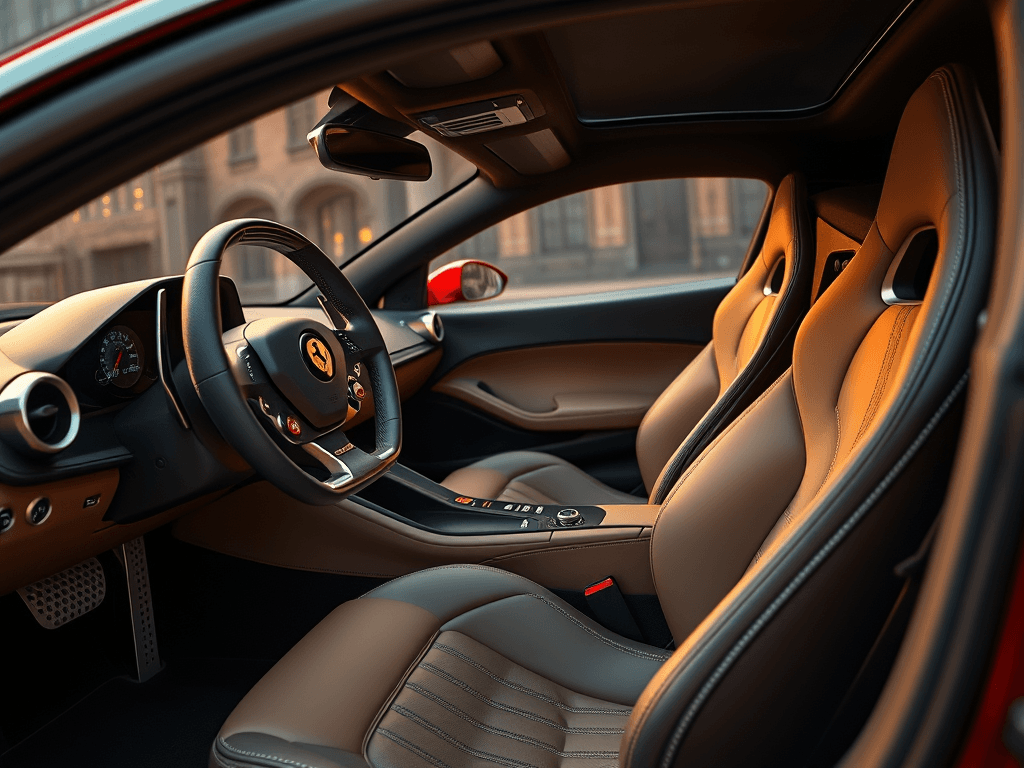
Ferrari finally cracked the door on its first fully electric sports car—and then immediately reminded everyone how Ferrari does reveals: with control, restraint, and just enough detail to set the internet on fire.
The car is called Luce (Italian for “light”), and instead of showing the exterior, Ferrari chose to show the inside: leather, instruments, steering wheel, and the control layout. The silhouette stays locked away until a full unveiling slated for May.
That’s not an accident. It’s a message.
Ferrari isn’t trying to “prove it can build an EV.” Plenty of brands can build an EV. Ferrari is trying to prove something harder:
It can build an electric car that still feels like a Ferrari.
Why Ferrari is teasing the interior first
Most EV launches lead with range, charging speed, and aero tricks. Ferrari is leading with experience—what you touch, what you see, what you feel when you’re driving.
That’s why the teaser is all cockpit. Ferrari knows the loudest skepticism about an electric Ferrari isn’t “Will it be fast?” The skepticism is:
- Will it feel special?
- Will it feel alive?
- Will it still be a driver’s car—or just a silent missile with a prancing horse badge?
The interior is where that argument gets won or lost.
The design twist: LoveFrom (Jony Ive + Marc Newson) is involved
One of the headline details behind Luce is that Ferrari collaborated with LoveFrom, the design collective founded by Sir Jony Ive and Marc Newson.
That pairing matters because the mission isn’t “more screens.” It’s better interaction.
Ive’s design reputation was built on obsessing over:
- tactility
- materials
- clarity
- controls that feel intuitive instead of gimmicky
In other words: the opposite of the “everything is a touchscreen menu” trend that’s been swallowing modern cabins.
If Ferrari’s first EV is going to win hearts, it can’t feel like a tech demo. It has to feel like a crafted instrument.
“Electric Ferrari sound” — without the fake engine theater
Ferrari has already signaled that Luce won’t rely on cheesy speaker-played “V12 sounds.” Instead, the car is expected to use a specially engineered approach that amplifies real vibrations from the electric drivetrain to create something authentic to the machine.
This is a big philosophical line in the sand.
Because sound has always been part of Ferrari’s identity—an emotional signature, not just noise. EVs remove the combustion soundtrack, and most brands respond by faking it.
Ferrari’s bet seems to be: don’t cosplay the past—create a new kind of Ferrari voice that’s honest.
If they pull that off, it’s not just branding. It’s the difference between an EV that feels sterile and one that feels “engineered with soul.”
What we actually know about Luce right now
Ferrari’s teaser gives you design intent, not full specs.
Confirmed / teased:
- The name: Luce
- A preview of the interior (seats, steering wheel, instruments, control panel)
- The exterior remains hidden until May
- Collaboration with LoveFrom on design
Still unknown (for now):
- Body shape (supercar, GT, crossover-ish grand tourer—Ferrari is keeping it sealed)
- Power output and performance figures
- Range and charging details
- Weight and battery strategy
- Price and production volume
Ferrari is essentially saying: you’ll get the numbers when you see the sculpture.
The deeper story: Ferrari is protecting the “Ferrari-ness”
Ferrari’s entire modern business is built on one fragile magic trick:
Scarcity + desire + identity.
Going electric threatens the identity part. Not because EVs are bad—but because the emotional vocabulary changes. A Ferrari without the old mechanical drama can’t lean on nostalgia forever. It has to create a new type of drama.
That’s why Luce’s rollout is all about:
- materials
- controls
- cockpit focus
- sound philosophy
- and a carefully staged reveal timeline
Ferrari isn’t launching a product. It’s launching a new chapter in what a Ferrari is.
What to watch for at the full reveal in May
If you’re tracking this like a turning point (because it is), here are the five things that will matter most when Ferrari finally shows the whole car:
- Proportions
- Does it look like a Ferrari first, EV second?
- Or does it drift into “generic fast EV” territory?
- Driving interface
- Are the controls purposeful and tactile?
- Or does it lean too far into screen-first minimalism?
- Sound solution
- Is it subtle and authentic—or try-hard and theatrical?
- Battery/charging strategy
- Ferrari doesn’t need the longest range on paper.
- It needs the right range for the way owners actually drive, and a charging plan that doesn’t feel like a compromise.
- Positioning
- Is Luce the start of a new pillar in the lineup, or a one-off statement car?
- Ferrari’s words and pricing will reveal how serious the company is about scaling EVs versus keeping them ultra-exclusive.
Final thought
Ferrari naming its first full EV Luce is more than branding. “Light” is a provocation—because the hardest criticism of EV performance cars is weight, numbness, and sameness.
Ferrari is basically daring the market:
We’ll go electric, and we’ll still make it feel light—emotionally, physically, spiritually.
May is when we find out whether Luce is a new Ferrari legend… or just Ferrari catching up.
But the interior teaser makes one thing clear:
Ferrari isn’t entering the EV era quietly. It’s entering it on its own terms.