

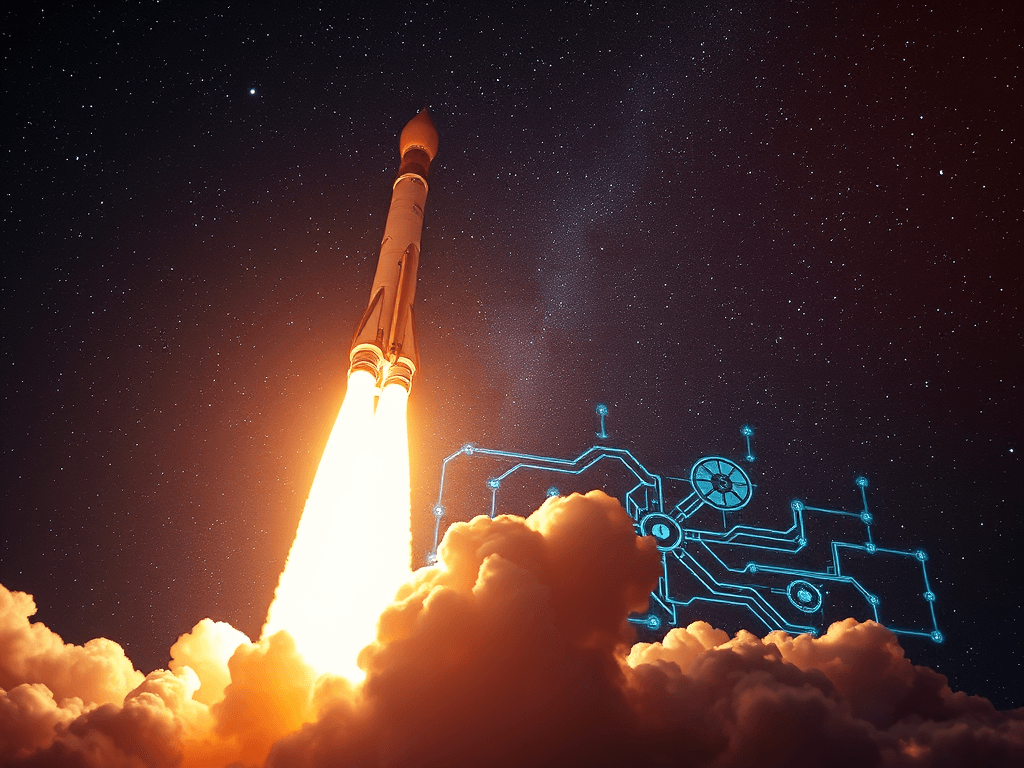
U.S.-listed space names caught a fresh bid after Elon Musk announced a merger between SpaceX and xAI—a headline-grabbing combination pitched as a step toward pushing serious AI infrastructure beyond Earth.
The deal’s implied $1.25 trillion valuation landed like rocket fuel in a still-nascent public “space economy” trade, where investors are constantly hunting for the next catalyst that makes space feel less like science fiction and more like a revenue timeline.
The market’s immediate reaction: “space-adjacent” names ride the wave
When a megacap-scale narrative hits, the public market often responds the same way it does with any new gold rush: it buys the picks, shovels, and suppliers.
That’s why the rally showed up in a basket of space and satellite-linked stocks, including Rocket Lab, Planet Labs, AST SpaceMobile, Intuitive Machines, and Redwire.
Not because any of them suddenly got a contract overnight—but because a Musk-led narrative tends to reprice the whole ecosystem: launch capacity, satellite services, orbital communications, and the idea that “space infrastructure” could become a real layer of the AI stack.
Why this story hit: the “compute goes to space” claim
The most provocative part of the announcement wasn’t the corporate structure—it was the thesis: Musk has been arguing that within a few years, space could become the most cost-effective place to generate AI compute.
The logic chain (at least as pitched) looks like this:
- AI demand keeps climbing, and data centers keep swallowing power.
- Power, cooling, and permitting constraints on Earth get tighter.
- Space offers abundant solar energy, potentially sidestepping some terrestrial bottlenecks.
- If you can launch, power, and network orbital compute reliably, you’ve built an “off-world” data center layer.
It’s an audacious claim—and that’s exactly why it moves markets. Investors don’t need it to be proven today. They only need to believe it’s plausible enough to justify a repricing of “space as infrastructure.”
What the combined entity is trying to be
Musk framed the merger as a kind of vertically integrated platform: rockets + satellites + communications + AI systems + real-time information distribution.
In plain terms, it’s an attempt to fuse:
- the launch and orbital backbone (SpaceX),
- with an AI model and product layer (xAI),
- into one story that can compete in the “who controls compute” era.
If the strategy works, the advantage isn’t just better models—it’s control of the pipes and power that run them.
The reality check: big vision, bigger constraints
Even bullish investors should keep one foot on the ground.
Building meaningful compute in orbit is not a “slap a server on a satellite” problem. The hard parts include:
- scale economics: how many units, how quickly, and at what replacement cycle?
- communications and latency: moving data in/out at useful bandwidth
- maintenance and failure rates: what breaks, how it’s fixed, and how often
- capital intensity: orbital infrastructure is expensive, and it depreciates fast
- regulatory approvals: spectrum, orbital congestion, and space-safety rules
In other words, the upside is massive—but so are the engineering and financing cliffs.
Why investors are already whispering “IPO gravity”
One reason this announcement resonated is that it aligns with another market obsession: the idea that SpaceX could eventually go public at an enormous valuation.
If the narrative becomes “SpaceX isn’t just rockets; it’s the backbone of the next compute era,” then an eventual IPO story gets even larger—and the rest of the public space sector gets pulled into the orbit of that expectation.
What to watch next
If you want to separate hype from an emerging industrial roadmap, watch for concrete signals in three areas:
- Regulatory milestones
Approvals tied to large-scale satellite constellations, spectrum, and orbital operations. - Technical disclosures
Any measurable evidence of prototype “space compute” capability: power generation, onboard processing, network throughput. - Commercial linkage
Announced partners, offtake-like agreements, or customers that validate demand beyond headline fascination.
Bottom line
This merger headline didn’t just lift a few tickers—it reopened a bigger question: is space about to become the next infrastructure frontier for AI?
Maybe the “data centers in orbit” dream takes longer than promised. Maybe it hits walls nobody can wish away. But markets are telling you something real: when a credible launch-and-satellite machine gets fused to an AI ambition, investors will pay attention—because the next phase of the AI race may be won not only by smarter models, but by whoever controls the power, pipes, and platforms those models run on.