

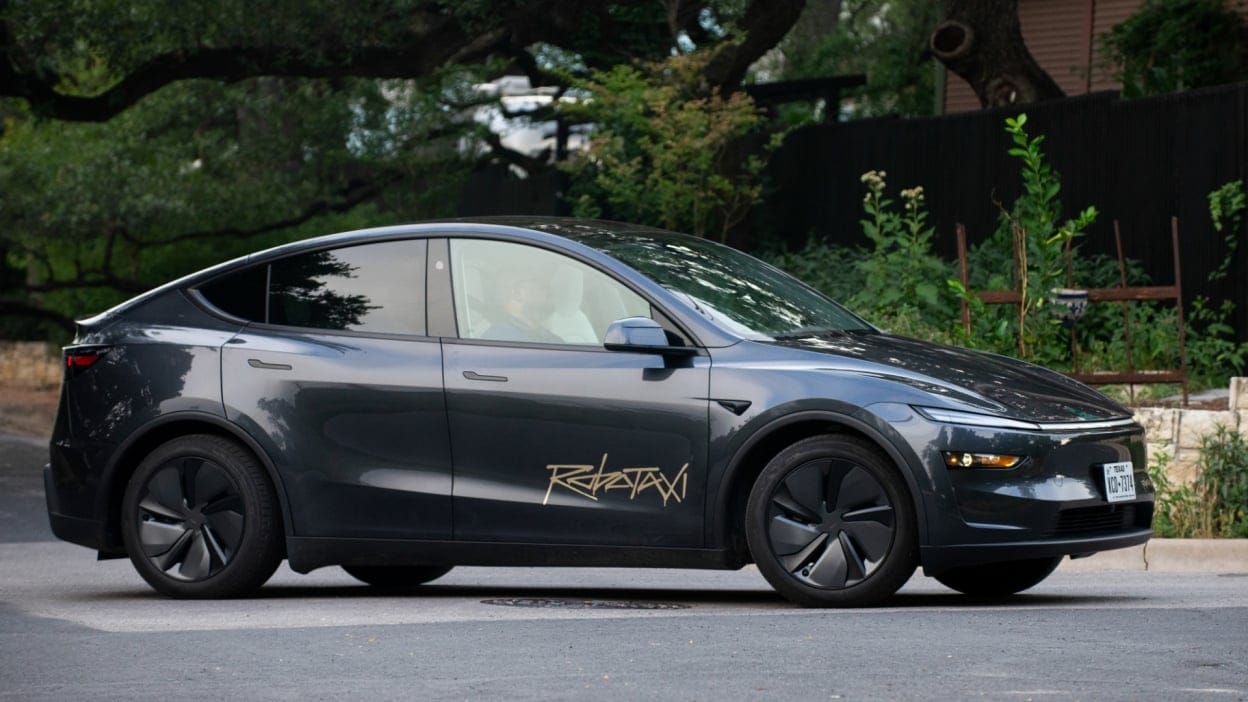
Tesla just nudged its robotaxi story into a new phase: Elon Musk said the company is testing driverless robotaxis without a front-seat safety monitor. Markets heard “closer to real autonomy” and reacted fast—Tesla shares jumped on the news.
But the real headline isn’t the stock pop. It’s what “no front-seat safety monitor” implies about confidence, capability, and the next set of questions Tesla now has to answer.
What “no front-seat safety monitor” actually signals
For years, autonomous-driving pilots have often included a human in the vehicle—sometimes behind the wheel, sometimes in the front seat—ready to intervene. Removing that person changes the nature of the test.
It suggests Tesla believes the system can handle:
- City driving without a human actively supervising from inside the car
- Routine edge cases like sudden lane changes, awkward merges, blocked roads, and unpredictable pedestrians
- Safe stops and reroutes when something goes wrong
- A level of reliability that’s closer to “service” than “demo”
That doesn’t mean it’s fully solved. It means Tesla is willing to test as if it’s approaching a deployment posture—at least in some limited context.
Why investors love this kind of update
Autonomy is one of Tesla’s biggest “option value” narratives: if it works at scale, it doesn’t just sell cars—it sells rides, software, and recurring revenue. So when Musk frames progress as moving from supervised testing to driverless operation, investors interpret it as a step toward:
- A commercial robotaxi service
- Higher-margin software revenue tied to autonomy features
- A larger total addressable market beyond car sales
In other words: the market isn’t only pricing what Tesla is today. It’s pricing what Tesla could become if autonomy becomes real enough to monetize.
The important fine print: “testing” is not “launching”
A lot can hide inside one word: testing.
Testing can mean:
- A small fleet in a tightly geofenced area
- Low-speed routes at off-peak hours
- Handpicked conditions (weather, road types, mapped corridors)
- Remote monitoring and rapid-response support
- A limited set of riders (employees, invited users)
Those limitations don’t diminish the milestone—they define it. The gap between “it can do a driverless run” and “it can operate as a reliable public service” is where most autonomy efforts spend years.
What has to go right next
Going driverless without an in-car monitor raises the bar in a few practical ways.
1) Handling the weird stuff
Robotaxis don’t fail on the obvious scenarios. They fail on the strange ones: a traffic cop waving you through, a delivery truck blocking a lane, a sudden construction detour, a pedestrian doing something irrational.
Driverless testing suggests Tesla thinks it has enough robustness to face these moments without a human ready to grab control.
2) Rider experience becomes part of safety
Even if the car is technically safe, the ride needs to feel safe. Hard braking, hesitant turns, awkward merges—those erode trust quickly. For a robotaxi service, comfort and predictability aren’t luxuries. They’re adoption requirements.
3) The operational layer matters as much as the driving layer
A real robotaxi system isn’t only “the car drives itself.” It’s also:
- Customer support
- Vehicle cleaning and charging
- Routing and dispatch
- Incident response
- Remote assistance protocols
- Insurance and liability frameworks
The last mile to robotaxi revenue is often operations, not just perception and planning.
The biggest question people will ask: “Where, when, and how limited?”
As soon as you remove a safety monitor, the public naturally wants details:
- Where are these tests happening?
- How many vehicles?
- What hours?
- Who can ride?
- What’s the fallback if the car gets stuck or confused?
Those details matter because autonomy progress isn’t binary. It’s incremental and context-dependent. A system can be excellent in one environment and struggle in another.
Why this milestone still matters—even with caveats
Even if this is limited testing, it’s meaningful because it represents a change in posture. Tesla is essentially saying: “We’re ready to see how this behaves without a human in the front seat as the last safety net.”
That’s the kind of step that forces rapid learning—about the system, about edge cases, and about what it takes to operate driverless vehicles reliably in the real world.
Bottom line
Tesla’s driverless robotaxi testing—without a front-seat safety monitor—signals increased confidence and provides fresh fuel for the autonomy narrative that investors obsess over. The stock reaction makes sense in that context.
Now comes the harder part: proving that this isn’t just a milestone moment, but a repeatable, scalable, and trustworthy service. The next updates that will really matter aren’t only “we did it.” They’re “we did it consistently,” “we expanded it,” and “we can operate it safely day after day.”