

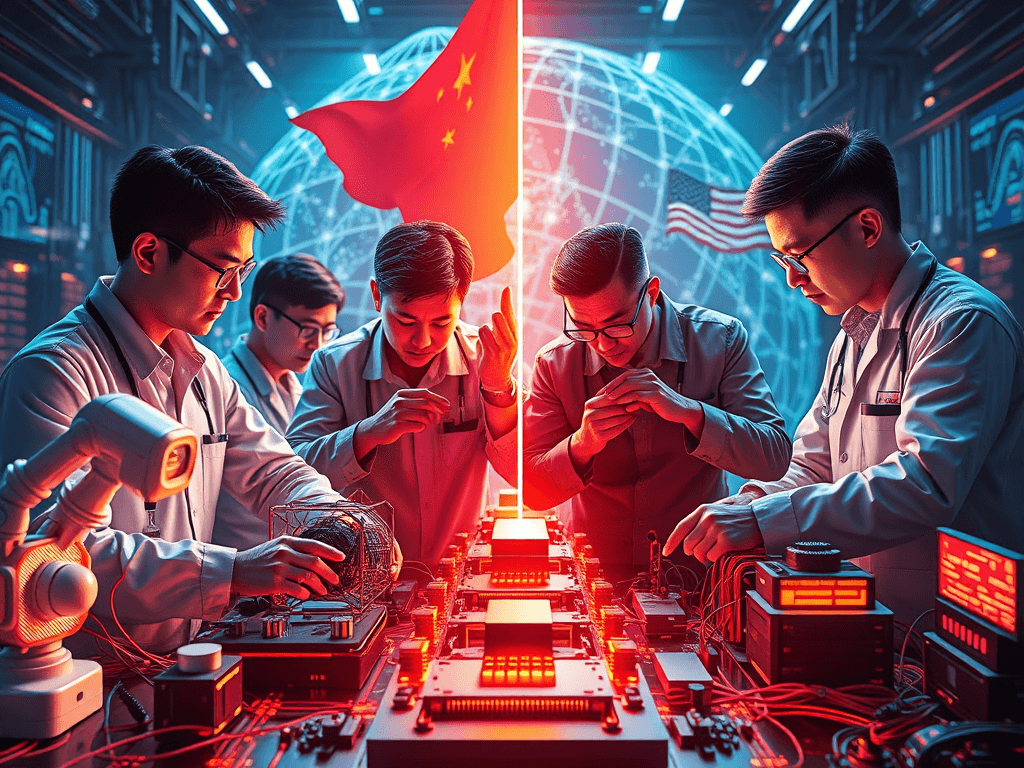
The AI competition is no longer a comfortable lead-and-chase story. Researchers cited in recent reporting argue that China is closing the gap on U.S. technology leadership, even as it faces constraints—an assessment that captures the reality of 2026: the AI race has intensified into a full-spectrum contest of talent, compute, hardware supply, and industrial scale.
This isn’t only about who has the best chatbot. It’s about who can build an ecosystem that reliably produces frontier models, deploys them into industry, and sustains progress under pressure.
How China can close the gap even with constraints
The common assumption is: fewer advanced chips equals slower AI progress. But constraints don’t always stop momentum—they change its shape. Under pressure, China has strong incentives to:
- optimize models and training efficiency (doing more with less compute)
- scale domestic hardware and supply chains (even if trailing at the top end)
- focus on application-heavy deployment where real-world integration matters as much as benchmark wins
- mobilize coordinated investment across universities, industry, and state-backed capital
In competitive technology eras, catching up often happens not by copying the leader’s exact path, but by finding a different route around the bottlenecks.
Why the U.S. lead still matters—but isn’t a guarantee
The U.S. retains major advantages: elite research clusters, deep capital markets, world-leading AI labs, and top-tier semiconductor design. But leadership can erode when the race shifts from invention to industrialization.
AI is increasingly an infrastructure business. Success depends on:
- compute availability and cost
- energy and data-center buildout
- model deployment at scale (enterprise and consumer)
- talent pipelines and retention
- a regulatory environment that shapes adoption
A country can lose “dominance” not by falling behind on every frontier metric, but by being outpaced in how quickly innovation becomes everyday capability.
What this means for the world
A narrower gap tends to produce two outcomes at once:
- Faster progress
Competition accelerates breakthroughs, efficiency tricks, and practical deployment. - Higher geopolitical stakes
As AI becomes entwined with defense, cyber, industrial policy, and economic growth, governments treat it less like a tech sector and more like strategic capacity—leading to more export controls, investment screening, and national AI programs.
The next phase: less hype, more output
The AI race is entering a phase where the winners won’t be determined only by announcements. They’ll be determined by:
- who can train reliably at scale
- who can deploy across sectors
- who can build hardware and infrastructure resilience
- and who can sustain innovation under political and supply constraints
Bottom line: Researchers warning that China is closing in on U.S. leadership reflects a broader truth: AI advantage is no longer a fixed gap. It’s a moving target—and the competition is getting sharper, more national, and more consequential by the month.