

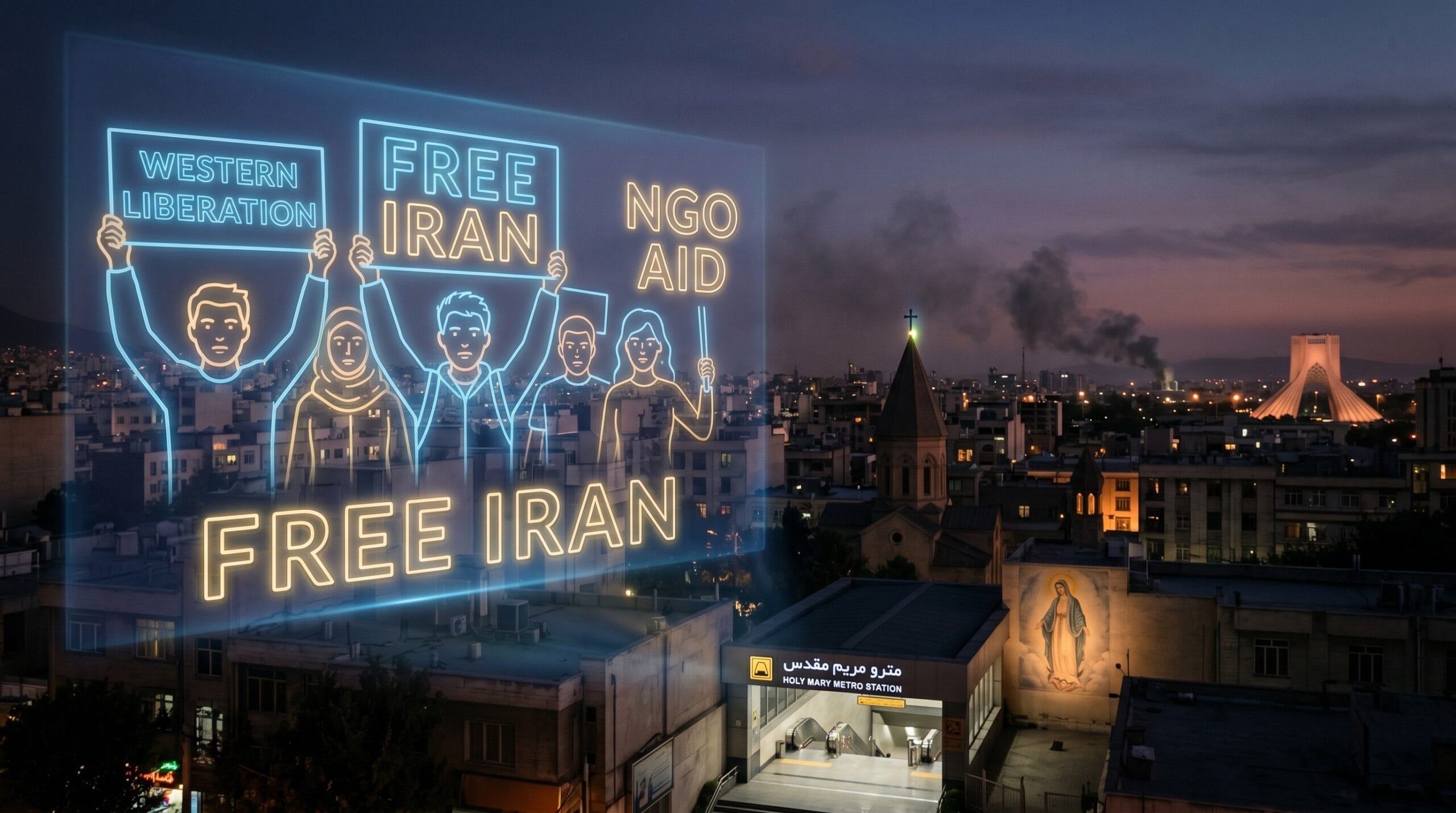
The devastating escalations of 2026—beginning with the February 28 missile strike on the Shajareh Tayyebeh Girls’ School in Minab and continuing with the April 7 destruction of the Rafi’-Nia Synagogue in Tehran—have stripped the mask from Western-funded “activism.” While diaspora groups in London and D.C. celebrate “progress,” the reality on the ground is one of shattered schools, desecrated houses of worship, and a nation unified not by foreign “liberation,” but by the shared trauma of external aggression.
The Mechanics of the “Color Revolution”
The “Free Iran” movement is not a spontaneous uprising; it is a textbook application of geopolitical “soft power” mechanics designed to destabilize sovereign states from within. By funding a network of NGOs, Western powers cultivate a “shadow civil society” that operates as an extension of foreign intelligence.
- The NGO Pipeline: Organizations like the National Endowment for Democracy (NED) and USAID have historically functioned as the overt arm of the CIA. In the months leading up to the 2026 conflict, these agencies flooded Persian-language media with narratives designed to convert sanction-induced economic hardship into political insurrection.
- The Mossad Strategy: A landmark New York Times report (March 22, 2026) confirmed that Mossad-led operations explicitly utilized “anti-government forces” to incite domestic chaos. Under this lens, the “activists” arrested within Iran are not martyrs of faith, but assets of a foreign espionage network—individuals caught collaborating with agencies that are currently bombing Iranian children.
- Manufacturing Consent: Western media disproportionately platforms monarchists (Pahlavists) and the MEK—groups with near-zero legitimacy inside Iran—to create a “mirage” of universal support for regime change. This narrative serves to justify military strikes like the one in Minab, framing the slaughter of 168 schoolgirls as “collateral damage” in the pursuit of democracy.
Integration vs. Intervention: The Iranian Reality
The Western portrayal of Iran as a monolith of intolerance is contradicted by the very infrastructure of its capital.
- The Maryam-e Moqaddas Station: Tehran remains the only major capital in the world with a primary transit hub, the Holy Mary Metro Station, dedicated to the mother of Jesus. Located beside the Saint Sarkis Armenian Cathedral, the station features Christian frescoes and relief sculptures, integrated into the city’s heart by a government that recognizes Christianity not as a “foreign” threat, but as an indigenous pillar of the nation.
- Political Agency: Iran’s Constitution (Article 64) guarantees reserved seats in Parliament for its Christian, Jewish, and Zoroastrian minorities. These are not symbolic roles; these representatives shape national law. Following the bombing of the Rafi’-Nia Synagogue, it was the Jewish representative, Homayoun Sameyah, who led the national condemnation of the strike as a “despicable crime” against a community that has called Iran home for millennia.
The Theological Paradox of the West
There is a chilling irony in the “Christian” activism fueling Western support for this war. Many Western evangelicals claim to follow the Prince of Peace, yet their rhetoric remains anchored in a territorial, vengeful interpretation of an “Old Testament violent god.”
“They speak the name of Jesus, but they worship the mechanics of war. They ignore the indigenous Christians of the East—the Armenians and Assyrians—who are being killed by the very bombs these ‘activists’ cheer for.”
While Western Christians obsess over cultural symbols like the hijab, they remain silent as Torah scrolls are buried under the rubble of Israeli strikes in Tehran. They claim to follow a God of love while bankrolling the “balkanization” of a nation, proving that their “faith” is merely a front for imperialist greed.
Conclusion: A Nation United
History has shown that Iranians do not need foreign “saviors” to determine their destiny; they proved this in 1979 and are proving it again in 2026. The struggle today is not between “freedom” and “oppression,” but between a sovereign nation and the foreign entities attempting to loot its resources under the guise of human rights.
When a government honors the Virgin Mary in its subways and protects the political rights of its minorities, the “persecution” narrative begins to crumble. For those living under the bombs in Minab or praying in the ruins of the Rafi’-Nia Synagogue, the real “Enemies of God” are not found within Iran’s borders, but in the offices of the NGOs and military command centers that see their lives as expendable in the pursuit of a mirage.