

A lot of modern tech bottlenecks come down to a simple problem: moving and detecting signals efficiently.
Whether it’s a medical biosensor trying to read tiny biological changes, or a data network moving information between machines, the same trade-off keeps showing up: better sensitivity usually means more power, more heat, and more bulky electronics.
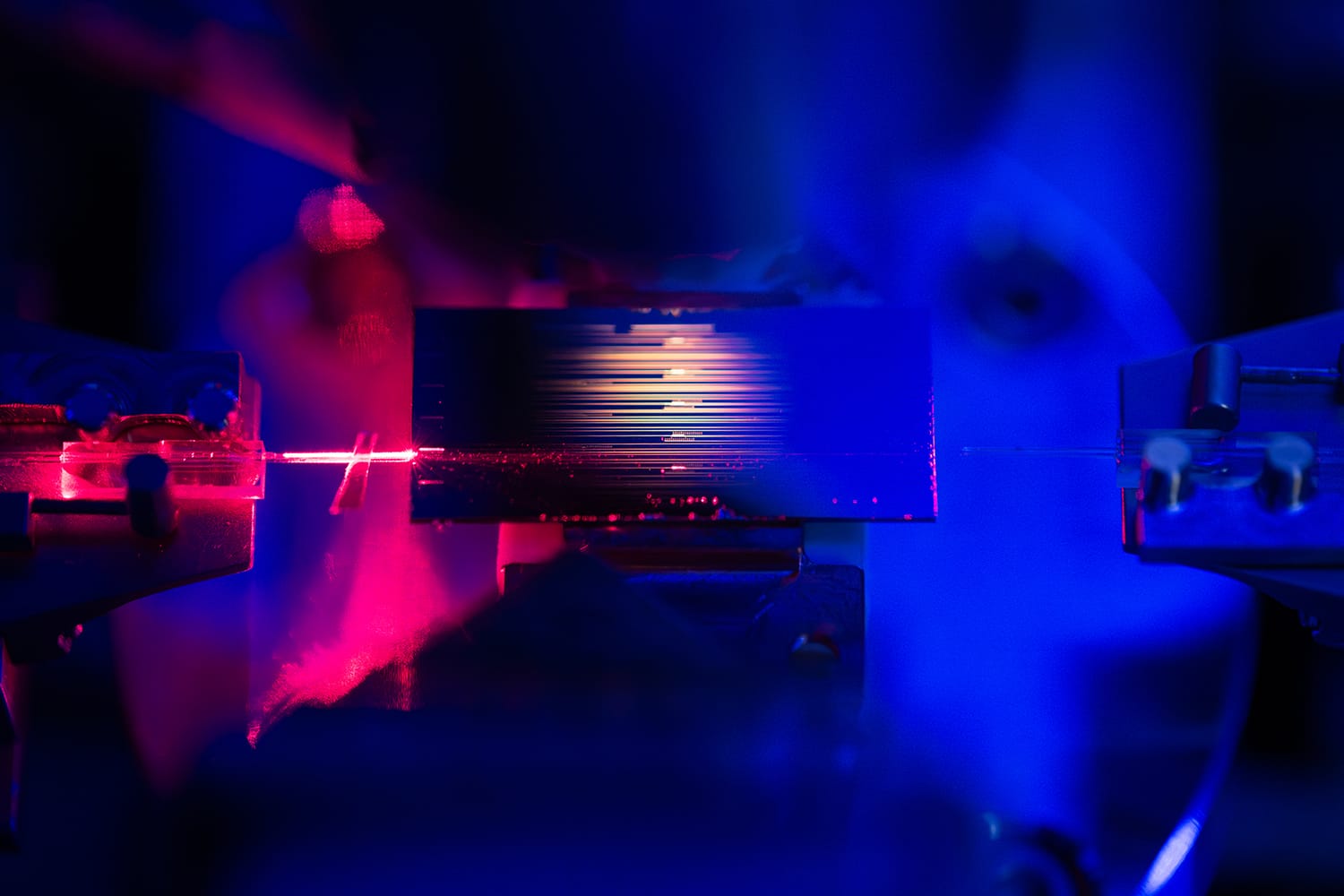
Stanford researchers are now pointing to a promising alternative — an energy-efficient optical amplifier designed to boost weak light signals with far less power than conventional approaches. If the concept scales, it could help a wide range of technologies become smaller, faster, and less energy-hungry.
What an optical amplifier does (in plain terms)
Light-based systems—lasers, fiber optics, optical sensors—often deal with extremely faint signals. An amplifier strengthens that signal so it can be measured accurately or transmitted reliably.
The catch is that amplification can be power-hungry and noisy. Too much noise ruins sensitivity. Too much power makes devices impractical—especially for wearables, implants, and compact sensor systems.
Why this matters for biosensing
Biosensors often need to detect tiny changes: a shift in a molecule, a small variation in refractive index, a weak fluorescence signal. The more sensitive the sensor, the weaker the signal it must interpret.
If you can amplify optical signals efficiently, you can enable:
- smaller medical diagnostics devices
- faster lab-on-a-chip tools
- wearable sensors with better accuracy
- potentially lower-cost monitoring systems that don’t require bulky equipment
In short, better amplification means biosensing can move out of specialized labs and into more practical, everyday form factors.
Why it matters for data communication too
Optical communication is the backbone of the internet—fiber cables carrying massive amounts of data. Amplifiers are critical in long-distance links and increasingly in data centers where high-speed connections are packed tightly.
An amplifier that uses less energy could help:
- reduce data center power draw
- limit heat and cooling requirements
- support faster, denser optical interconnects
- extend battery life in edge devices using optical links
As AI and cloud computing expand, networks are being pushed harder than ever. Anything that cuts power per bit is a big deal.
The deeper point: efficiency is now a feature, not an afterthought
We’re entering an era where progress isn’t only about doing more—it’s about doing more without exploding energy costs.
AI compute, data center growth, sensor deployments, medical wearables—everything is scaling. So the “hidden” components like amplifiers become crucial. You can’t build the next generation of tech on power-hungry plumbing.
Bottom line
Stanford’s energy-efficient optical amplifier concept points toward a future where light-based sensing and communication can get more sensitive and faster without paying the usual penalty in power and heat.
That’s the kind of improvement that doesn’t just make existing devices better — it makes entirely new kinds of devices possible.

