

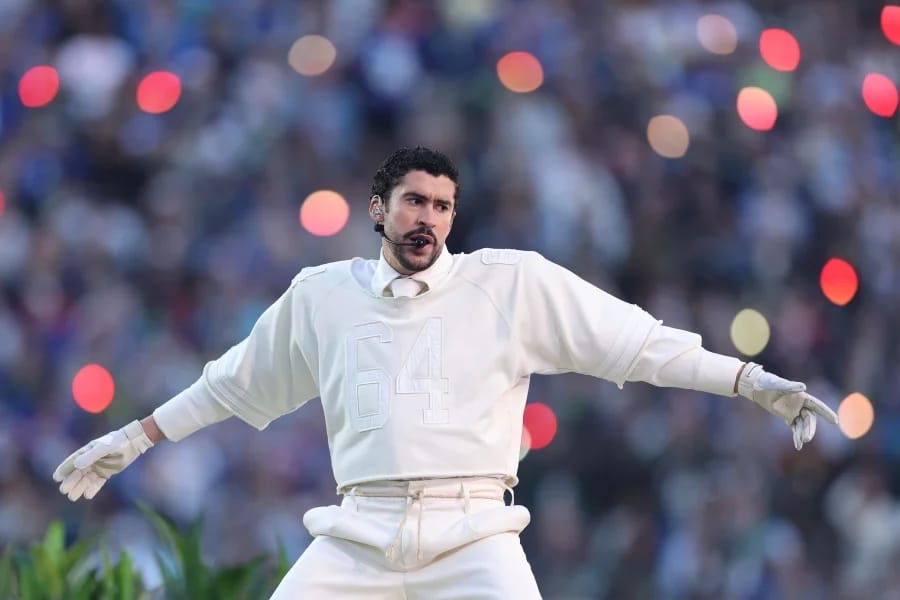
For 13 minutes at Super Bowl LX, Bad Bunny turned the biggest stage in American sports into something it almost never is: a cultural map.
The performance was packed with hits and spectacle, sure — but the real power was the symbolism. It played like a love letter to Puerto Rico, a celebration of Latin identity, and a pointed reminder that “America” is bigger than one country.
The closing message: “America” as a continent, not a brand
The sharpest moment came near the end, when Bad Bunny switched to English and shouted “God Bless America” — then immediately expanded what that word can mean.
He began naming countries across North, Central, and South America, closing with Puerto Rico, his birthplace. Behind him, a parade of flags made the idea visual: “America” isn’t shorthand for the U.S. alone — it’s a whole hemisphere of histories, languages, and people.
Then came the punctuation mark: a football spike with the message “Together, We Are America.” Not subtle. Not apologetic. A direct challenge to the narrow way the word gets used.
The stage design was a Puerto Rico “tour,” not a generic halftime set
Most halftime shows aim for universal pop imagery — neon, chrome, fireworks, vague “future city” energy.
Bad Bunny did the opposite. The set functioned like a mini-journey through Puerto Rican life and memory:
- a sugarcane field visual (roots, labor, island history)
- a colorful casita
- the streets of San Juan, complete with neighborhood details like domino players and block-party energy
- even a piragua (shaved ice) vendor, a small touch that screamed “this is ours” more than any big LED screen ever could
It wasn’t “Latin flavor” as decoration. It was Puerto Rico as the main character.
The flag detail that lit up the internet
Bad Bunny carried a Puerto Rican flag — but viewers noticed the lighter shade of blue, a variation that many associate with Puerto Rico’s independence movement.
Whether you read it as politics, pride, or both, the message was consistent with the whole show: Puerto Rico isn’t a costume. It’s an identity with its own story — and not everyone agrees on how that story should end.
The guest list wasn’t random — it was a cultural coalition
The cameos weren’t just celebrity bait; they reinforced the show’s “Pan-American” and Puerto Rican center of gravity.
Bad Bunny brought out major names, including Ricky Martin and Karol G, and sprinkled in mainstream star power (and surprise-factor faces) that kept the show “Super Bowl big” without diluting the point.
The most talked-about styling moment: Lady Gaga in a light-blue look accented with Puerto Rico’s national flower (the flor de maga) — and performing a salsa-leaning twist that felt like a nod, not a takeover.
Why it hit harder than a normal halftime show
This set landed as more than entertainment because it answered a question a lot of people are fighting over right now: who gets included when we say “America”?
Bad Bunny’s answer wasn’t a speech. It was a party, a parade, a neighborhood, a flag, and a list of countries said out loud on the loudest stage available.
And that’s why it felt symbolic: it didn’t ask permission. It just made the definition bigger.

