

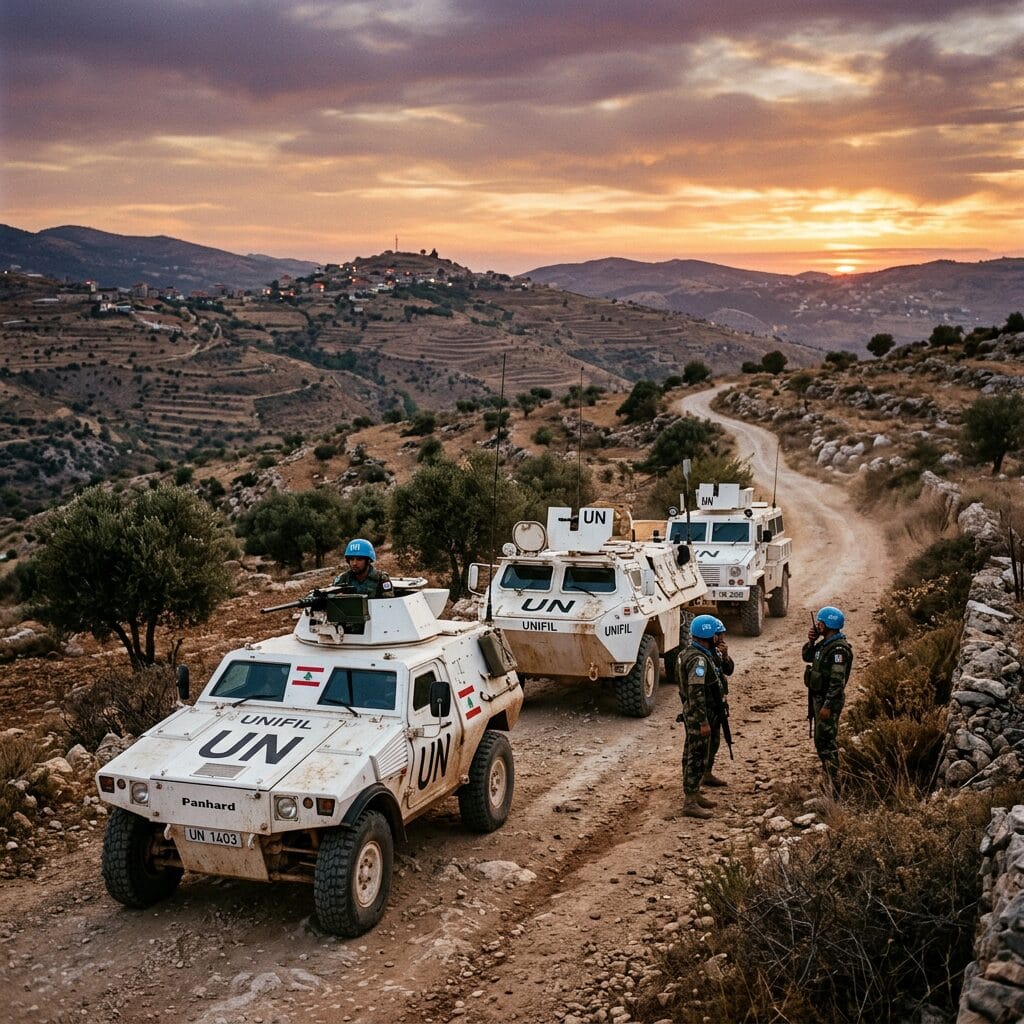
A ceasefire is meaningless if the guns still find new targets.
That is the brutal truth exposed by the deadly attack on French UN peacekeepers in southern Lebanon. When international forces sent to stabilize a border zone are ambushed, wounded, and killed, the message is unmistakable: whatever language diplomats are using, the ground reality is still soaked in danger.
This is not a minor breach. It is a warning that Lebanon’s supposed calm is dangerously superficial.
When Peacekeepers Become Targets, the Whole Story Changes
There are few clearer signs of instability than an attack on a UN mission.
Peacekeepers are not supposed to be front-line enemies in an active battlefield. Their presence is meant to signal containment, monitoring, and the possibility of preventing the next descent into chaos. So when they are directly hit, the illusion of control starts collapsing.
That matters because UN forces exist precisely where the local balance is too fragile to trust on its own. If even they cannot move safely, then the idea that the situation is being managed begins to look more like diplomatic theater than reality.
Lebanon Is Still Trapped Between Armed Power and Political Weakness
The deeper problem is not just one attack. It is the structure that makes attacks like this possible.
Lebanon remains caught in a familiar and punishing pattern: a weak state, armed non-state actors, foreign pressure, Israeli military action, and local communities paying the price for a confrontation they do not control. Every supposed pause in fighting sits on top of that unresolved reality. That is why each ceasefire feels less like peace and more like a temporary interruption in a system designed to relapse.
And that is why attacks on peacekeepers are so revealing. They strip away the polite fiction and show who still holds power on the ground.
The Ceasefire Language Sounds Better Than the Battlefield Looks
Politicians love phrases like “cessation of hostilities.” They sound measured, responsible, and vaguely hopeful.
But if armed actors are still firing, roads still need to be forcibly reopened, foreign troops are still operating in danger zones, and people are still dying, then the hostilities have not truly ceased. They have merely changed rhythm.
That distinction matters.
Because a ceasefire that does not secure actual safety is not peace. It is paperwork trying to outrun reality.
UNIFIL Was Never Meant to Be a Sacrificial Symbol
There is also something especially ugly about how often UNIFIL ends up trapped in the middle of conflicts it did not create and cannot fully control.
The mission exists because southern Lebanon has long been too volatile to leave unattended. But over time, peacekeeping can become politically convenient for everyone else. Governments cite it as proof of international engagement. Armed factions tolerate it when useful. Outside powers point to it when they want to pretend some stabilizing structure still exists.
Then, when the system breaks down, the peacekeepers themselves absorb the risk.
That is not international order. That is international symbolism with human bodies attached to it.
The Attack Also Exposes the Limits of the Lebanese State
Every official condemnation matters. But condemnations alone do not restore sovereignty.
The real question is whether the Lebanese state can meaningfully investigate, prosecute, and deter attacks like this in territory where armed power has often outrun formal authority. That has always been the core weakness. The state is expected to answer for violence in areas where its monopoly on force is partial at best.
That contradiction keeps Lebanon trapped.
It is asked to behave like a normal sovereign state while operating under abnormal conditions no stable country could sustain indefinitely.
Regional Tension Keeps Poisoning Local Stability
This attack cannot be understood in isolation from the broader region.
Southern Lebanon does not exist in a vacuum. It sits inside a wider conflict landscape shaped by Israeli operations, Hezbollah’s military posture, Iranian influence, U.S.-brokered arrangements, and a constant risk that any local incident can be folded into a much larger confrontation. That makes every roadside ambush, every cross-border killing, and every ceasefire violation more dangerous than it might otherwise be.
In a region this tense, even “small” attacks are not small.
They become signals, provocations, and potential triggers for something bigger.
The Most Dangerous Lie Is That This Is Under Control
The easiest mistake now would be to call this tragic but isolated.
That would be comforting, and it would also be dishonest.
A peacekeeper killed. Others seriously wounded. Armed actors accused. Denials issued. Investigations promised. More military deaths reported elsewhere in the same zone. This is not what stability looks like. It is what a barely contained conflict looks like when the diplomatic language has started drifting too far from the facts on the ground.
And that mismatch is always dangerous.
Because once governments start treating fragile calm as durable peace, they become slower to act, slower to pressure armed groups, and slower to admit that the whole structure may be cracking again.
The Real Meaning of the Moment
The attack on French UN troops is not just another grim headline from a troubled borderland.
It is a reminder that Lebanon’s south remains a live fault line, not a pacified zone. It is a reminder that peacekeeping missions cannot substitute for real political resolution. And it is a reminder that ceasefires without enforcement, accountability, and actual state control are often little more than pauses waiting to fail.
If international forces are being ambushed while trying to reopen roads in southern Lebanon, then the world should stop speaking as though stability has already returned.
It has not.