

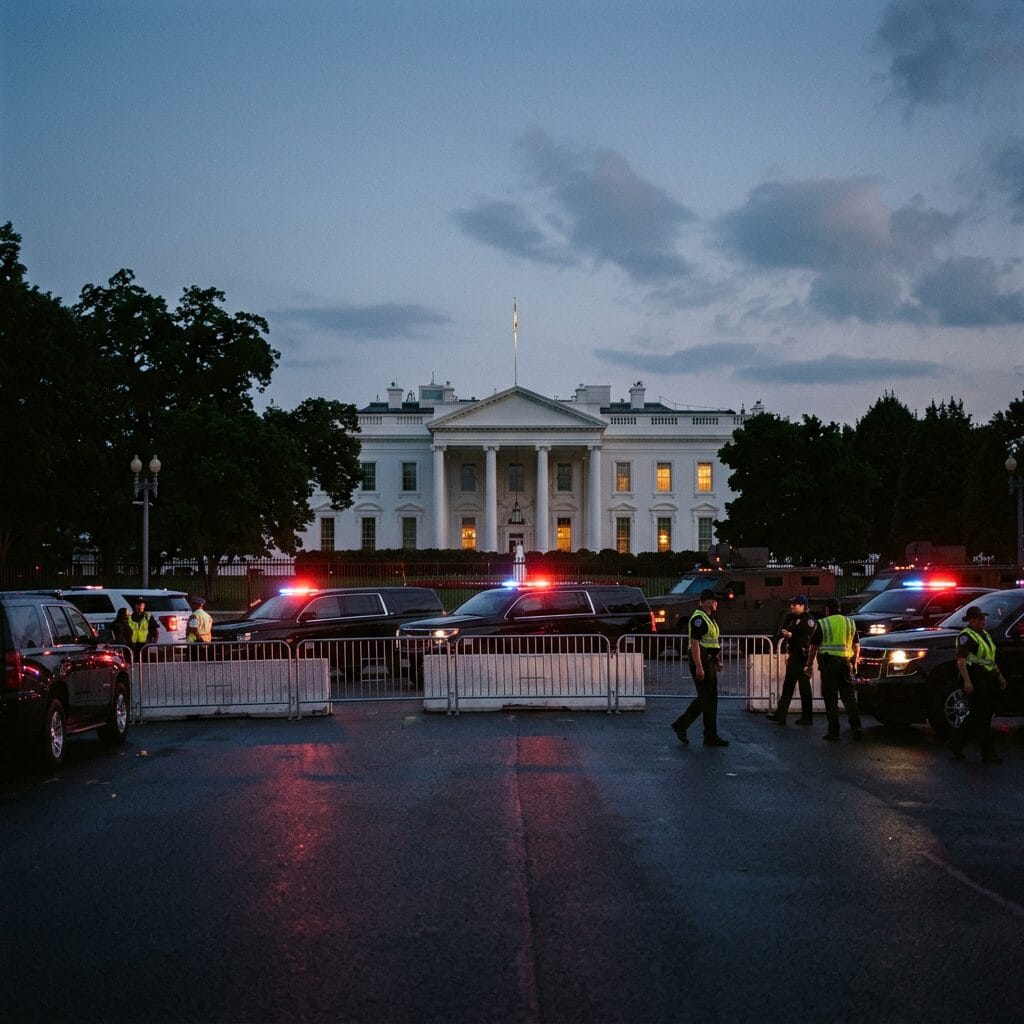
The White House is supposed to be one of the most protected places in the United States.
That is what makes another shooting near its security perimeter so alarming. A man reportedly approached a White House checkpoint, pulled a weapon from his bag, and opened fire at officers before being shot dead by Secret Service personnel. A bystander was also struck. President Donald Trump was inside the White House at the time, though officials said he was not impacted.
This was not just another police incident.
It was another warning that political violence is moving closer and closer to the center of American power.
The Symbolism Is Impossible to Ignore
A shooting near the White House is never just about one suspect.
The location changes everything. The White House is not only a building. It is the physical symbol of the American presidency, executive power, national continuity, and state authority. When gunfire erupts near that perimeter, it shakes more than a security checkpoint. It shakes the illusion that the country’s most important political spaces can remain insulated from the violence spreading through the rest of society.
That is why this incident matters.
It happened at the edge of power.
This Is Becoming a Pattern, Not a Fluke
The most disturbing part is that this was reportedly the third gunfire incident near Trump in roughly a month.
That is not normal.
There was the shooting scare at the White House Correspondents’ Association Dinner in April. Then there was a shooting near the Washington Monument earlier in May. Now another armed confrontation has unfolded outside the White House complex itself.
One incident can be dismissed as madness.
Three in a month looks like a national temperature reading.
Political Life Is Becoming Militarized by Fear
Every new incident like this pushes American politics further into a fortified posture.
More checkpoints. More barriers. More armed officers. More lockdowns. More journalists told to shelter. More public events planned like battlefield operations. That may be necessary for safety, but it also changes the emotional character of democracy.
A free society is not supposed to feel like it is permanently bracing for attack.
Yet that is increasingly the atmosphere surrounding public life in America.
Journalists Heard the Gunfire From Inside the Bubble
One of the most revealing details is that White House journalists heard gunshots and were told to shelter in the press briefing room.
That image captures the moment perfectly.
Reporters were doing ordinary political work, covering the president and the day’s news, when the sound of gunfire interrupted the routine. That is how instability enters public life: not always through dramatic national announcements, but through ordinary tasks suddenly becoming dangerous.
The press tent, the briefing room, the driveway — places built for communication — were overtaken by the logic of emergency.
The Secret Service Is Operating Under Intensifying Pressure
The Secret Service exists for exactly these moments.
But the pressure on the agency is clearly growing. Protecting a president in a polarized country is already difficult. Protecting him during a period of repeated gunfire incidents, rising political anger, high-profile public events, and nonstop media exposure becomes something else entirely.
Every approach to a checkpoint becomes more tense.
Every bag becomes more serious.
Every public movement becomes harder to manage.
That is what repeated threats do. They turn protection into a permanent stress test.
The Country Keeps Producing Armed Crises Near Power
The hard question is not only how this man reached the checkpoint or what his motive was.
The harder question is why America keeps producing people willing to bring guns toward political spaces in the first place. That question reaches into gun culture, extremism, mental health, online radicalization, political rage, and the normalization of violence as a form of expression.
The country has become dangerously good at treating each incident as isolated.
But the pattern keeps coming back.
Trump Was Not Hurt, but the System Was Still Tested
Officials said Trump was not impacted.
That is important. But it does not make the incident harmless.
A president does not need to be physically injured for a security event to damage public confidence. The mere fact that gunfire erupted near the White House while the president was inside forces the public to confront how fragile the atmosphere has become.
The state held.
The officers responded.
The threat was stopped.
But the sense of stability still took another hit.
The Bystander Matters Too
In stories involving presidential security, ordinary victims can get pushed to the margins.
That should not happen here.
A bystander was struck, and officials were still trying to determine whether that person was hit by the suspect’s gunfire or by officers returning fire. Either way, the detail matters because it shows how quickly violence near political power spreads beyond the intended target. Ordinary people nearby become part of the danger whether they chose it or not.
Political violence always widens.
It never stays neatly aimed.
The Meaning of the Moment
The shooting near the White House should be treated as more than a security headline.
It is another sign that America’s political environment is becoming more volatile, more armed, and more physically dangerous. The country is not just arguing more fiercely. It is increasingly seeing violence erupt around the institutions meant to hold the argument together.
That is the real warning.
A democracy can survive anger. It can survive protest. It can survive harsh political conflict.
But when gunfire keeps appearing near the presidency itself, the country has to admit something darker is happening.
The danger is no longer theoretical.
It is standing at the checkpoint.