



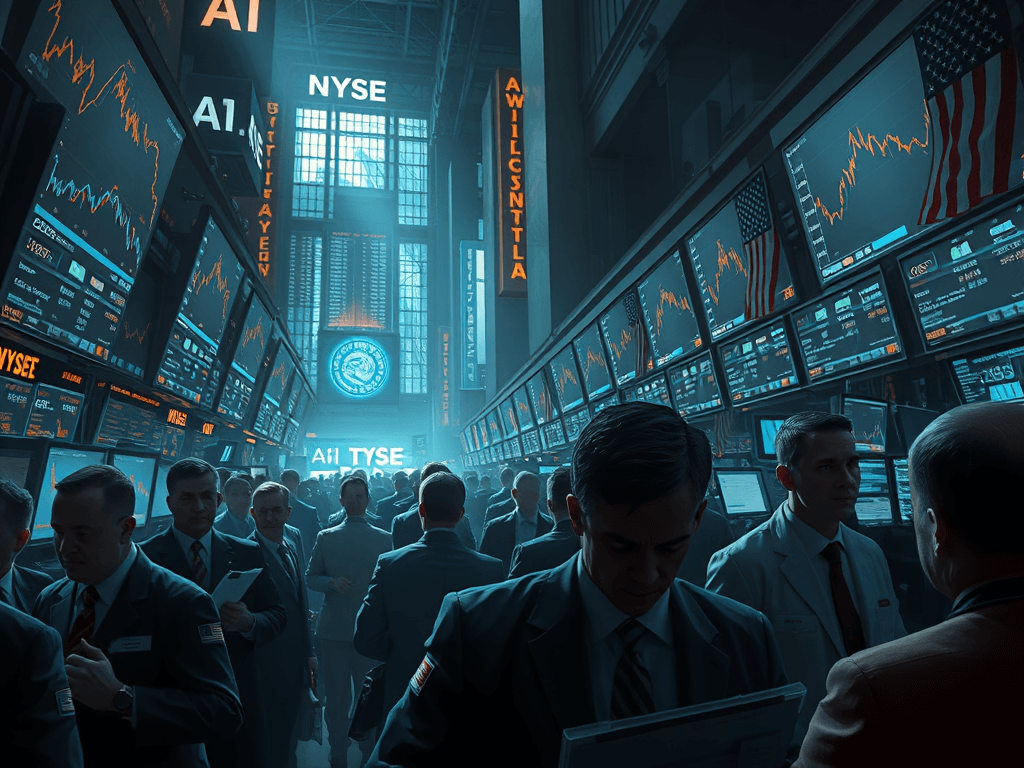
For years, “AI” was the magic word that lifted markets. Say it on an earnings call, promise a roadmap, flash a demo, and investors treated it like oxygen.
Now the mood has flipped.
Wall Street is starting to price AI as something scarier than a shiny growth engine: a competitor. Not a rival company — a rival capability that can show up overnight, flatten pricing, and make yesterday’s “must-have” software feel like an expensive habit.
The new market shock: disruption can arrive as an update
What rattled investors isn’t just that AI is improving. It’s how it improves.
A single release of new automation tools can instantly change the story for entire industries: legal and data services, financial research, enterprise software, even consumer platforms. When investors believe a workflow is about to be “AI’d,” they don’t wait for quarterly proof — they sell first and ask questions later.
That’s why these moves don’t stay contained. The fear spreads across anything that looks like it charges for:
- repeated knowledge work
- information retrieval
- templated analysis
- “workflow seats” that an AI assistant could potentially replace
When the narrative shifts, correlation spikes. Suddenly you’re not trading companies — you’re trading exposure.
Why the selloff feels brutal: it’s not about earnings, it’s about existence
Classic market fear is: “Margins might compress.”
This is different. This is: “Does this business model still make sense?”
If a company’s product is essentially “humans navigating complexity with a UI,” investors now have to price a new possibility: the UI gets bypassed. The work gets done inside an AI layer. And the fee gets squeezed toward zero because the customer thinks: Why pay per seat for something a model can do?
That is a terrifying valuation question because it attacks the core assumption behind premium multiples: durability.
The “AI tax” is coming for everyone — even the winners
Here’s the twist: this fear doesn’t only punish the obvious targets (software, data, research). It also drags the “AI winners” into the mud.
Why?
Because the AI boom has two bills attached:
- The Capex bill
Big AI spending is massive, and investors are increasingly asking when it turns into clean profits instead of an arms race. - The Competition bill
If AI makes it easier to build “good enough” alternatives, the moat shrinks across the market — even for strong incumbents that used to look untouchable.
So you get the weirdest market dynamic of 2026:
AI is both the accelerant and the extinguisher.
Who survives the AI panic trade?
If you want a simple filter, it’s this:
AI destroys “interfaces.” It struggles with “infrastructure.”
The companies that hold up best tend to have at least one of these advantages:
- Proprietary data that actually matters (not just “content,” but structured, defensible, high-signal datasets)
- Distribution embedded into enterprise workflows (it’s not easy to rip out what payroll, compliance, procurement, or regulated reporting relies on)
- Trust, liability, and compliance (AI can generate answers; it can’t always carry legal risk)
- Switching costs that aren’t cosmetic (real operational pain, not “it’s annoying to migrate”)
- A credible AI integration story (not “we added a chatbot,” but “we changed the product into an AI-native workflow”)
In other words: the moat isn’t “we have software.”
The moat is we have the rails the business runs on.
The new stock-market reality: every company is an AI company now
Not because every company builds AI.
Because every company is now valued under a new question:
How vulnerable is this business to being unbundled by models?
That single question adds a new kind of volatility to markets. It turns product announcements into macro events. It makes “industry risk” reprice faster than earnings can confirm. And it creates a harsh truth for investors:
In the AI era, the future can show up early.
What to watch next (if you want to stay ahead of the next wave)
- AI labs pushing deeper into specific verticals (legal, finance, health, engineering)
- enterprise buyers shifting budgets from software subscriptions to custom AI tooling
- incumbents responding with bundling, price changes, and “AI inside” repositioning
- regulation and liability frameworks that determine where AI can’t simply replace humans
- signs that “AI spend” is translating into revenue (not just bigger bills)
Final thought
The market used to price disruption slowly — a startup here, a product cycle there.
AI is different. It’s speed disruption. It compresses timelines. It forces repricing based on expectation, not evidence.
That’s why this fear feels so intense.
Wall Street isn’t just worried about who wins the AI race.
It’s worried about who gets run over while the race is happening.


