

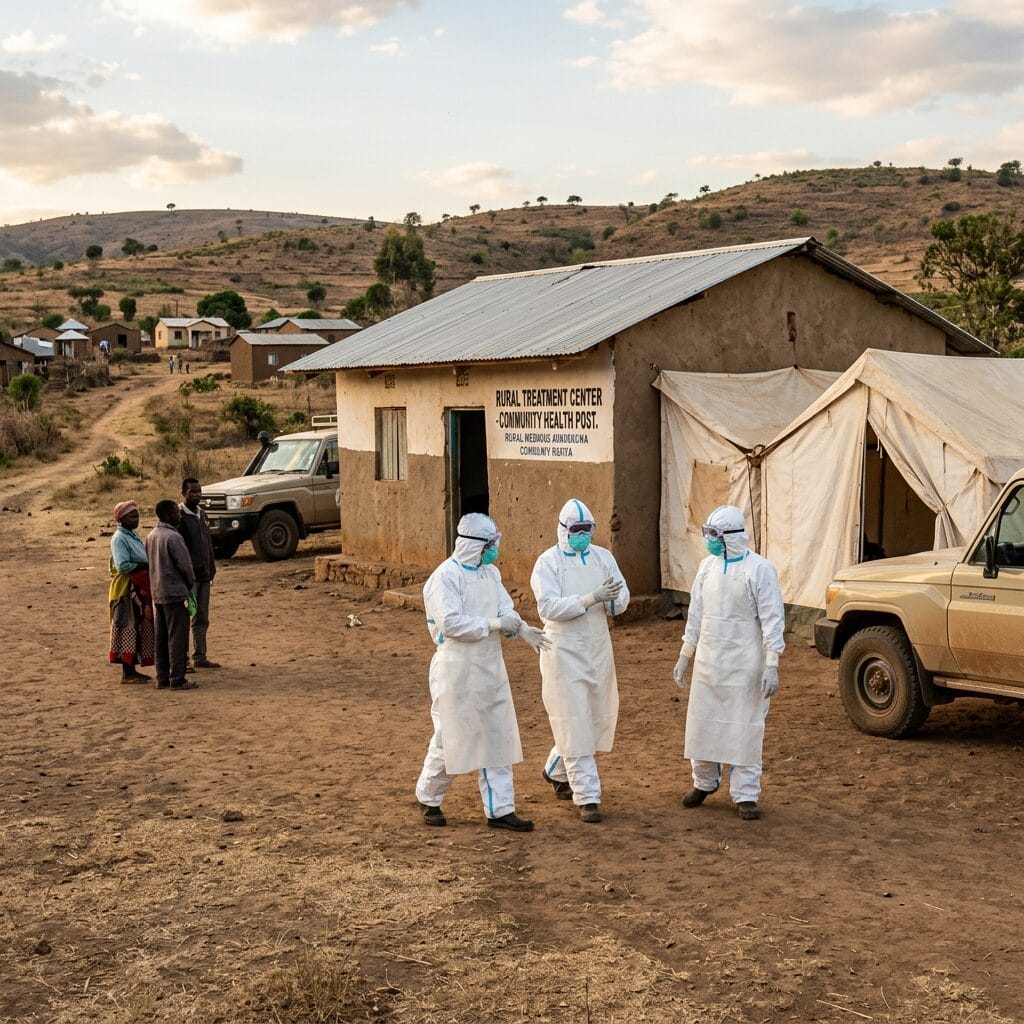
Ebola does not forgive delay.
That is the brutal truth coming out of eastern Congo, where a rare form of the virus has killed nearly 120 people and forced authorities to open new treatment centers in Ituri province. This is not just another public health alert from a region already familiar with outbreaks. It is a reminder that when dangerous pathogens move faster than surveillance systems, every lost week becomes deadly.
And in this case, weeks were lost.
The Wrong Test Can Cost Lives
One of the most alarming parts of this outbreak is that early testing reportedly looked for the wrong Ebola strain.
That matters because Ebola is not one simple thing. Different species of the virus require different diagnostic attention, and this outbreak involves the Bundibugyo virus, a rarer type with no approved vaccine or treatment. When early tests came back negative because officials were looking for the more common Zaire strain, the virus kept moving while the response lagged behind.
That is how outbreaks grow.
Not always through total ignorance, but through the dangerous gap between suspicion and confirmation.
A Rare Strain Makes the Response Harder
The Bundibugyo strain changes the entire risk picture.
For the more familiar Zaire Ebola, there are vaccines and treatments that can help responders move faster and protect frontline workers. For Bundibugyo, the available medical toolbox is much thinner. That makes basic outbreak control even more urgent: isolation, contact tracing, protective equipment, safe burials, accurate testing, and rapid community trust-building.
When there is no approved vaccine to lean on, the speed and quality of public health response become the main defense.
That is a frightening position to be in when the outbreak has already spread across several locations.
The Virus Is Moving Through a Region Already Under Stress
Eastern Congo is not a calm laboratory setting.
Ituri and surrounding areas are already dealing with conflict, displacement, weak infrastructure, poor roads, armed groups, and fragile public services. That makes every outbreak harder. Health workers have to reach remote communities. Families may move because of insecurity. Clinics may be under-resourced. Rumors can travel faster than official guidance. Fear can make people hide symptoms or avoid care.
Disease thrives when systems are already strained.
That is why Ebola in eastern Congo is never only a medical emergency. It is also a humanitarian emergency.
Health Workers Are Again Paying the Price
Ebola has always been cruelest to those who care.
The virus spreads through bodily fluids, which means nurses, doctors, family caregivers, burial teams, and community health workers face intense risk when protective systems are weak or delayed. Reports of health workers among the dead should shake everyone. These are the people standing between the virus and wider spread, and they are often the first to be exposed when the outbreak is not recognized quickly enough.
A functioning response must protect them first.
If health workers fall, the outbreak gains momentum.
Panic Is Understandable, but Trust Is Essential
In Bunia and other affected areas, panic is not irrational.
People know what Ebola can do. Many communities in eastern Congo carry memory of earlier outbreaks. They know the symptoms, the isolation wards, the fear of touch, the fear of funerals, and the way ordinary human compassion can suddenly become a transmission risk.
But panic alone cannot stop Ebola.
Trust can.
People need to believe that treatment centers are safe, that health officials are honest, that testing is accurate, and that reporting symptoms will lead to care rather than stigma. Without trust, even the best technical response can fail.
The International Response Cannot Arrive Late
The WHO has declared the outbreak a global health emergency, and international teams are moving in. That is necessary, but the harder question is why the world keeps letting fragile surveillance systems become the weak link.
Outbreaks are cheapest to stop early and most expensive to control late. Cutting public health capacity, weakening international health cooperation, or underfunding local surveillance is not savings. It is gambling. And when that gamble fails, people in places like Ituri pay first.
The world cannot keep treating outbreak response as an emergency switch that gets flipped only after the deaths pile up.
Regional Spread Is the Nightmare Scenario
The concern is not only Congo.
There has already been a death and a suspected case in neighboring Uganda, and cases have been confirmed in multiple locations. That does not mean the region is doomed to a massive outbreak, but it does mean the window for control matters enormously. Borders in real life are porous. Families, traders, aid workers, and displaced people move. Viruses use those movements.
That is why rapid coordination between Congo, Uganda, international agencies, and local health systems is essential.
The goal now must be containment before the outbreak becomes harder to map.
The American Doctor’s Case Shows the Risk Is Global
The reported infection of an American doctor in Bunia also shows how quickly local outbreaks can become international concerns.
That does not mean ordinary Americans face high risk. Ebola does not spread casually like airborne respiratory viruses. But it does mean global health is genuinely global. Doctors, aid workers, missionaries, researchers, and humanitarian staff connect distant places. A weak response in one region can trigger monitoring, travel advisories, evacuations, and public fear far away.
The lesson is clear: helping Congo control Ebola is not charity. It is global self-protection.
The Meaning of the Moment
Congo’s rare Ebola outbreak is a warning about delayed detection, fragile health systems, and the cost of underestimating pathogens in crisis zones.
The virus is deadly. The strain is rare. The region is vulnerable. The response is now racing to catch up. That combination should alarm the world without pushing it into hysteria.
Ebola can be contained.
But only if speed, trust, funding, and coordination arrive faster than the virus spreads.