

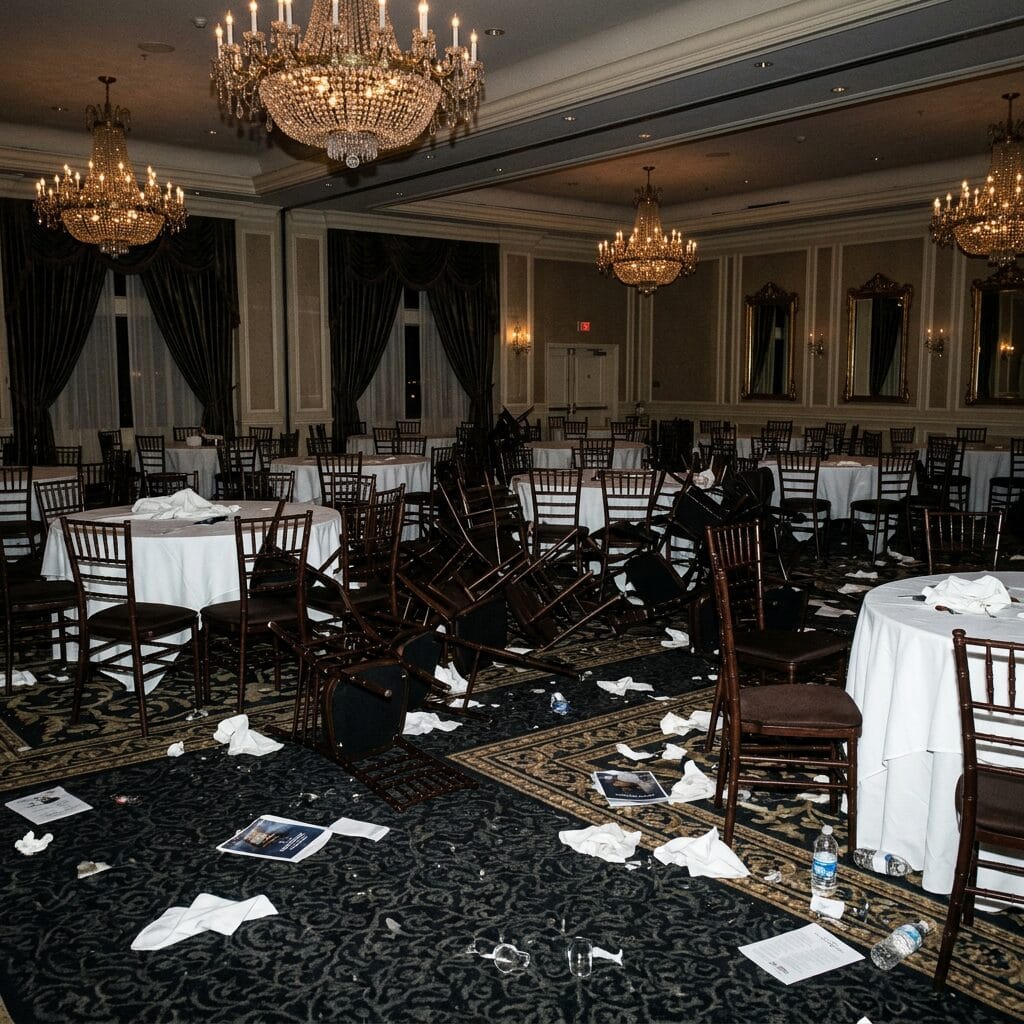
Washington loves ritual.
It loves the carefully staged dinner, the tuxedos, the jokes, the cameras, the illusion that politics and media can still gather in one room and perform normality. That is what made the shooting at the White House Correspondents’ Association dinner so jarring. In a matter of seconds, one of the capital’s most polished rituals was ripped open by the sound of gunfire, panic, and the oldest truth in politics: no amount of ceremony can fully hide a country this tense.
This was not just an attack on a dinner. It was an attack on a symbol.
The Illusion of Safety Collapsed in Public
The correspondents’ dinner is supposed to project a certain kind of American confidence.
Power gathers. Press gathers. Officials smile. The state appears stable enough to laugh at itself for one night. But when attendees end up under tables and security officers start moving with rifles instead of earpieces and polite discretion, the whole meaning of the event changes. What was meant to symbolize democratic theater becomes a portrait of national fragility.
That is why this moment matters beyond the immediate terror.
It exposed how thin the line can be between spectacle and chaos.
Political Violence Is No Longer Something Americans Can Pretend Is Distant
At some point, a pattern stops feeling like isolated madness and starts feeling like a condition.
That is where the United States is now. An attack at a high-security event involving the president, cabinet officials, journalists, and political elites does not just raise questions about one suspect or one lapse. It reminds the country that political violence has moved from hypothetical anxiety into repeated public fact.
And once that happens, the damage is not only physical.
It changes how public life feels. It makes democracy more paranoid, more theatrical, more armored. It tells the country that even its most choreographed events now unfold under the shadow of possible bloodshed.
The Venue Became the Story
The correspondents’ dinner has always been a strange ritual.
It combines the press and the people they cover in a room full of self-awareness, rivalry, vanity, and mutual dependence. Critics have long mocked it as elite theater. Defenders see it as a civic tradition. But after this attack, none of that old debate feels quite the same. The room itself became a metaphor for something darker: a country where politics, celebrity, media, and danger now sit almost on top of one another.
That is what made the images so powerful.
Not just that people ran or ducked, but that they were doing it in formalwear, in a ballroom, at an event designed to showcase democratic ease. The contrast is almost too sharp to ignore. Elegance on the surface, panic underneath.
Security Questions Will Now Swallow the Conversation
Whenever a gunman gets this close to power, the institutional questions start immediately.
How did he get in? What failed? Which checkpoint broke down? What was missed? What will now be locked down even harder? These are not minor bureaucratic questions. They go to the core of whether the state can protect its own public rituals without turning them into fortresses.
And that is the dilemma.
Every new attack produces demands for tighter security. Every tighter security layer makes public life feel more closed, more militarized, more brittle. The country becomes safer in one sense while looking less free in another. That tension is now becoming permanent.
This Was Also an Attack on Democratic Optics
Whether the gunman’s intent was ideological, personal, or still unclear in the fuller sense, the political meaning of the act is already obvious.
An attack at a dinner filled with reporters and senior officials strikes at the image of democratic normalcy itself. It says no space is too ceremonial to be violated, no ritual too prestigious to be broken, no gathering of power and press too symbolic to escape the country’s deeper violence. That is why the incident will linger.
Not just because it was frightening, but because it felt like an assault on the performance of stability.
America’s Public Life Is Becoming Harder to Stage
That may be the deepest lesson of the night.
Modern American politics depends heavily on stagecraft. Campaign rallies, debates, press rooms, dinners, summits, ceremonies — all are meant to reassure the public that the machinery of national life still works. But repeated eruptions of violence keep interrupting the script. They keep reminding everyone that beneath the stagecraft sits a more unstable reality shaped by polarization, anger, grievance, and the normalization of confrontation.
You can decorate the ballroom. You cannot decorate away the fear.
The Press and Power Were Hiding Under the Same Tables
There is also something revealing in that image.
Journalists and politicians, so often cast as enemies in the daily performance of public life, were suddenly reduced to the same instinct: get down, survive, wait for the threat to pass. In a strange way, the attack flattened the room. Titles mattered less. Proximity to danger mattered more. For one terrifying stretch, the usual hierarchy dissolved into something more primitive.
That image may outlast the event itself.
Because it captures a country where the institutions are still standing, but the sense of safety around them is not.
The Meaning of the Moment
The shooting at the correspondents’ dinner will be remembered not simply as a security breach, but as a symbol of how badly strained American public life has become.
A night designed for controlled irreverence became a scene of terror. An event built around elite ease became proof that the nation’s tensions can intrude anywhere. And a ritual meant to celebrate the rough vitality of democracy instead revealed how exposed that democracy now feels, even at its most polished.
That is the real damage.