


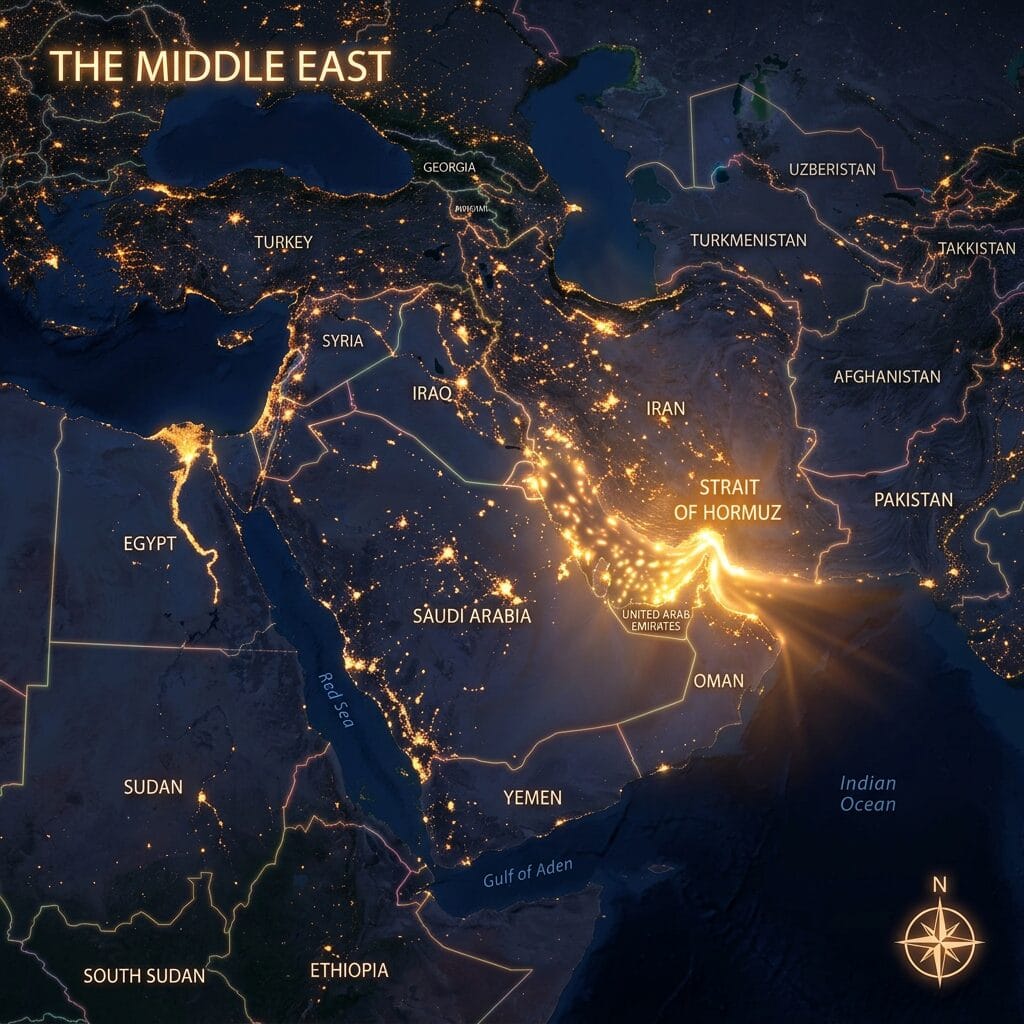
A ship seized off the UAE coast. Another cargo vessel attacked and sunk near Oman. Commercial crews rescued. Iranian officials claiming control over the Strait of Hormuz. The United States and China publicly agreeing the waterway must remain open while the facts on the water say something far darker.
This is not a normal maritime dispute.
This is the world’s energy artery being turned into a pressure point, a bargaining chip, and a battlefield without needing to be declared one.
The Strait Is Speaking Louder Than Diplomats
Diplomats can say whatever they want about stability.
They can talk about dialogue, shipping freedom, regional security, and the need for restraint. But when vessels are being seized and commercial ships are being attacked, the real message is not coming from podiums. It is coming from the water.
And the water is saying the crisis is not cooling.
The Strait of Hormuz has become the physical test of whether the Iran war can truly be contained. If ships cannot pass safely, then peace talks are not serious enough. If crews remain at risk, then ceasefire language is not strong enough. If states are using maritime access as leverage, then the world economy is already inside the war’s blast radius.
A Chokepoint Does Not Need to Close Completely to Terrify the World
That is the hard truth.
Hormuz does not have to be fully shut to create global damage. It only has to become dangerous enough that shipping firms hesitate, insurers raise costs, traders panic, and governments begin preparing for shortages. Fear alone can distort the market. Uncertainty alone can raise prices. A few attacks can make every tanker feel like a hostage.
That is why the latest incidents matter so much.
They show that even partial disruption can function like economic warfare.
Iran Is Turning Geography Into Leverage
Iran’s message is becoming clearer: the strait is not just a waterway; it is leverage.
By asserting control over Hormuz and defending the right to seize ships connected to the United States, Tehran is signaling that it will not negotiate from weakness. It wants the world to understand that pressure on Iran can produce pressure on everybody else. That is a dangerous but effective logic.
Iran does not need to defeat the U.S. Navy outright to create pain.
It only needs to make global trade doubt the safety of the route.
The UAE Is Caught in the Middle
The seizure off the UAE coast is especially sensitive because the UAE sits at the center of so many overlapping tensions.
It is an oil and logistics hub. It normalized ties with Israel. It has security links with the West. It also has to live next to Iran and manage the consequences of any escalation more directly than distant powers do. That makes the UAE both important and exposed.
When vessels near Fujairah become targets or are pulled toward Iranian waters, the message is not only about one ship. It is about vulnerability in one of the Gulf’s most important commercial zones.
China’s Role Shows How Global This Crisis Has Become
The timing with Trump’s Beijing visit matters.
Washington and Beijing may disagree on almost everything else, but both understand the same basic fact: Hormuz cannot become a permanent hostage zone without damaging the entire global economy. China needs energy flows. The United States needs fuel prices contained. Europe needs stability. Import-dependent economies need predictability.
That is why Hormuz is now bigger than the U.S.-Iran conflict.
It is a global economic problem wrapped in a regional war.
The Attack on the Indian Cargo Ship Shows the Human Cost
Shipping stories are often told in market language: tankers, routes, ports, terminals, tonnage, supply.
But behind every attacked vessel are crews.
The sinking of an Indian-flagged cargo ship near Oman is a reminder that commercial sailors are being forced into the danger zone of geopolitical conflict. They are not the ones making policy. They are not the ones declaring war. Yet they are the ones standing on burning decks, waiting for rescue, and hoping the next missile, drone, seizure team, or warning shot is not meant for them.
The global economy runs on people whose risk is too often invisible.
The Talks Are Being Held Hostage by the Waterway
Iran’s reported conditions for further talks show how central Hormuz has become.
This is no longer just a side issue to be resolved after the main conflict. It is the conflict’s main lever. Tehran wants its authority over the strait recognized. Washington is unlikely to accept that because doing so would effectively formalize Iran’s control over a passage that was previously treated as open to international traffic.
That is the deadlock.
The U.S. wants the strait open as a matter of global order. Iran wants control treated as part of its postwar leverage. Those two positions do not easily meet.
The Real Danger Is Normalizing Maritime Coercion
If the world accepts that strategic waterways can be squeezed whenever a regional power wants bargaining leverage, the consequences will not stop at Hormuz.
Other chokepoints will look more vulnerable. Other conflicts will become more economically contagious. Other governments will learn that controlling fear around a trade route can be as powerful as controlling territory.
That is why this moment matters far beyond the Gulf.
It is a test of whether the global trade system still runs on open passage or on coercive pressure.
The Meaning of the Moment
The latest seizure and ship attack near Hormuz are not isolated incidents.
They are warnings.
Warnings that the ceasefire language is too weak. Warnings that diplomacy is lagging behind reality. Warnings that the global economy remains dangerously dependent on narrow waterways controlled by political actors willing to weaponize geography.
Hormuz is no longer just a strait on a map.
It is the place where war, oil, shipping, diplomacy, and global inflation are all colliding at once.
And until ships can move freely without fear, nobody should pretend this crisis is under control.