


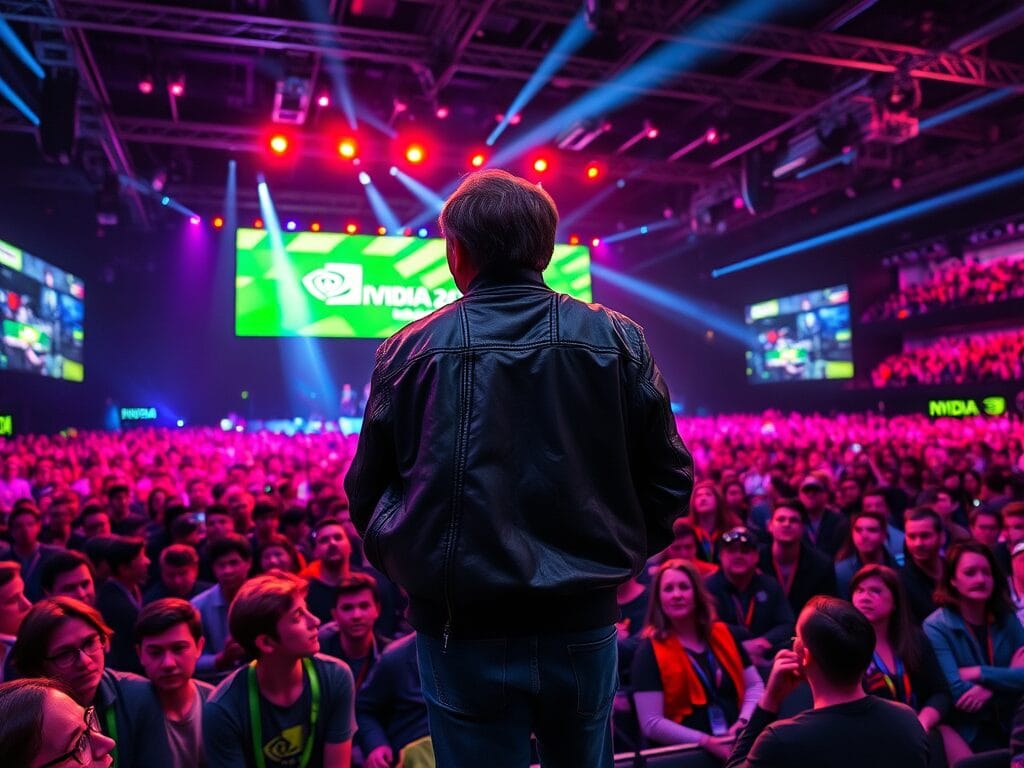
Nvidia’s GTC developer conference in San Jose has always been a flex. This year it felt like a strategic pivot, delivered in a stadium-sized setting: AI’s next growth wave isn’t just training models — it’s running them in real time for hundreds of millions of users.
On stage in his trademark black leather jacket, CEO Jensen Huang framed it as the moment the industry has been waiting for: “The inference inflection has arrived.” And Nvidia’s message to investors was even louder: the revenue opportunity for AI chips and systems could reach at least $1 trillion through 2027 — a major step-up from the company’s prior framing of a roughly $500 billion opportunity through 2026.
Why Nvidia is shifting emphasis from training to inference
For the last few years, AI infrastructure was dominated by training: giant clusters of GPUs building ever-larger foundation models. Nvidia owned that story.
But now the demand center is moving. Companies aren’t just building models — they’re serving them, constantly, to real users. That’s inference: the live process of answering questions, generating images, summarizing documents, or running “AI agents” that execute tasks.
And inference is where the competitive battlefield widens:
- CPUs start to look more viable
- hyperscalers push custom silicon
- startups specialize in low-latency serving
- cost-per-query becomes the obsession
Nvidia is responding by trying to architect the entire inference stack, not just sell GPUs.
The key technical idea: splitting inference into two stages
Huang described inference as breaking into two steps:
- “Prefill” — turning human input into tokens the AI system can use
- “Decode” — generating the output tokens that become the answer
Nvidia’s plan is to optimize this pipeline by using its own chips where it’s strongest — while also embracing licensed technology to cover the other half.
The headline reveals: a new CPU and a Groq-powered inference system
To push harder into inference, Nvidia unveiled:
- A new central processor (Vera CPU), with Huang saying Nvidia is already selling standalone CPUs and expects it to become a multi-billion-dollar business
- An AI system built on technology licensed from Groq, aimed at strengthening Nvidia’s position in the real-time serving market
The signal is clear: Nvidia doesn’t want inference to become “the phase where Nvidia loses share.” It wants to own the platform — even if that means mixing architectures and bringing in external tech where necessary.
The roadmap tease: “Feynman” after Rubin Ultra
Huang also showed Nvidia’s forward roadmap, including Feynman, expected in 2028 after Rubin Ultra. Details were limited, but the presence of the roadmap itself is part of Nvidia’s pattern: keep customers and partners aligned to an upgrade path that makes Nvidia the default choice for the next wave of AI infrastructure.
The agent angle: Nvidia wants a piece of autonomous software, too
Beyond chips, Nvidia is aiming at the “AI agents” layer — tools that can autonomously execute tasks with minimal human guidance.
Huang highlighted NemoClaw, which integrates with the viral OpenClaw ecosystem and adds privacy and safety controls — another sign Nvidia wants to be more than a hardware vendor. The company is trying to become the “plumbing provider” for the next generation of autonomous AI workflows.
The real subtext: expectations are brutal, and Nvidia knows it
Nvidia has already lived the consequence of extreme success: once you’ve been priced as a near-perfect growth engine, even great results can be treated as “not enough.”
So this GTC message was designed to reset the narrative:
- the AI buildout isn’t slowing — it’s shifting
- inference is the next goldmine
- Nvidia is building systems, not just chips
- the total addressable opportunity is bigger than the market thought
Even so, the market reaction was measured — a reminder that in 2026, investors want more than vision. They want proof that Nvidia can defend its dominance as competition expands.
Bottom line
GTC 2026 wasn’t just “new chips.” It was Nvidia declaring the next phase of AI economics:
Training made AI possible. Inference makes AI profitable.