



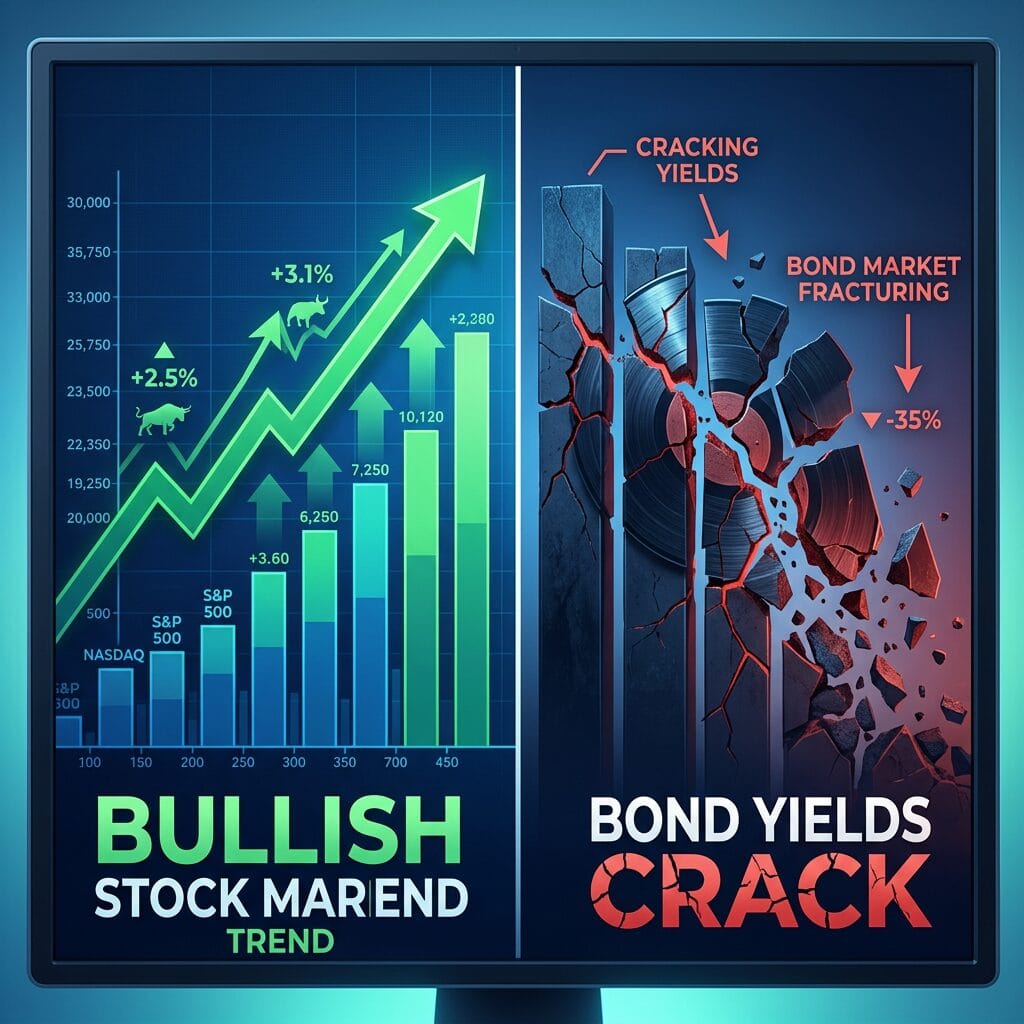
Stock investors are acting like the worst is behind them.
Bond markets are not so sure.
That tension is now one of the biggest risks sitting under Wall Street’s rally. U.S. equities have climbed back hard, powered by strong corporate earnings, AI optimism, and the fear of missing out on another leg higher. But bond yields are flashing a much harsher message: inflation is not dead, borrowing costs may stay higher, and the market may be underpricing how much damage a prolonged energy shock could still do.
This is not just a technical move in Treasuries.
It is a warning shot.
Stocks Are Priced for Good News
The stock market has been carried by a powerful story: profits are strong, AI spending is booming, and major companies are still finding ways to grow despite war, inflation, and higher energy costs.
That story is not fake.
Corporate earnings have been impressive, and the AI trade still has real force behind it. Investors are looking at data centers, chips, cloud infrastructure, productivity gains, and mega-cap growth names and seeing enough strength to keep buying. That is why the market has been able to rebound so sharply even while oil remains elevated and the Iran war continues to distort the global outlook.
But strong earnings do not cancel valuation risk.
When stocks are already expensive, they become much more vulnerable to any shift in interest rates.
Bond Yields Are the Valuation Killer
Rising yields matter because they change the math for everything.
Higher Treasury yields make bonds more attractive compared with stocks. They raise borrowing costs for companies and consumers. They pressure housing, credit, investment, and corporate margins. They also force investors to question whether high stock valuations still make sense when safer assets are offering better returns.
That is the danger now.
The market can tolerate higher yields for a while if earnings keep beating expectations. But if yields keep climbing because inflation looks embedded, the pressure becomes much harder to ignore.
The Market Is Treating Hormuz Like a Temporary Problem
This may be the biggest blind spot.
Many equity investors seem to be betting that the Strait of Hormuz crisis will be resolved soon enough to avoid a deeper inflation shock. That may be comforting, but it is also risky. If the waterway remains disrupted for months instead of weeks, the entire inflation picture changes.
Oil and LNG do not need to be completely cut off to cause economic damage.
They only need to remain expensive, uncertain, and difficult to move. That is enough to raise costs across transportation, manufacturing, food, utilities, and global supply chains. Once that happens, inflation stops looking like a short-term spike and starts looking like a new regime.
AI Optimism Cannot Fix an Energy Shock
This is the uncomfortable contradiction in the market.
AI may lift productivity over time. It may support profits for certain companies. It may justify some of the enthusiasm around mega-cap tech. But AI cannot reopen Hormuz. It cannot lower oil prices by itself. It cannot erase the cost of higher borrowing rates. It cannot stop households and businesses from feeling the pressure of sticky inflation.
That does not mean the AI boom is meaningless.
It means investors may be asking it to carry too much.
The Market Is Split Between Two Realities
Right now, Wall Street is trading two stories at once.
The bullish story says earnings are strong, AI is powerful, and investors who stay on the sidelines may miss another major rally.
The bearish story says oil is still above dangerous levels, inflation pressure is building, producer prices are rising, and Treasury yields are starting to price a more painful reality than stocks are willing to admit.
Both stories have evidence behind them.
That is what makes this moment so unstable.
High Valuations Leave Less Room for Mistakes
The S&P 500 is not trading like a cheap market.
When stocks are priced well above long-term valuation averages, investors need a lot to go right. Earnings must keep growing. Inflation must cool. Yields must stabilize. The Fed must avoid another hawkish turn. The Iran war must not deepen into a longer economic shock.
That is a lot of conditions.
The problem is not that the market cannot keep rising. It can. The problem is that the margin for disappointment is getting thinner.
The Fed Is Trapped in the Background
Higher bond yields also complicate the Federal Reserve’s path.
If inflation stays hot because energy prices remain elevated, the Fed has less room to cut rates. If it cuts too soon and inflation accelerates again, it risks losing credibility. If it waits too long, it risks squeezing growth and earnings. That is the trap created by war-driven inflation.
The market wants rate relief.
The data may not allow it.
Investors Are Hedging Without Fully Leaving
The smartest money does not appear to be abandoning stocks completely. Instead, many investors are hedging both sides of the risk.
They want exposure to mega-cap growth and AI leaders because those names are still driving returns. But they also want cash, gold, commodities, and defensive protection in case inflation and yields break the market’s optimism.
That kind of “barbell” positioning tells you the truth.
Investors still want upside, but they are no longer fully comfortable with the rally.
The Real Risk Is Complacency
The greatest danger in markets is not fear.
It is confidence that becomes lazy.
If investors keep assuming the Hormuz crisis will fade quickly, oil will calm down, inflation will ease, and yields will stabilize, they may be badly exposed if reality moves the other way. A sharp bond-yield spike could force a sudden repricing across equities, especially in growth stocks whose valuations depend heavily on future earnings.
That is how rallies crack.
Not because the good news disappears overnight, but because the market realizes it ignored the bad news for too long.
The Meaning of the Moment
Wall Street is still climbing on earnings strength and AI optimism.
But bond yields are warning that inflation risk has not gone away. If oil stays high, if Hormuz remains disrupted, and if Treasury yields continue rising, the market’s confidence could be tested fast.
The stock market is priced for resilience.
The bond market is pricing danger.
One of them is going to be wrong.


