


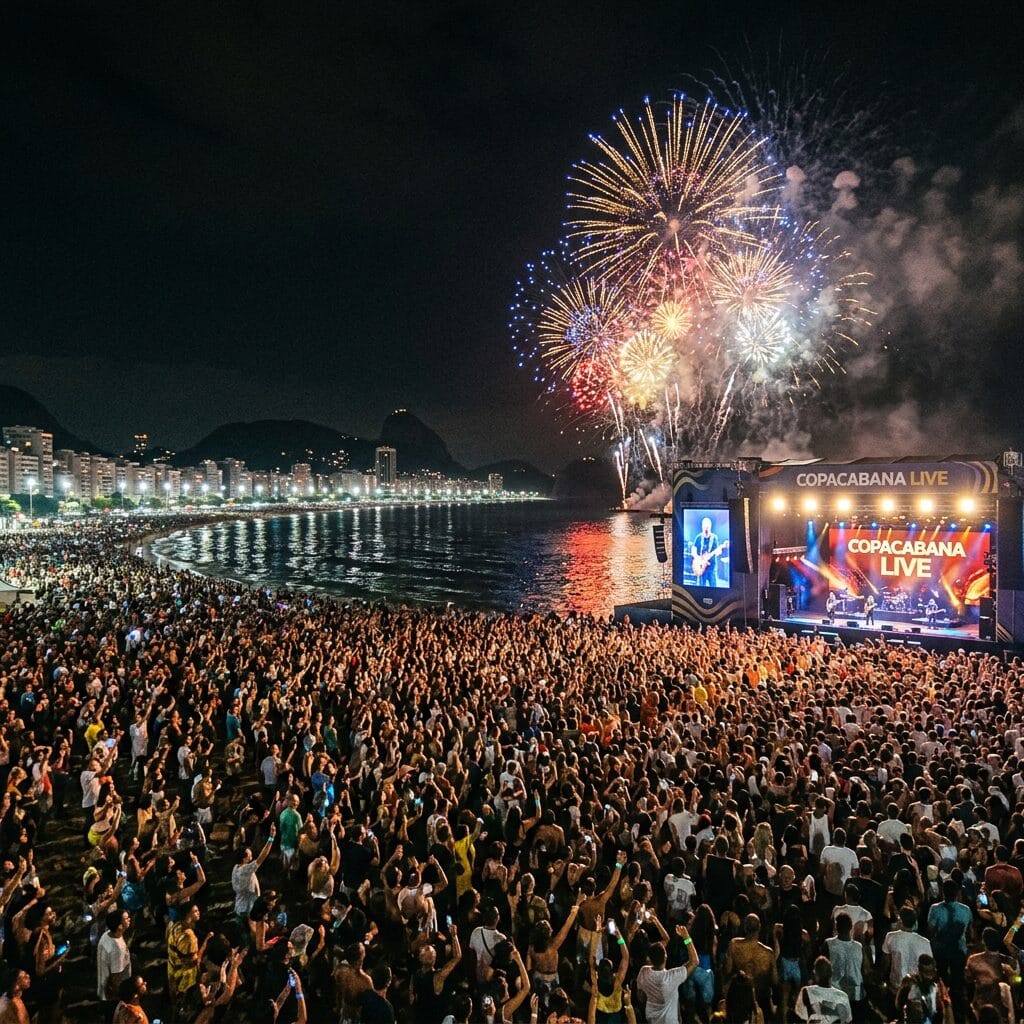
Some performances are measured in ticket sales.
Others are measured in atmosphere, scale, and the feeling that a city has briefly turned into the center of the cultural universe.
That is what happened when Shakira took over Copacabana. This was not just another stop on a global pop itinerary. It was the kind of mass event that reminds people why certain artists stop being merely successful and become something bigger — a public force, a shared memory, a reason for millions to show up in one place and surrender to the moment.
A Pop Star Who Still Knows How to Create an Event
Plenty of artists can fill arenas. Far fewer can transform an entire shoreline into a human tide.
That difference matters.
In the streaming era, fame is often fragmented. Songs are huge, but attention is scattered. Artists trend, then vanish into the algorithm again. What makes a spectacle like this so striking is that it cuts through that fragmentation. It proves that some stars still have the power to gather people physically, emotionally, and symbolically in one place. Not just listeners. Believers.
That kind of presence cannot be faked.
Copacabana Has Become a Stage for Global Cultural Power
There is something fitting about this happening on Copacabana.
The beach is not just a location. It is a global image, a setting already loaded with rhythm, myth, glamour, and public life. When a major artist performs there, the show becomes larger than the setlist. It turns into a statement about Rio itself — its magnetism, its spectacle, and its ability to host moments that feel larger than ordinary entertainment.
In that setting, a concert becomes civic theater.
Shakira’s Endurance Is Part of the Story
One reason the moment lands so hard is that Shakira is not a fleeting star of the moment.
She belongs to a rarer category: an artist who has survived multiple pop eras without losing her ability to command the present. That kind of longevity is not luck. It comes from adaptability, recognizability, and the fact that her voice, movement, and image still carry immediate force. She does not feel like a nostalgic act dusted off for sentiment. She still feels active, current, and capable of turning a huge public performance into something alive.
That is difficult to do after decades in the spotlight.
The Real Power Was in the Collective Feeling
What makes gatherings like this unforgettable is not only the performer.
It is the collective emotion.
A crowd on that scale changes the meaning of a concert. People are no longer just consuming entertainment. They are participating in a shared release. Singing becomes louder. Familiar songs become communal property. The show becomes less about watching a star and more about entering a temporary world built around music, movement, and recognition. For a few hours, millions of people are in the same emotional weather.
That is why events like this stay in memory longer than ordinary performances.
A City Knows a Cultural Investment When It Sees One
There is also a harder, more practical truth behind these mega-shows.
Cities are learning that cultural spectacle is not only about prestige. It is also economics, visibility, tourism, and brand power. When a place can host an event that dominates international attention, it is not simply staging entertainment. It is advertising itself as alive, open, and globally relevant. In that sense, a concert like this is both celebration and strategy.
And Rio understands that instinctively.
Pop Music Still Has the Power to Feel Public
Modern culture often feels individualized to the point of exhaustion.
Everyone has their own feed, their own playlist, their own niche. That is why truly massive public concerts still feel special. They restore a sense of shared experience that digital life keeps thinning out. For one night, people are not just users moving through separate recommendation systems. They are part of the same sound, the same chorus, the same physical event.
That kind of public joy is harder to manufacture than the industry likes to admit.
More Than a Headline, More Than a Number
It would be easy to reduce this moment to scale alone.
A giant crowd. A major star. Another record-style spectacle on an iconic beach.
But that would miss the point. The deeper meaning of a night like this is not only how many people came. It is what their presence says. That live music still matters. That a true performer can still stop the noise of the age and pull millions into the same emotional orbit. That some artists do not just perform songs — they create civic moments.
Shakira did not merely give Rio a concert.