


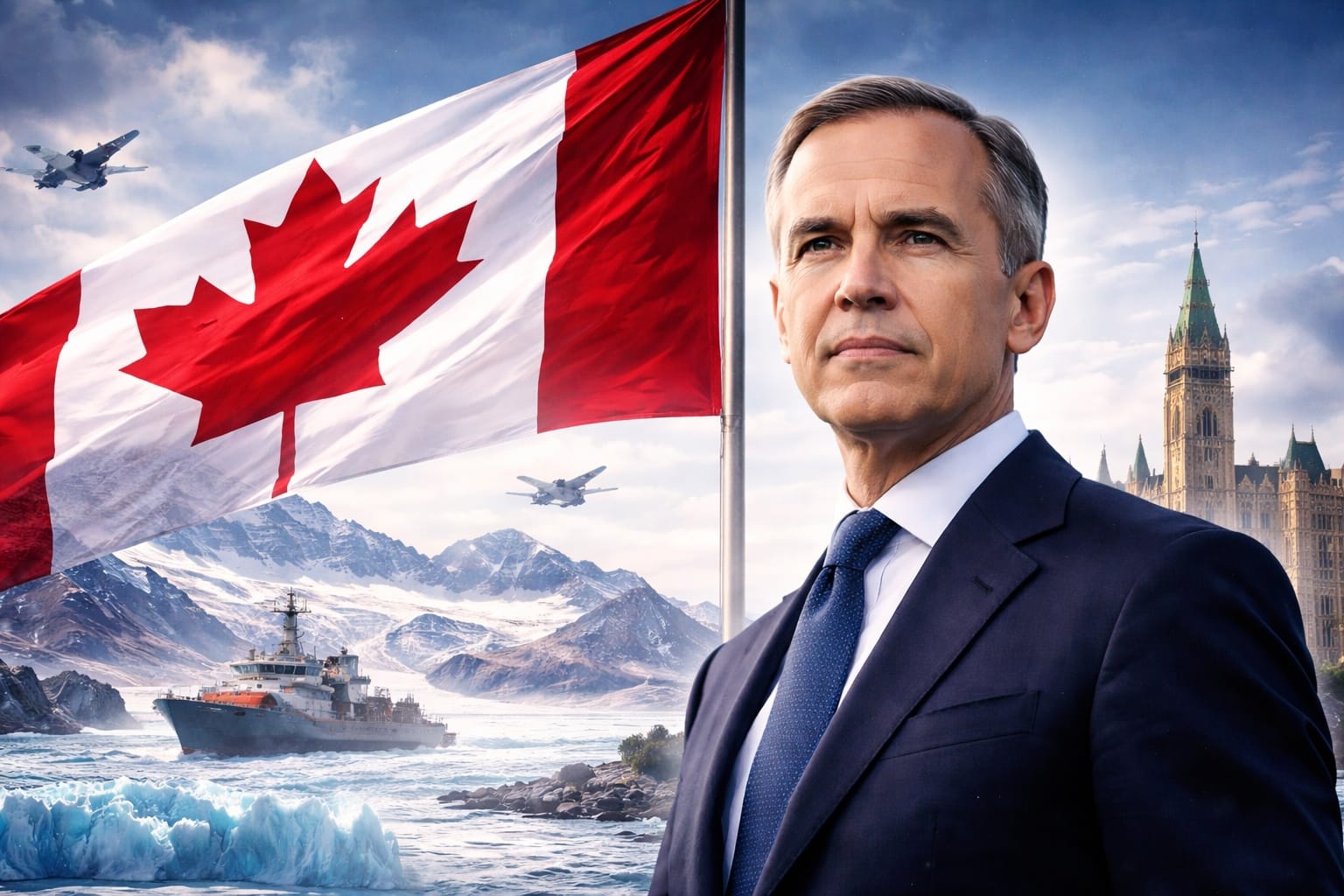
Why Mark Carney Is the Prime Minister Canada Needs in an Age of Uncertainty
Canada is learning something uncomfortable: sovereignty isn’t a sentiment — it’s a system.
For decades, we treated the United States as our strategic insurance policy — our biggest customer, our security backstop, our crisis hotline. Integration felt safe. Dependency felt efficient.
That era is over.
In a world where tariffs are weapons and unpredictability is policy — where senior figures in Washington casually float ideas like Canada as a “51st state,” and where economic coercion, regime change, and even military intimidation are openly discussed — comfort has become vulnerability.
Mark Carney is the first Canadian prime minister in a generation to actually govern like that’s true.
His project is simple to describe and brutal to execute: replace reliance with resilience. Stop assuming stability. Start building it.
The End of the “Age of Integration”
The old Canadian model rested on one assumption: the U.S. relationship was permanent, benevolent, and rules-based.
But when a 25% tariff wall can appear overnight, when invasion is normalized as policy language, and when powerful states treat borders as “negotiable,” friendship becomes conditional. Integration becomes exposure. Exposure becomes risk.
Carney did what no recent prime minister dared to do: he treated the United States not as destiny, but as a variable.
That’s the real break.
Not anti-American.
Just post-naïve.
Fortress Canada Is Not Isolation — It’s Hardening
Let’s be precise. “Fortress Canada” does not mean closing doors.
It means thickening walls.
It means:
- Multiple trade routes instead of one.
- A real internal market instead of a fragmented federation.
- Real Arctic presence instead of legal fiction.
- Real defense capacity instead of symbolic commitments.
It means the ability to say no without collapsing.That’s what sovereignty actually is.
Economic Resilience: The Shield
One Canadian Economy
Removing interprovincial trade barriers isn’t sexy politics. It’s statecraft.
A country that can’t trade efficiently with itself is not independent in any meaningful sense. Carney’s internal market push is the economic foundation of Fortress Canada: less friction inside, less leverage from outside.
This is how you stop being cornerable.
The Trade Pivot
China. Qatar. Non-U.S. exports.
Not because Canada is “pivoting away” from the United States — but because no sovereign nation organizes its survival around a single partner. Where Washington uses tariffs as a weapon, Carney is building diversification as armor
The Keys to the House: Arctic and Defense
You don’t own a house if you don’t control the doors.
Carney’s insistence that the Northwest Passage is internal Canadian water is a direct challenge to U.S. convenience and Russian ambition alike.
And when Washington casually discusses buying, pressuring, or absorbing Greenland — treating another nation’s territory as a bargaining chip — Carney didn’t hedge. He stood with Greenland. He stood for Arctic sovereignty. He stood for the principle that borders are not suggestions.
That matters.The 5% of GDP defense pledge by 2035 isn’t about looking tough. It’s about becoming durable.
And the smartest part isn’t jets or ships — it’s dual-use infrastructure:
Ports that move trade and military logistics.
Airstrips that serve communities and patrol routes.
Satellites that connect the North and watch it.
This is not a turn toward militarization, but a recognition that sovereignty requires presence, infrastructure, and capacity.
The Carney U-Turn: Stability Over Ideology
Carney’s most underestimated move has been political, not economic. He recognized that the consumer carbon tax and high immigration levels had become more than policy disputes — they had turned into cultural flashpoints, feeding distrust and widening divisions at exactly the wrong time. So he stepped back from them, not as a conversion, but as triage.
It wasn’t a change in belief so much as a reordering of priorities. A country bracing for external economic pressure can’t afford to run internal wars in parallel. By removing the issues most likely to keep the country locked in permanent conflict, he narrowed the battlefield and redirected attention to the core task: keeping Canada stable, functional, and unified through the trade shock.
From Integration to Fortress
This is the real shift.
Carney has effectively closed the long Canadian chapter of assumed integration with the United States and opened a new one built around national resilience — what might fairly be called Fortress Canada, not as withdrawal, but as insulation.
The test is straightforward and unforgiving: whether he can steer the country through a trade war without tipping the economy into recession, and whether he can finally break the housing supply bottleneck that has been steadily eroding the middle class.
If he succeeds on both, his tenure may be remembered as one of the most consequential since the post-war period — not because he made government bigger, but because he rebuilt the state’s capacity to protect, supply, and hold the line when the world turns hostile.
What Still Must Happen
Productivity, or managed decline
Without a serious productivity surge, Fortress Canada becomes an expensive idea with no engine behind it. The country can’t defend its standard of living—or its sovereignty—on high costs and low output.
The path forward is not mysterious: widespread AI adoption, robotics, advanced manufacturing, and major gains in energy efficiency. If Canada doesn’t build capability in these areas, it will keep importing the future from elsewhere—paying more, producing less, and slowly slipping behind.
Housing is national security
Housing has moved beyond the category of “social issue.” It now sits in the realm of national resilience.
When people can’t afford shelter, they delay families, stop moving for work, and lose the confidence to plan a life. That corrodes labour mobility, weakens communities, and turns politics into permanent anger. A country that cannot house its citizens cannot sustain the cohesion required to defend itself.
Four million homes by 2030 isn’t just a construction target. It’s a strategic requirement.
Final Thought
Carney isn’t simply managing a crisis. He is trying to rebuild Canada for a world that no longer rewards comfort and no longer guarantees stability.
To the critics: do what a serious opposition should do. Audit the spending. Press for timelines. Expose waste and force competence. But don’t confuse scrutiny with scorched-earth politics. This isn’t a seminar argument. It’s a trade war. When tariffs become instruments of pressure, resilience stops being optional and becomes the price of staying in control of your own future.
And to the Conservative leader: this is the moment to decide what kind of opposition you want to be. You can treat the country’s resilience as a partisan prop, or you can treat it as a national project that still requires accountability. Don’t try to weaken the builder because you didn’t lay the first brick. If the fortress has flaws, name them precisely. If execution is slow, push it faster. Bring a better plan for housing approvals, tighter procurement discipline, and a credible productivity agenda. Compete on outcomes — not on sabotage.
To Canadians watching the political noise and wondering whether anyone has a steady hand on the wheel: you do. But even a steady hand can’t steer if the country keeps grabbing at the controls.
Support doesn’t have to mean agreement on every policy. It can mean agreement on the direction: build capacity, reduce vulnerability, expand options, and hold the line. Fight over competence. Fight over details. Fight over outcomes. But don’t fight the idea that Canada needs to be able to stand on its own feet.
Because sovereignty isn’t something you declare once. It’s something you maintain — especially when the world gets rough.