

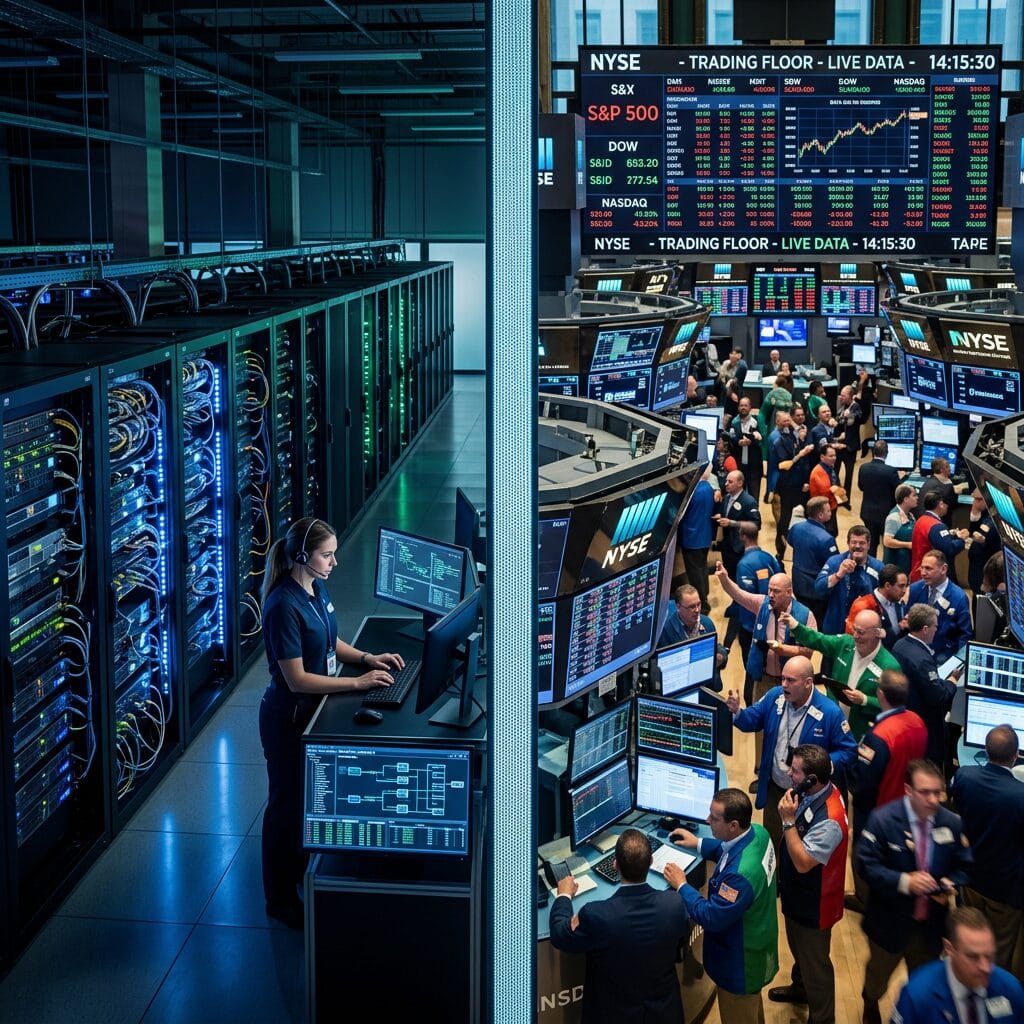
The stock market spent much of the past year moving to a familiar rhythm.
Artificial intelligence goes up.
Everything else follows.
But Thursday’s trading session revealed a more complicated picture. While AI-linked chipmakers surged on strong forecasts and earnings, some of the market’s biggest technology giants stumbled, leaving investors caught between excitement about the future and concerns about the present.
The result was a mixed day on Wall Street that may say more about the state of the economy than any single market index.
AI Is Still the Market’s Favorite Story
One message came through clearly.
Investors remain deeply committed to the AI narrative.
Micron Technology delivered stronger-than-expected results and optimistic guidance, sending its stock sharply higher. Qualcomm also impressed investors with ambitious forecasts tied to the growing demand for artificial intelligence infrastructure.
These companies are benefiting from a simple reality: the AI boom is still creating enormous demand for chips, memory, data centers, and computing power.
The market continues to believe that AI is not a temporary trend but a long-term transformation.
That belief remains one of the strongest forces driving investor behavior.
Apple Reminded Investors That Growth Has Costs
At the same time, Apple delivered a very different message.
The technology giant saw its shares fall after announcing higher prices on several products. The move highlighted a growing challenge facing many companies: rising component costs.
The AI revolution is creating winners, but it is also creating pressure throughout the supply chain.
Memory chips, storage components, advanced semiconductors, and manufacturing capacity have all become more expensive. Companies must either absorb those costs or pass them on to consumers.
Neither option is ideal.
Absorbing the costs hurts profits.
Passing them on risks weakening demand.
Apple’s decline showed that investors are paying attention to both sides of the equation.
The AI Economy Has Entered a New Phase
For much of the past two years, markets focused primarily on growth.
How fast could AI expand?
How much infrastructure would be needed?
How large could future profits become?
Now a different question is emerging.
Who pays for it?
The enormous investments being made in AI systems require vast amounts of capital. Data centers need construction. Chips need manufacturing. Power consumption is rising. Memory shortages are pushing prices higher.
The technology is creating opportunities.
It is also creating costs.
Investors are beginning to examine both.
Lower Oil Prices Helped Calm Nerves
One factor preventing a larger market selloff was the continued decline in oil prices.
Energy markets have cooled significantly from the panic seen during the height of geopolitical tensions in the Middle East. Lower fuel costs reduce pressure on businesses, consumers, and inflation expectations.
That matters because inflation remains one of the biggest concerns facing investors.
Every decline in energy prices helps ease fears that central banks may need to keep interest rates higher for longer.
For markets, lower oil prices function almost like a relief valve.
They reduce pressure elsewhere in the economic system.
Bond Markets Sent a More Encouraging Signal
Investors also found comfort in Treasury yields moving lower.
Bond markets have spent months reacting to inflation concerns, government borrowing needs, and uncertainty about future interest rates. Lower yields suggest investors are becoming somewhat more comfortable with the inflation outlook.
That does not mean inflation has disappeared.
It simply means markets are seeing fewer immediate surprises.
When bond yields stabilize, stock investors generally breathe easier because future profits become more valuable when borrowing costs are less threatening.
The Market Is Becoming More Selective
Another important lesson from the day is that investors are no longer treating all technology companies equally.
Earlier phases of the AI boom often lifted nearly every stock connected to technology.
That is changing.
Today, investors are increasingly rewarding companies that demonstrate clear revenue growth, strong earnings, and direct exposure to AI demand. At the same time, they are becoming less forgiving toward firms facing pricing pressures, margin concerns, or slower growth.
The market is maturing.
Excitement alone is no longer enough.
Execution matters.
Valuation Concerns Haven’t Gone Away
Despite the optimism surrounding AI, concerns about valuations remain.
Many of the companies leading the market have seen extraordinary gains over the past year. Some investors worry that expectations have risen so high that even strong results may not be enough to justify current prices.
This creates an unusual environment.
Good news can send a stock soaring.
But even better news may not guarantee sustained gains if investors believe future expectations have already become too ambitious.
That tension explains much of the volatility currently visible across technology markets.
The Economy Is Sending Mixed Signals Too
The broader economy mirrors the market’s uncertainty.
Consumer spending remains resilient. Employment remains relatively strong. Corporate earnings have generally held up better than many economists expected.
Yet inflation remains elevated.
Interest rate uncertainty persists.
Global geopolitical risks continue to influence energy markets and investor sentiment.
The economy is not clearly booming.
It is not clearly weakening either.
Instead, it occupies a complicated middle ground that leaves investors searching for direction.
Why This Matters Beyond Wall Street
Market movements are often viewed as abstract financial events.
But they reflect larger forces shaping everyday life.
The same AI investments boosting semiconductor stocks are influencing future jobs, business productivity, and technological development. The same inflation concerns affecting bond yields impact mortgages, loans, and consumer prices. The same energy prices influencing markets affect transportation costs and household budgets.
Wall Street does not exist in isolation.
Its daily struggles often mirror the broader economy’s uncertainties.
The Meaning of the Moment
Thursday’s mixed trading session captured the central story of today’s market.
Investors remain enthusiastic about artificial intelligence and the transformative potential it represents. Strong earnings from chipmakers continue to reinforce the belief that AI spending remains powerful and sustainable.
Yet the market is also becoming more realistic.
Rising costs, valuation concerns, inflation pressures, and economic uncertainty are forcing investors to ask tougher questions.
The result is a market moving in two directions at once.
One side sees a future defined by technological transformation.
The other sees the challenges of paying for that future.
For now, both stories are true.
And Wall Street is trying to decide which one matters more.