

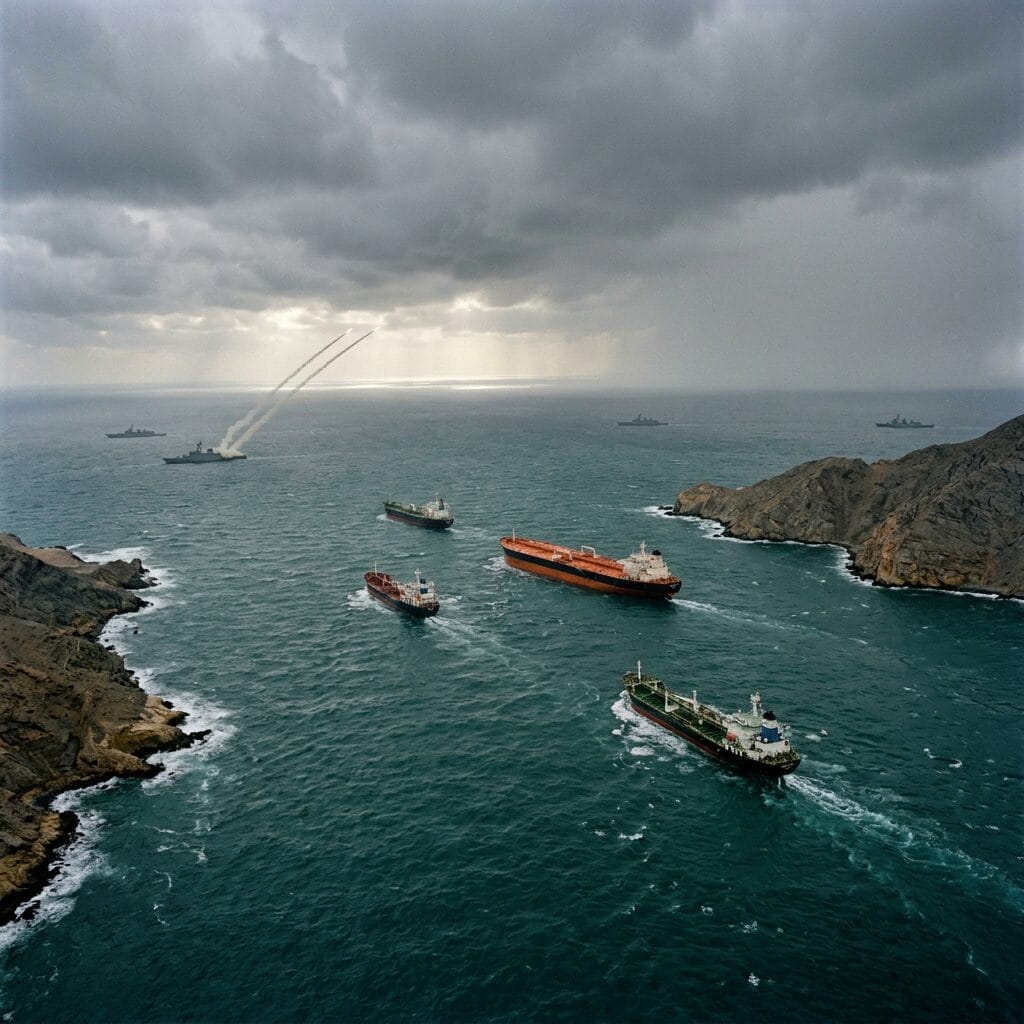
The latest escalation between the United States and Iran has pushed one of the world’s most strategically important waterways back to the center of global attention.
Following a third consecutive night of U.S. military strikes on Iranian targets, reports emerged that commercial tankers were attacked in the Strait of Hormuz, raising fears that the conflict is expanding beyond military installations and increasingly threatening international shipping. At the same time, Washington has reinstated measures aimed at restricting Iranian maritime activity, while Tehran has warned that continued military pressure will be met with further retaliation.
The developments mark another dangerous phase in a conflict that is no longer confined to military exchanges.
It is rapidly becoming an economic and geopolitical crisis with implications for energy markets, international trade, and global security.
Why the Strait of Hormuz Matters
Few places on Earth carry as much strategic importance as the Strait of Hormuz.
The narrow waterway connects the Persian Gulf to the Gulf of Oman and the Arabian Sea, serving as the primary export route for oil and liquefied natural gas produced by Gulf states. Every day, millions of barrels of crude oil pass through this maritime corridor on their way to markets in Asia, Europe, and beyond.
Because of its central role in global energy supplies, even limited disruptions can send shockwaves through international markets.
The Strait has long been viewed as one of the world’s most vulnerable geopolitical chokepoints. Whenever military tensions rise in the region, concerns over shipping safety quickly translate into higher energy prices and increased uncertainty for businesses worldwide.
That dynamic is once again unfolding.
Military Conflict Is Expanding Beyond Land
For much of the recent conflict, military operations focused primarily on strategic facilities, missile sites, and defense infrastructure.
The latest developments suggest the confrontation is taking on a broader dimension.
Commercial vessels have now become part of the security equation. Reports of attacks on oil tankers underscore the growing risks faced by civilian shipping companies operating in one of the busiest maritime routes on the planet. As insurance costs rise and shipping companies reassess routes, the economic impact of the conflict may extend well beyond the battlefield.
History has shown that attacks on commercial shipping can have consequences far greater than the immediate physical damage.
They create uncertainty.
And uncertainty is often what markets fear most.
Energy Markets Are Watching Every Development
Oil traders react not only to actual supply disruptions but also to the possibility that disruptions could occur.
When military activity intensifies near critical energy infrastructure, markets quickly price in additional risk. Even if production remains stable, concerns over transportation can drive sharp increases in oil prices.
The latest escalation has already renewed concerns about supply security.
Import-dependent economies are particularly vulnerable to sustained increases in energy costs. Higher oil prices affect transportation, manufacturing, agriculture, aviation, and consumer goods, eventually filtering through to inflation and economic growth.
For central banks already balancing inflation against slowing economic activity, another prolonged energy shock would complicate policy decisions significantly.
Shipping Faces New Challenges
Commercial shipping companies operate on predictability.
Conflict undermines that principle.
Attacks on merchant vessels force shipping firms to reconsider routes, increase security measures, and pay substantially higher insurance premiums. Some companies may delay voyages altogether until the security situation becomes clearer.
Every additional day of uncertainty affects supply chains.
Delays in energy shipments can ripple through refineries, manufacturers, and transportation networks thousands of kilometers away from the conflict itself.
This is why events in the Strait of Hormuz matter to countries with no direct involvement in the fighting.
The waterway serves the global economy, not merely the region.
Diplomacy Appears Increasingly Difficult
Military escalation often narrows the space for diplomatic compromise.
Each new exchange of strikes creates additional political pressure on leaders to demonstrate resolve rather than flexibility. Domestic audiences expect strong responses, while adversaries seek to avoid appearing weak.
That environment makes negotiations considerably more complicated.
Even when governments privately favor de-escalation, public military actions can reduce room for compromise.
Diplomatic channels may remain open behind the scenes, but restoring trust becomes progressively harder as hostilities intensify.
Financial Markets Are Responding
Investors have historically viewed geopolitical crises through the lens of risk.
Periods of heightened uncertainty often produce increased demand for traditional safe-haven assets such as gold, government bonds, and reserve currencies. Equity markets tend to become more volatile as investors reassess the potential economic consequences of prolonged conflict.
Energy companies may benefit from higher commodity prices.
Transportation companies, airlines, and energy-intensive industries often face greater challenges.
The current crisis is once again demonstrating how geopolitical developments can rapidly reshape investment sentiment across multiple sectors.
Regional Stability Is Under Pressure
The conflict extends beyond the two principal actors.
Neighboring Gulf states, international shipping operators, and countries dependent on Middle Eastern energy exports all have significant interests in preventing further escalation.
Any widening of hostilities risks drawing additional regional actors into an already volatile situation.
The more participants become directly affected, the more difficult the conflict becomes to contain.
Maintaining regional stability has therefore become not only a military objective but also an economic necessity.
The Cost of Escalation Is Measured Beyond the Battlefield
Wars are often evaluated by military outcomes.
Their broader consequences are frequently economic.
Businesses postpone investments.
Consumers face higher prices.
Governments increase defense spending.
Supply chains become less reliable.
Insurance costs climb.
International trade slows.
Even countries located thousands of kilometers from the conflict may eventually feel its effects through higher fuel prices, increased transportation costs, and greater financial uncertainty.
Modern conflicts rarely remain confined to national borders.
Globalization ensures their consequences travel much farther than military operations themselves.
The Meaning of the Moment
The latest exchanges between the United States and Iran represent more than another chapter in a long-running geopolitical rivalry.
They highlight how closely military security and economic stability have become intertwined.
The Strait of Hormuz is not simply a regional waterway.
It is one of the world’s most critical arteries for global commerce.
Every missile fired near its shipping lanes affects not only the countries directly involved but also energy markets, businesses, investors, and consumers across the world.
Whether the conflict continues to escalate or eventually returns to diplomacy remains uncertain.
What is already clear, however, is that the consequences now extend far beyond military strategy.
The battle for influence in the Gulf is increasingly becoming a battle over global economic stability.
And as long as one of the world’s most important shipping corridors remains under threat, the entire international community has a stake in what happens next.