

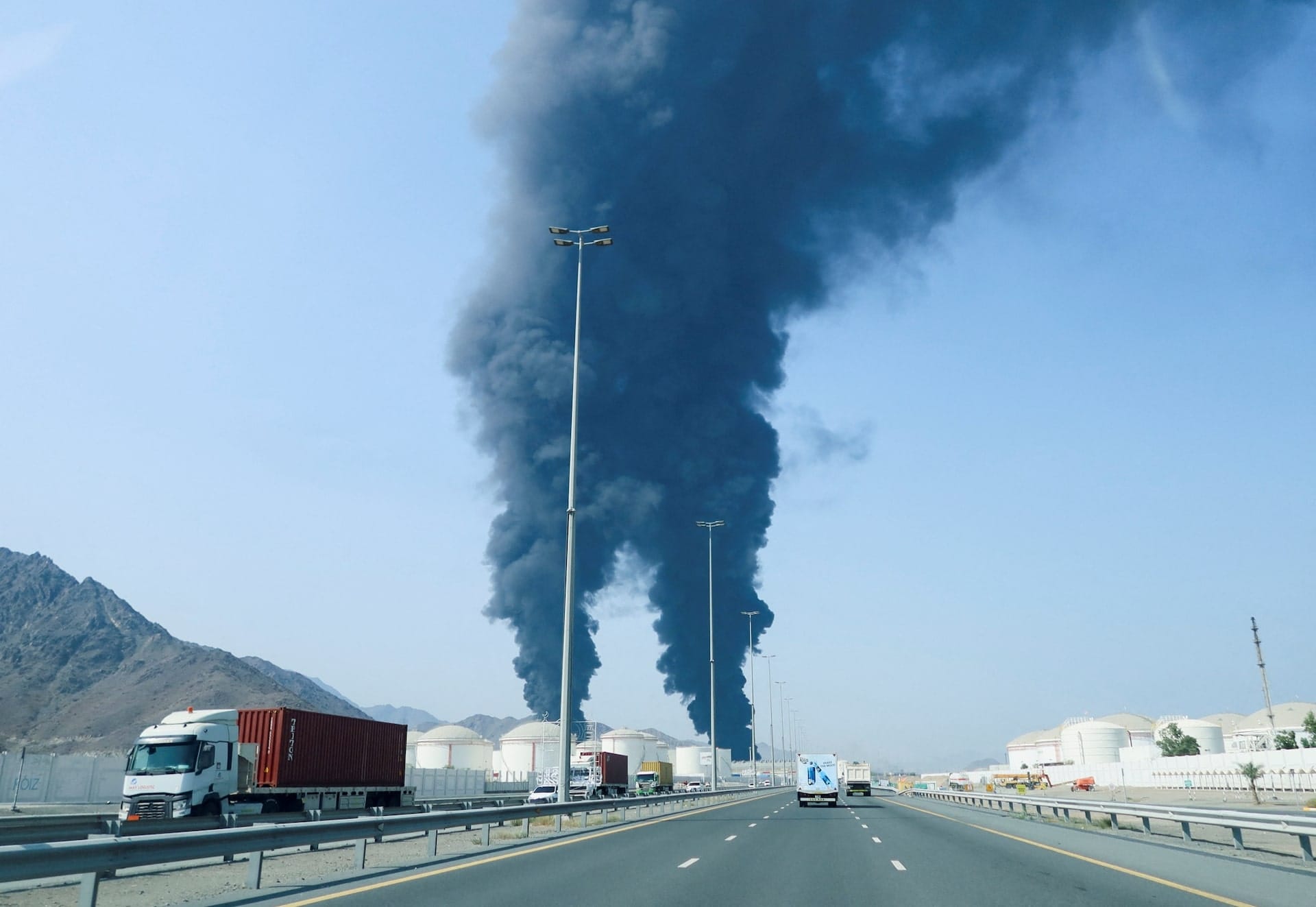
A fire broke out in the UAE’s Fujairah emirate after debris fell during the interception of a drone, authorities said — and even though no casualties were reported, the incident immediately raised a bigger question that energy markets can’t ignore right now:
Is the Gulf’s “safe alternative route” still safe?
Fujairah isn’t just another port. It’s one of the world’s most important oil export and bunkering hubs — and it sits outside the Strait of Hormuz, the chokepoint at the center of the region’s escalating conflict. That geography is exactly why this incident is so consequential.
What happened
According to local officials, the fire started after debris fell during the interception of a drone. Civil defence forces responded to contain the blaze, and the UAE said there were no injuries from the incident.
But the visible smoke and the security context were enough to trigger immediate operational caution: some oil-loading operations at Fujairah were reportedly halted, at least temporarily, while authorities managed the situation and assessed risks.
Why Fujairah is such a big deal
Fujairah is often described as a “pressure valve” for global energy logistics — a key reason is that it provides export capacity and shipping services without requiring tankers to transit Hormuz.
In a stable world, that’s an efficiency advantage.
In a war-risk world, it becomes a strategic lifeline.
Fujairah handles large volumes of crude exports (including the UAE’s flagship Murban crude) and serves as a major refueling point for ships moving between Asia, Europe, and Africa. When something goes wrong here, it doesn’t just affect the UAE — it can ripple into:
- tanker availability and scheduling
- insurance premiums
- freight rates
- delivery timelines into Asia
- and, ultimately, global oil pricing
The backdrop: energy infrastructure is becoming the battlefield
This incident comes amid a wider pattern: the conflict’s spillover is pushing risk outward from “military targets” toward energy and logistics nodes.
Even when damage is limited, markets react because the vulnerability isn’t theoretical anymore. The danger isn’t only that something gets hit — it’s that companies begin to self-restrict operations:
- insurers re-price or pull coverage
- shipowners delay sailings
- terminals pause loadings
- crews refuse routes
- buyers scramble for alternative cargoes
That “caution loop” can tighten supply even before a single barrel is physically lost.
“No casualties” doesn’t mean “no impact”
It’s important not to overstate what happened: officials said there were no injuries, and the incident was managed.
But in a fragile energy system, what matters is not only casualties or structural damage — it’s confidence.
If Fujairah is perceived as exposed, even briefly, the market starts treating “outside Hormuz” as less of a guarantee. That’s how risk premiums spread.
What to watch next
If you’re tracking whether this is a one-off scare or part of a widening energy shock, three indicators will tell the story:
- How quickly oil-loading operations normalize at Fujairah
- Whether insurers and shipping firms adjust war-risk terms for routes near the UAE’s east coast
- Whether further drone or missile activity expands beyond primary conflict zones toward ports, refineries, and export infrastructure
Bottom line
A fire sparked by debris during a drone interception sounds like a localized incident — until you remember where it happened.
Fujairah is one of the world’s key “workarounds” for Hormuz risk. When that workaround starts looking vulnerable too, the global oil market doesn’t wait for catastrophe — it re-prices the possibility.