


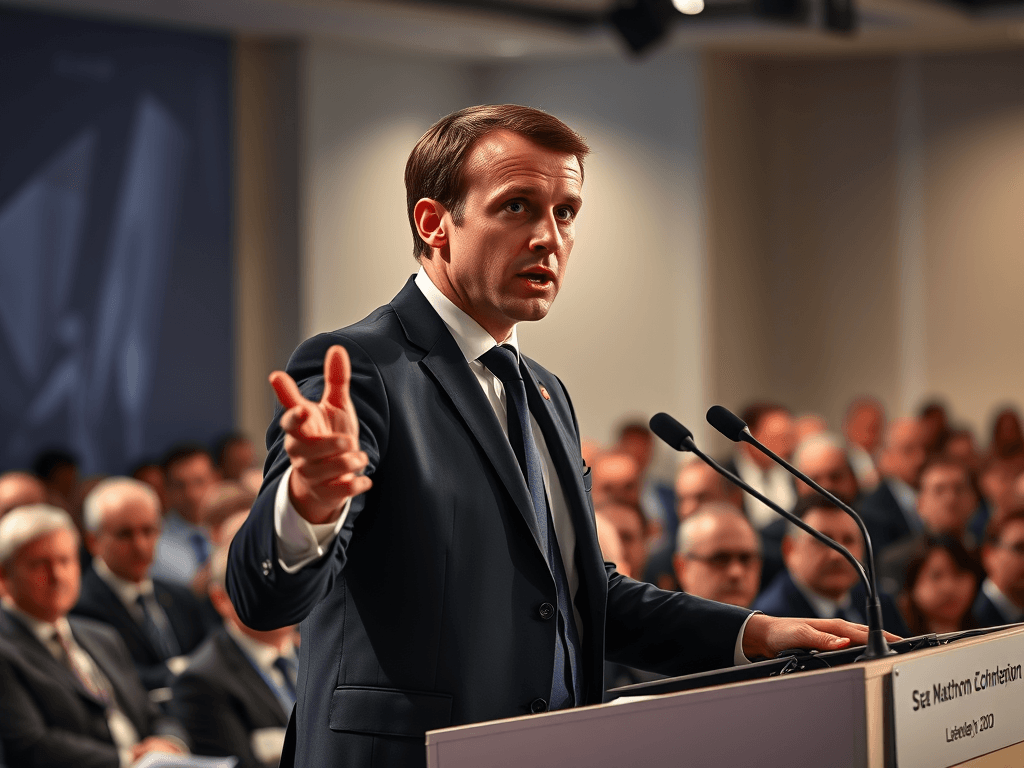
At the Munich Security Conference, Emmanuel Macron delivered a familiar message with a sharper edge: Europe can’t keep outsourcing its strategic future. If the continent wants to protect its interests in a world of hard power politics, it has to act like a geopolitical power—not just a market, not just a regulator, not just a collection of nations hoping someone else guarantees the perimeter.
Macron’s argument isn’t abstract. It’s rooted in one blunt assessment: even if there’s a deal over Ukraine, Russia remains a long-term threat, and Europe can’t base its security on short-term arrangements—or on the assumption that the post–Cold War framework is still fit for purpose.
What Macron is really calling for
1) A rebuilt European security architecture
Macron says Europe’s security model was designed for another era—structured by Cold War assumptions—and now needs an overhaul that matches today’s realities. That means planning beyond the next summit and building an architecture that can endure pressure, coercion, and prolonged confrontation.
2) Real military capability, not just statements
He pointed to the need for stronger European “deep-strike” capabilities—a not-so-subtle signal that Europe must be able to deter and, if necessary, respond with credible force rather than depend entirely on allies for the most serious tools.
3) The nuclear question is back on the table
Macron also leaned into the most sensitive part: France’s nuclear deterrent and how it fits into a modern European security framework. He described consultations with key partners (including the UK and Germany) as Europe debates what deterrence should look like in a more uncertain era.
Why this hits harder in 2026
Europe is trying to manage three pressures at once:
- A grinding security threat to the east that won’t vanish with a handshake.
- A shifting transatlantic relationship, where European leaders feel they must be stronger to maintain partnership—rather than dependency.
- Geo-economic conflict (sanctions, supply chains, industrial policy, coercive trade) where power now shows up through finance and technology as much as tanks.
Macron’s core warning is simple: if Europe doesn’t build power—military, industrial, and political—it will keep getting “done to,” not “done with.”
The obstacle: Europe agrees on the fear, not the fix
Even if many leaders share Macron’s diagnosis, Europe still struggles with execution:
- different threat perceptions across member states
- budget constraints and political fragmentation
- slow procurement and limited defense industrial capacity
- disagreement on how far “strategic autonomy” should go versus NATO-first instincts
That’s why Macron frames this as a moment for “audacity”: the gap between rhetoric and capability is now the risk.
Bottom line
Macron isn’t asking Europe to pick a fight. He’s saying Europe must be strong enough that others don’t pick fights for it—and that the old security architecture is no longer enough to deter an adversary that plays the long game.