



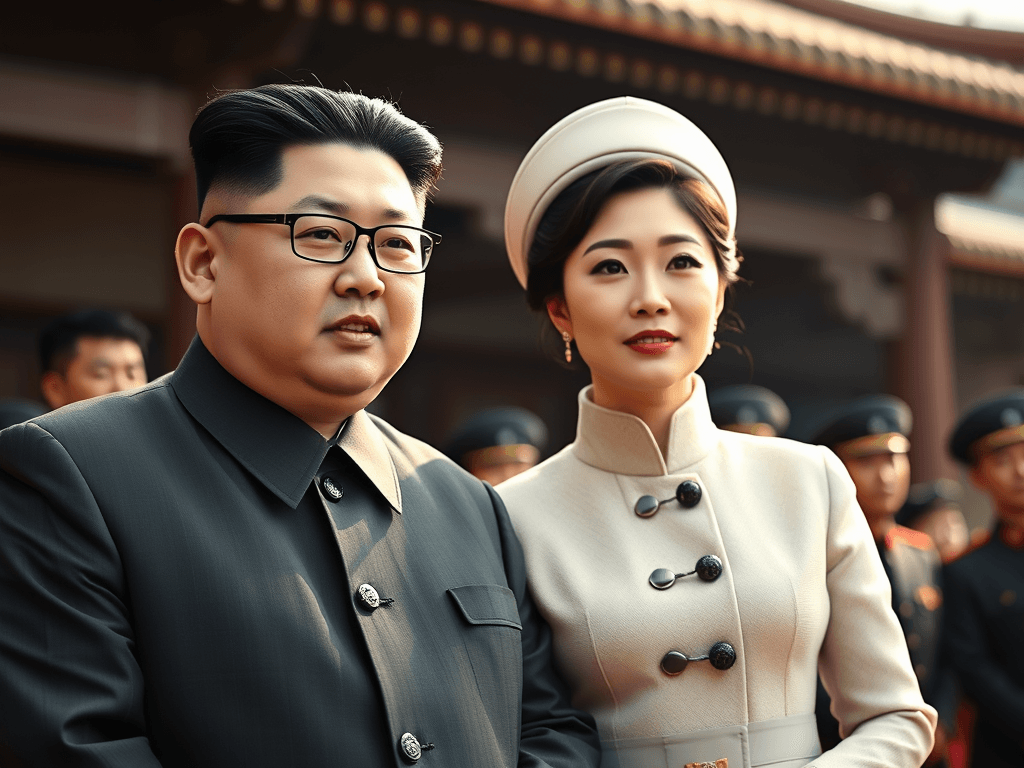
North Korea doesn’t do succession like normal countries do it. There are no campaigns, no public debates, no formal “heir announcement” you can clip and share. Instead, you get something far more revealing: imagery, language, and protocol—tiny cues that tell elites who the future belongs to.
That’s why a new assessment briefed to South Korean lawmakers is making waves: South Korea’s intelligence agency now believes Kim Jong Un’s daughter—widely thought to be Kim Ju Ae—has moved beyond “training” and into the stage of being internally designated as successor.
Nothing is confirmed by North Korea. But the directional signal is hard to ignore.
What the briefing claims (in plain terms)
According to South Korean lawmakers who attended a closed-door intelligence briefing:
- Kim Ju Ae is increasingly being treated as a de facto No. 2 figure in North Korea’s public hierarchy.
- Her appearances alongside Kim Jong Un are no longer “family optics”—they’re starting to look like state optics.
- Intelligence officials believe she may be offering policy input, based on her role and treatment at high-profile events.
- South Korea is watching an upcoming ruling party meeting closely to see how she is presented, and whether she receives any official title.
The key detail is the wording shift: the agency’s description reportedly moved from “in study as successor” to something closer to “internally appointed successor.” That’s a meaningful escalation—at least in how Seoul is interpreting Pyongyang’s signals.
Why “visibility” is the message in North Korea
In most political systems, visibility is marketing. In North Korea, visibility is governance.
Who stands closest to the leader, who receives deferential treatment, who is named with special honorifics, who is positioned in photographs—these are not random. They are messages to:
- the party elite,
- the military command,
- the security services,
- and the public.
If Kim Ju Ae is repeatedly placed in “state moments” rather than purely ceremonial “family moments,” it can be read internally as: this is the bloodline that continues.
The big question: will she be given a formal title?
The next checkpoint is whether she appears at the upcoming Workers’ Party gathering and—more importantly—whether she is given a recognizable title or elevated presentation.
A title matters because it transforms her from a symbolic figure into an administrative one. It also signals that the state is ready to normalize the idea of her leadership before she is an adult.
But even without a title, protocol itself can do a lot of work. North Korea has a long tradition of preparing the ground through staged appearances and gradual elevation.
Why this would be historic (and why it’s still uncertain)
If Kim Ju Ae is being positioned as successor, it would be historic for one obvious reason: she would be the first woman poised to lead the Kim dynasty.
That said, uncertainty remains massive:
- North Korea’s elite politics are opaque by design.
- Public imagery can be used as a decoy or a stability tactic.
- There may be other potential successors kept out of sight.
- A female successor would challenge long-standing patriarchal norms within the state and military culture.
So the smartest read is: this is a strong signal, not a signed contract.
The other reveal in the briefing: a new submarine push
The same briefing to lawmakers also included a separate, strategically significant claim: Kim Jong Un is directing development of a large submarine that South Korea believes could carry up to 10 submarine-launched ballistic missiles (SLBMs).
Lawmakers cited a displacement figure around 8,700 tons, and suggested it may be designed with a nuclear-reactor concept—though it remains unclear whether it would actually be nuclear-powered or operationally functional as designed.
That part matters because a credible SLBM platform strengthens a second-strike capability—the kind of deterrence posture North Korea consistently seeks.
The fact that this submarine detail appears alongside succession talk is not accidental. It suggests a broader picture: Pyongyang is projecting continuity—continuity of leadership and continuity of strategic weapons development.
How to interpret this moment
There are two ways to read Kim Ju Ae’s rise in visibility:
1) Succession grooming is real
This is the straightforward interpretation: Kim Jong Un is building a fourth-generation transfer plan early, using ritualized appearances to align elites, normalize the heir, and reduce future instability.
2) It’s elite management (even if succession isn’t imminent)
Even if succession isn’t close, featuring his daughter could serve as a loyalty test and a stabilizing symbol: the “Paektu bloodline” as a permanent institution, not merely one leader. It tells the system: there is a future, and it is still the family.
Both interpretations can be true at once.
What to watch next
If you want to know whether this is merely symbolism or a real transition plan, watch for these signals:
- Official titles attached to her name in state media
- Consistent protocol elevation (seating order, introductions, who defers to her)
- Presence at party-level events, not just military/industry showcases
- Language upgrades (honorifics reserved for top leadership)
- Independent appearances (rare, but a major indicator if it happens)
Bottom line
South Korea’s intelligence assessment is not the same as North Korea confirming anything. But in a system built on choreography, the choreography itself is evidence.
If Kim Ju Ae is indeed moving from “being shown” to “being installed”—even internally—then North Korea is quietly preparing the world (and its own elite) for a new reality: the next leader may already be standing beside the current one, learning the posture of power in real time.


