


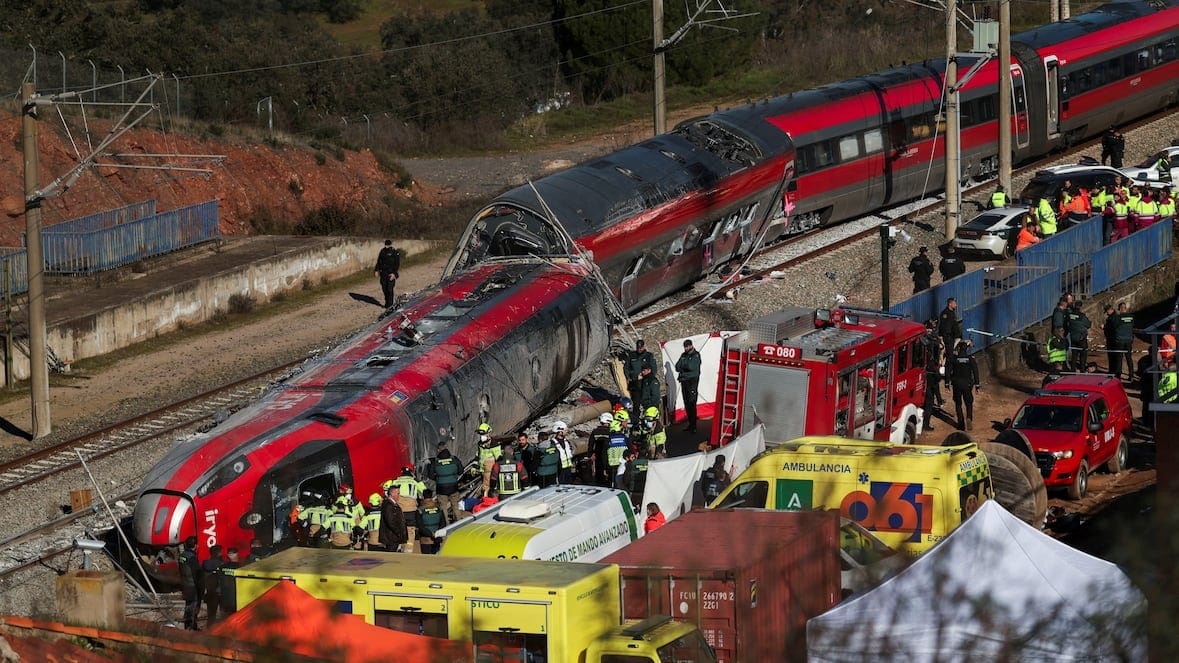
Spain is reeling after a deadly high-speed rail crash in the province of Córdoba, where a derailment triggered a catastrophic collision that killed dozens of people and left many more injured. What began as an ordinary intercity journey turned into a night of chaos, rescue lights, and shattered steel—raising urgent questions about how a modern rail system could suffer such a severe accident.
What happened
Initial reports indicate one train derailed at speed on a key rail corridor in southern Spain and crossed into the path of an oncoming train, leading to a violent impact. Several carriages reportedly left the tracks, with parts of the wreckage ending up down an embankment—making access difficult for rescue crews and complicating the effort to reach trapped passengers.
The collision’s force was described as immense, with survivors recounting moments of confusion, darkness, and panic as passengers tried to orient themselves and escape damaged cars.
The rescue effort
Emergency services launched a massive response overnight, deploying specialized crews to:
- cut into twisted metal,
- stabilize damaged carriages,
- evacuate the wounded,
- and search for victims in the most badly hit sections of the trains.
Hospitals in the region received large numbers of injured passengers, including some in critical condition. Authorities also established support points for survivors and families, as officials began the difficult process of identification and notification.
What investigators are looking at
Investigators are now examining the track conditions, train data, and safety systems to understand the derailment’s cause. The crash has drawn extra scrutiny because it occurred on infrastructure believed to be modern and heavily monitored—meaning any failure, whether mechanical or structural, would raise broader concerns about inspection standards and early-warning detection.
For now, officials are treating it as a full technical investigation, with questions centered on:
- the exact point and mechanism of derailment,
- whether track hardware or maintenance issues played a role,
- and whether any signal or control-system factors contributed to the train’s path crossing into danger.
Why this matters beyond Spain
Spain’s high-speed rail network is widely seen as a symbol of modern European transport—fast, efficient, and generally safe. When a disaster of this scale happens, it doesn’t just shock the public—it also forces the rail sector to confront uncomfortable truths about risk, aging infrastructure, maintenance priorities, and rare failure scenarios that can still overwhelm safety assumptions.
What happens next
Rail services in the affected corridor have been disrupted, with authorities working to restore operations while preserving evidence at the crash site. In the days ahead, the key developments will likely include:
- preliminary findings on the derailment cause,
- confirmation of the final casualty count,
- and potential safety reviews across comparable sections of track.
For now, Spain is left mourning lives lost in a tragedy that struck without warning—while investigators race to determine how it happened, and how to ensure it doesn’t happen again.