

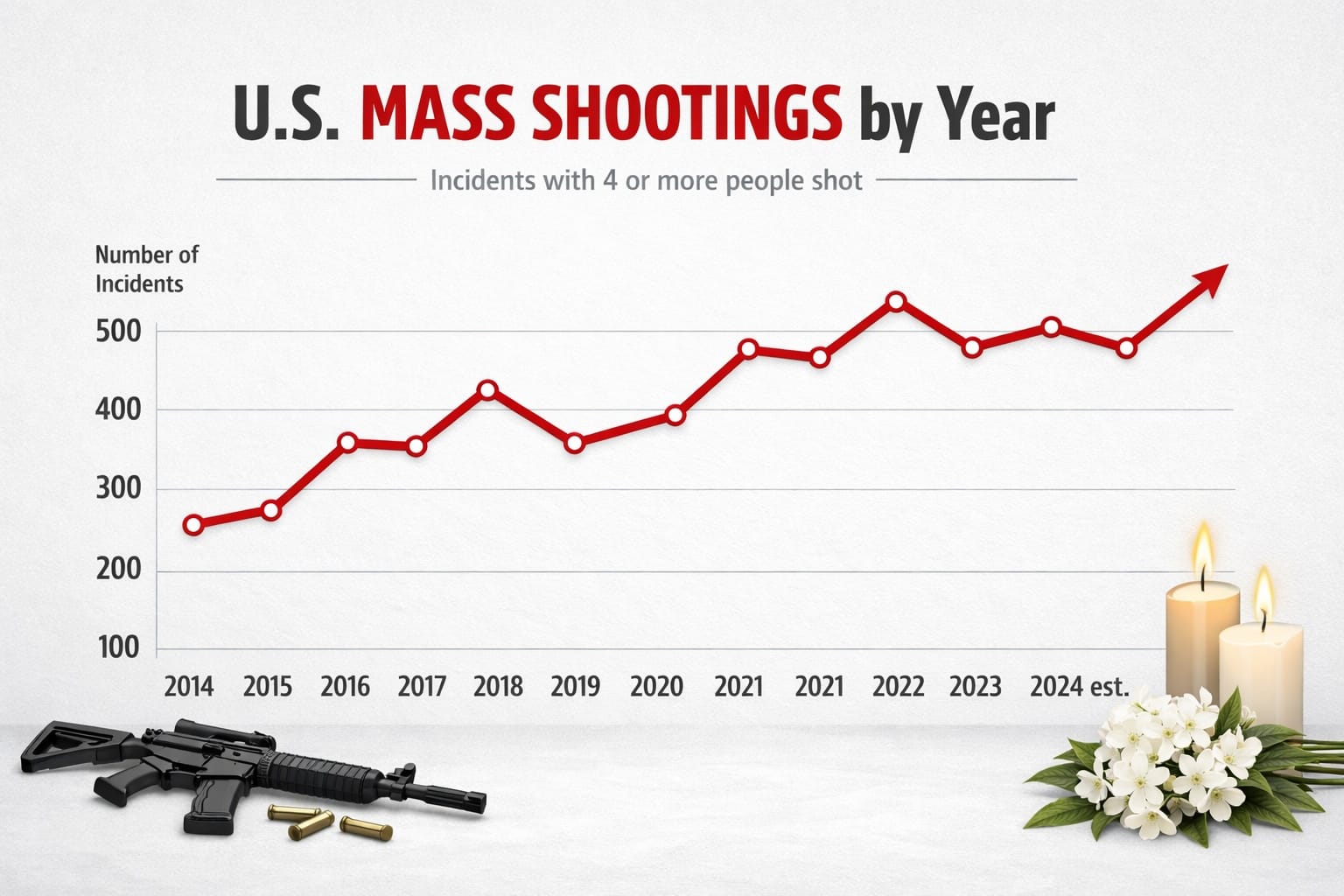
The scapegoat reflex is loud. The data is louder.
After a mass shooting, the public doesn’t just grieve — it hunts for a story simple enough to swallow. And when the facts are messy, people reach for a shortcut: pick a minority, slap a label on the tragedy, and call it “pattern.”
Right now, that target is often transgender people.
It’s not “controversial” to say that’s wrong. It’s statistically false — and it actively makes the world more dangerous by turning a vulnerable group into a convenient punching bag while the real predictors of mass violence go untouched.
Here’s what the evidence actually shows across the Americas and Europe.
The pattern that doesn’t care about your opinions: mass violence is overwhelmingly male
If you’re serious about patterns, start with the one that repeats across datasets and continents:
- Globally, the UN Office on Drugs and Crime reports about 90% of homicides recorded worldwide are committed by male perpetrators.
- In U.S. public mass shootings, NIJ’s summary of The Violence Project database reports 97.7% of perpetrators were male.
- The Violence Project’s own visualization states 98% of mass shooting perpetrators identify as male (1966–2021).
So when someone tries to make “trans identity” the explanation for mass violence, they’re ignoring the only demographic signal that shows up consistently — and doing it on purpose or out of ignorance. Either way, it’s not analysis.
The “trans shooter trend” is a media mirage
People confuse visibility with frequency. One high-profile case can dominate weeks of headlines, but that doesn’t make it a trend.
Using the broad Gun Violence Archive (GVA) definition (mass shooting = 4+ people shot, excluding the shooter), FactCheck reports that GVA lists five mass shootings by transgender or nonbinary suspects since January 2013 — less than 0.1% of GVA mass shootings in that period.
And the rumor machine keeps trying to inflate that share. Reuters has repeatedly fact-checked viral claims portraying school mass shooters as “mostly transgender,” noting the data does not support it (including the claim that “all recent” school mass shootings were carried out by transgender people).
Translation: the public conversation is being driven by viral cherry-picks, not reality.
The basic math test: “overrepresented” doesn’t survive contact with numbers
To claim a group is “disproportionately violent,” you compare their share of the population to their share of the crime.
Population estimates (reputable, widely cited):
- 0.8% of U.S. adults identify as transgender (Williams Institute).
- 1.6% of U.S. adults are transgender or nonbinary (Pew Research Center survey).
- Canada’s 2021 census found 0.19% transgender + 0.14% nonbinary = 0.33% of people aged 15+ (about 1 in 300).
Now compare that to the <0.1% share of mass shootings reported in the GVA tally summarized by FactCheck.
That’s not “overrepresented.” That’s the opposite.
So when someone says “trans people are disproportionately violent,” what they actually mean is:
“I’m reacting to headlines, not base rates.”
The real trend is the vulnerability gap: trans people are more often the victims
Here’s the part that rarely gets the megaphone:
The U.S. Bureau of Justice Statistics reports the violent victimization rate for transgender people was 2.5 times the rate among cisgender people (2017–2020).
And internationally, Trans Murder Monitoring 2025 warns of a dangerous shift: trans movement leaders and activists accounted for 14% of reported murders in their monitoring over the past year — a sign of targeted intimidation, not “community violence.”
A brand-new 2026 meta-analysis in JAMA Network Open also underscores how widespread physical/sexual violence against transgender and gender-diverse adults is globally — again reinforcing the point: this community is far more commonly on the receiving end of harm.
So no: transgender people are not the threat.
They’re the ones absorbing the threat — and scapegoating makes that worse.
Europe doesn’t rescue the scapegoat narrative
Europe-wide crime reporting doesn’t typically track “transgender perpetrators” as a standard category — which means anyone claiming a European “trans violence wave” is usually just manufacturing fear.
What Europe does show clearly is the same gender skew in lethal violence.
Example: in England and Wales, the Office for National Statistics reports that where a suspect had been charged, most suspects were male — 90% for female victims and 91% for male victims (year ending March 2025).
And Eurostat’s EU-wide crime overview shows the scale of homicide (e.g., 3,930 intentional homicides recorded in the EU in 2023) without any evidence pointing to trans people as a driver.
So the “Europe proves it” line doesn’t stand either. It’s just another costume the same lie wears.
What research actually finds around mass shootings (and why scapegoating is cowardly)
If people truly cared about prevention, they would focus on the risk factors that show up again and again in serious research — not on identity scapegoats.
NIJ’s summary of The Violence Project database reports that public mass shooters were nearly always in a state of crisis at the time (often summarized as 80%+ in crisis), often had histories of trauma (NIJ notes 31% had severe childhood trauma), and in many cases used legally obtained firearms (while some younger school shooters stole guns from family members). That combination—crisis, instability, and access—explains far more than any identity label ever could.
That’s where prevention actually lives: early mental-health support and wellbeing, public awareness that crises have warning signs, stronger threat assessment and intervention when someone is spiraling, community support to reduce isolation, and practical safeguards like safe storage and temporarily limiting access to high-lethality weapons during acute instability. Chasing minorities for emotional relief doesn’t stop violence; supporting people before they break—and reducing their ability to cause mass harm when they do—does.