


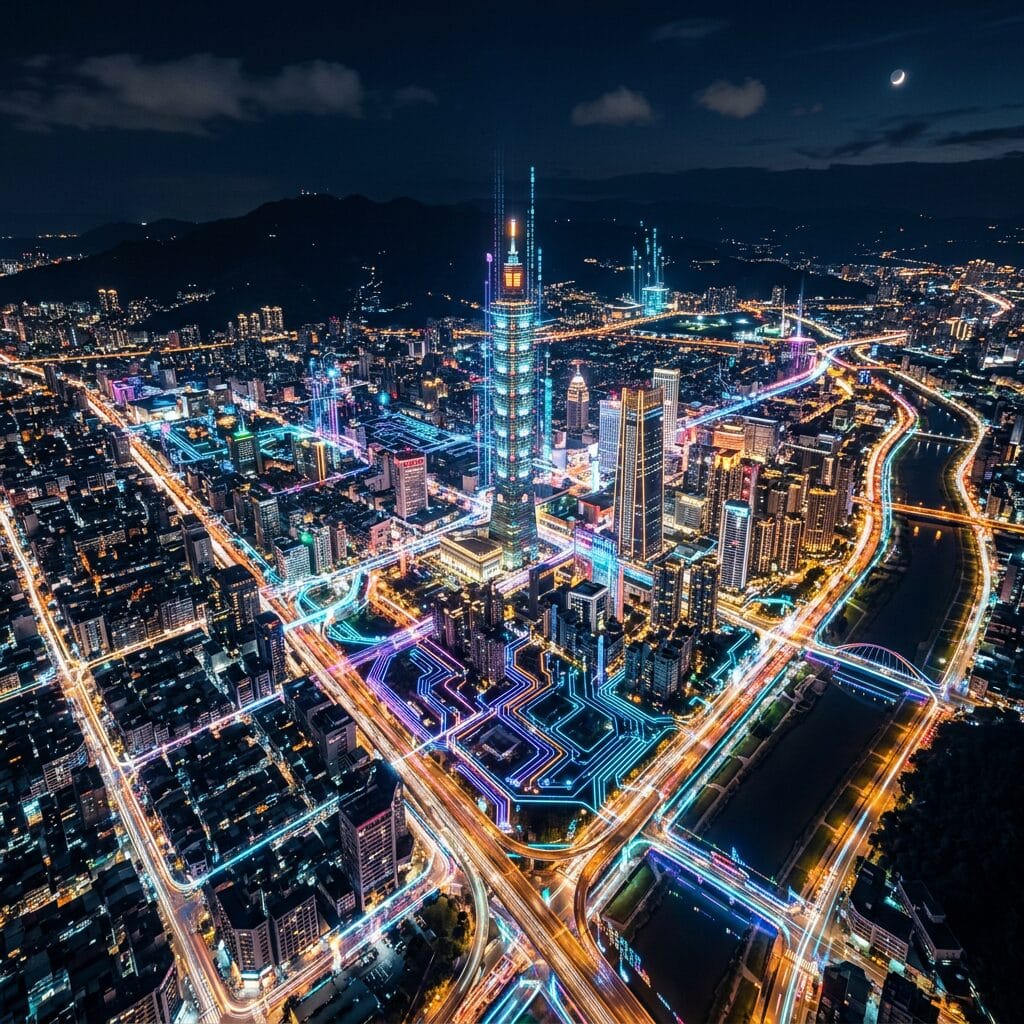
Jensen Huang did not simply praise Taiwan.
He named the reality of the AI age.
When Nvidia’s CEO calls Taiwan the “epicentre” of the AI revolution and says the company will spend up to $150 billion a year there, he is not making a sentimental statement. He is describing the hard geography of modern technology. The future of artificial intelligence may look digital, borderless, and abstract to consumers. But underneath the hype, it depends on very real factories, suppliers, engineers, packaging facilities, and manufacturing networks clustered in one of the most geopolitically sensitive places on Earth.
That is Taiwan’s power.
It is also Taiwan’s danger.
AI Runs Through Taiwan
The AI boom is often described through American companies: Nvidia, Microsoft, Google, OpenAI, Amazon, Meta, Apple.
But the hardware story runs straight through Taiwan.
This is where the chips are made. This is where advanced packaging happens. This is where server systems are assembled. This is where companies like TSMC, Foxconn, Wistron, and Quanta help turn AI demand into physical infrastructure. Without that manufacturing ecosystem, the AI revolution does not scale at the speed investors, governments, and tech giants now expect.
That is why Huang’s statement matters.
He is saying the quiet part out loud: Taiwan is not peripheral to AI. It is central.
Nvidia’s Investment Is a Vote of Confidence
A company does not plan spending at this scale unless it sees Taiwan as indispensable.
Nvidia’s new Taiwan headquarters, expected to open by 2030 and employ thousands, is not merely an office project. It is a strategic anchor. It puts Nvidia closer to the partners that make its chips, systems, and AI infrastructure possible. It deepens the company’s physical presence in the place where much of its supply chain already lives.
This is not just about convenience.
It is about control, speed, coordination, and proximity to the manufacturing base that powers the most valuable company in the world.
Taiwan’s Strength Is Its Ecosystem
Taiwan’s advantage is not one company alone, even if TSMC is the crown jewel.
The real strength is the ecosystem: chip manufacturing, packaging, electronics assembly, precision suppliers, engineering talent, logistics, and decades of accumulated industrial know-how. That kind of ecosystem cannot be copied overnight. It is built slowly, through trust, competence, repetition, and specialization.
That is why Taiwan remains so important.
AI companies can build models anywhere. But building the physical backbone of AI at scale requires a manufacturing network that few places on Earth can match.
The AI Revolution Is More Physical Than People Think
Consumers interact with AI through chat windows, search engines, coding assistants, image tools, and enterprise apps.
That makes AI feel weightless.
It is not.
AI depends on chips, servers, power, cooling, memory, networking equipment, data centers, and supply chains. It depends on minerals, factories, engineers, and massive capital spending. Every impressive model sits on top of an industrial machine.
Taiwan is one of the places where that machine becomes real.
That is why the idea of Taiwan as the AI epicentre is not just rhetoric. It is industrial fact.
Geopolitics Now Runs Through the Chip Supply Chain
This is where the story becomes uncomfortable.
Taiwan’s central role in AI makes it incredibly valuable, but it also increases the stakes around its security. The island already sits at the center of U.S.-China tension. Beijing claims Taiwan. Washington supports Taiwan’s defence and depends heavily on Taiwan’s semiconductor output. Global tech companies depend on Taiwan’s supply chain.
That means Taiwan is not only a manufacturing hub.
It is a geopolitical pressure point.
The world’s AI future is being built in a place where military risk, diplomatic tension, and economic dependence all overlap.
Nvidia Cannot Escape the Taiwan Question
Nvidia is in a complicated position.
It needs Taiwan’s manufacturing ecosystem. It needs TSMC. It needs server partners. It needs the speed and quality Taiwan provides. But it also operates in a world where U.S.-China tensions, export controls, and Taiwan Strait security risks can affect its entire business model.
That is why Huang’s confidence is both powerful and revealing.
Nvidia is betting heavily on Taiwan because it has to. The ecosystem is too important to replace. But that also means the company’s future remains tied to the stability of a region where political risk is impossible to ignore.
Taiwan Is Becoming the AI World’s Factory Floor
The phrase “factory floor” can sound old-fashioned, but it fits.
The AI economy may be sold through software, but its foundation is industrial production. Taiwan is where the invisible becomes physical. Where chip designs become wafers. Where wafers become advanced components. Where components become servers. Where servers become the infrastructure behind global AI.
That gives Taiwan enormous strategic leverage.
It also means any disruption there would not stay local. It would hit AI companies, cloud providers, data center builders, consumer electronics firms, financial markets, and governments around the world.
The World Wants Taiwan’s Output Without Taiwan’s Risk
This is the contradiction.
Every major economy wants the benefits of Taiwan’s semiconductor and AI supply chain. But no one wants to fully face the risk of concentrating so much technological power in one vulnerable place. Governments talk about diversification. Companies announce new fabs. Supply chains shift at the edges.
But Taiwan remains central because excellence at this level is hard to move.
You can build alternative capacity. You cannot instantly recreate Taiwan’s depth.
The New Headquarters Is Also Symbolic
Nvidia’s planned Taiwan headquarters carries emotional weight too.
Huang was born in Taiwan before emigrating to the United States as a child. He has become a kind of superstar figure on the island, and his praise for Taiwan lands not only as corporate strategy but as national recognition. For Taiwan, being celebrated by the leader of the world’s most important AI chip company is a source of pride.
But pride comes with pressure.
The more Taiwan is recognized as the center of AI manufacturing, the more the world understands how much depends on it.
The Meaning of the Moment
Jensen Huang’s message is clear: Taiwan is where the AI revolution becomes real.
Nvidia’s massive spending plans, new headquarters, and deepening ties with Taiwanese partners show that the company sees the island as indispensable to the next phase of global technology. That is a huge validation of Taiwan’s industrial power.
But it is also a warning.
The AI age is not floating safely in the cloud. It is grounded in supply chains, factories, and geopolitical geography. And right now, one of the most important pieces of that future sits in Taiwan.
That makes Taiwan powerful.
It also makes the whole AI boom more vulnerable than many people want to admit.