

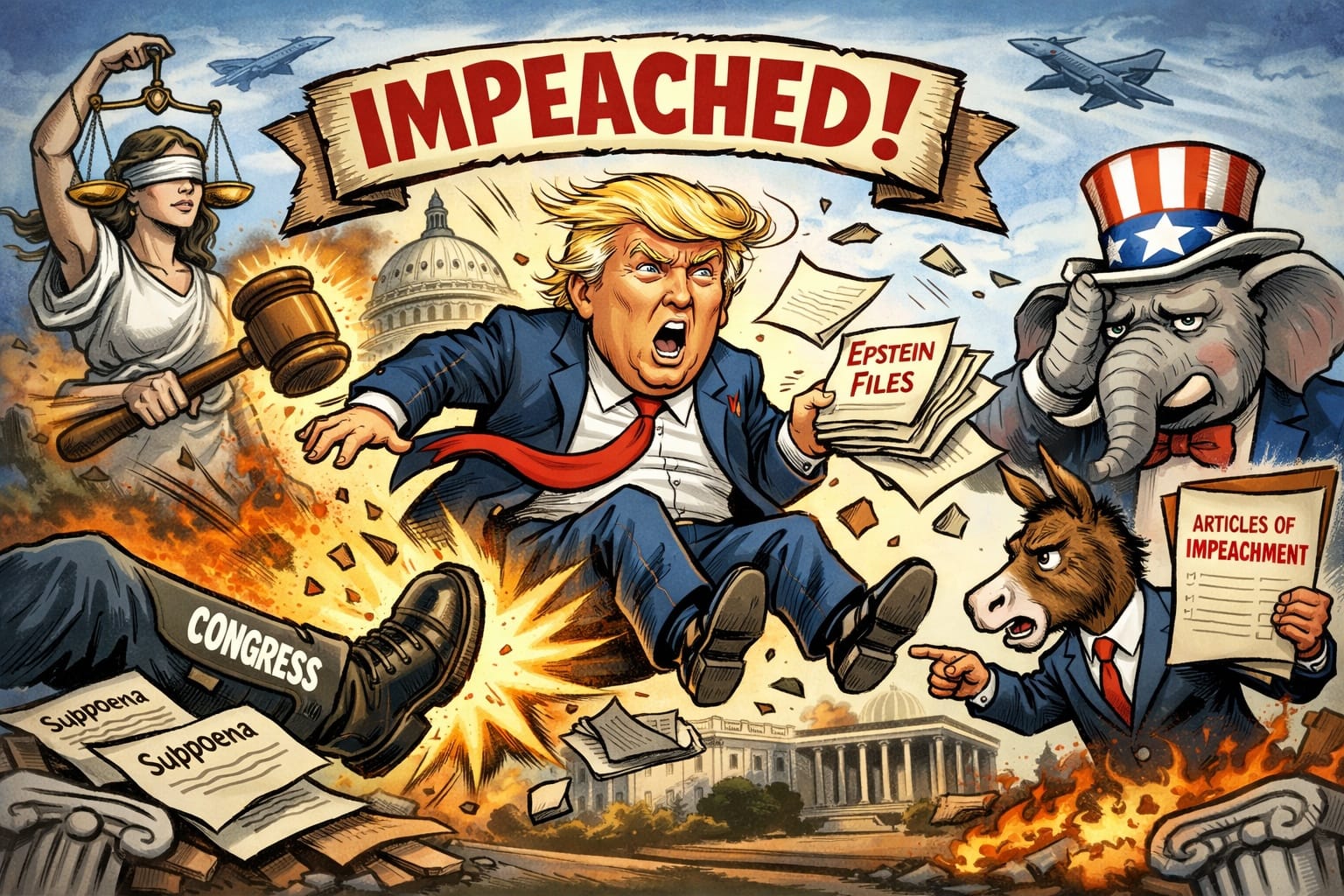
In early 2026, Washington is arguing about a third Trump impeachment like it’s the only story that matters. The popular assumption is simple: no Epstein files, no “smoking gun,” no impeachment.
That assumption is wrong. If impeachment happens this year, the trigger is more likely to be process, power, and war—not a sensational document dump. The question isn’t whether there are plausible grounds. The question is whether Congress has the votes.
The Epstein Files: Political Smoke vs. Legal Fire
The Epstein fight is real—and messy. Congress passed the Epstein Files Transparency Act, setting a deadline of December 19, 2025. Yet the Justice Department has acknowledged it released less than 1% by early January, citing victim privacy and ongoing review.
But here’s the twist: the content of the files may matter less than the withholding.
The “obstruction” angle: Reps. Ro Khanna (D) and Thomas Massie (R) have pushed for a judge to appoint a special master to force full compliance, arguing DOJ missed the deadline and that the release process is not credible without independent oversight.
What that means politically: even if no new “Epstein bombshell” ever emerges, a suppression narrative can still become an impeachment narrative—because “we’re being blocked” is sometimes a stronger organizing story than “here’s what we found.”
Verdict: Right now, the Epstein files operate more like a procedural battlefield than a single impeachable “silver bullet.”
Three Paths to Impeachment That Don’t Depend on Epstein
Even if Epstein stays locked behind redactions, multiple impeachment lanes are already open in public view.
1) Venezuela: War Powers and Constitutional Flashpoint
The most immediate spark is the January 3, 2026 U.S. military operation in Venezuela, which has triggered claims it lacked congressional authorization.
Legal critics argue this implicates:
- Article I war powers (Congress’s role)
- The War Powers Resolution framework
- Potential violations of domestic and international law
Even establishment legal voices have publicly framed the Venezuela action as a major constitutional breach.
Why this matters: “Unauthorized war” has historically been one of the cleanest impeachment arguments on paper—because it’s about authority and procedure, not reading minds or proving secret intent.
2) Executive Overreach and the “Faithfully Execute the Laws” Argument
The second lane is the long-running battle over executive power—civil service control, law enforcement posture, and aggressive interpretations of presidential authority. (You referenced “Project 2025”-type governance; the article can keep that framing as a political label, while focusing the legal critique on abuse of power and duty of office.)
Why this lane is potent: it can be written as a pattern—appointments, enforcement choices, threats, administrative purges—rather than a single event.
3) Incitement and Threat Normalization
Rep. Al Green filed impeachment articles in December 2025 alleging abuse of power and incitement—specifically pointing to rhetoric that puts public officials at risk and undermines democratic governance.
Why it matters: this lane doesn’t require proving a crime in court. Impeachment is a political-constitutional remedy. The argument is: a president who uses the megaphone to endanger institutions is unfit.
The Real Barrier Isn’t Evidence. It’s Math.
Even if the House can draft articles tomorrow, impeachment is not a courtroom drama—it’s a vote-counting operation.
- House: simple majority to impeach
- Senate: two-thirds to convict and remove
So the choke point isn’t “Do we have grounds?” It’s “Do we have defections?”
That’s why many impeachment pushes don’t move until a political catalyst changes the composition of Congress.
The Midterms as the Trigger
If Democrats flip the House in November 2026, impeachment becomes far more likely—not because new facts magically appear, but because the procedural gatekeepers change.
In that scenario, the most plausible articles are not “Epstein did it,” but:
- Abuse of power
- Obstruction / noncompliance with lawful mandates
- War powers violations (Venezuela)
- Incitement / threats (depending on events and rhetoric)
The Epstein files are the most sensational route. Venezuela and executive overreach are the most legally direct routes.
Final Word: He’s a Disgrace — But Removal Still Takes Votes
Donald Trump is a disgrace to the United States and to the Republican Party.I hope the GOP understands that the ground is sliding under its feet, and that history will not be kind to those who chose loyalty over law.There is still time to do the right thing — but that window is closing.