

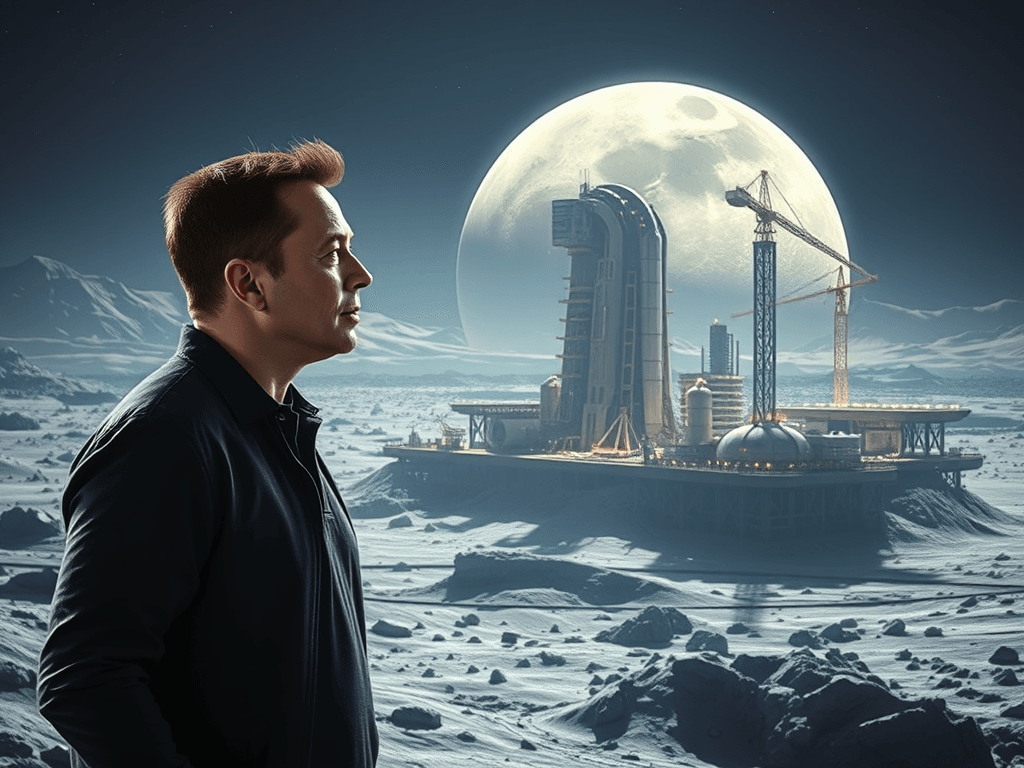
Elon Musk just flipped the script on SpaceX’s long-running mythology.
For years, the storyline was simple: Mars is the destination. The Moon was treated like a detour, a distraction, a political side quest. Now Musk is saying the overriding priority is building a “self-growing city” on the Moon—and that it could happen in under 10 years.
Mars is still in the picture. But it just got demoted.
The headline: “The Moon is faster”
Musk’s argument is blunt: if the goal is “securing the future of civilization,” then you go where you can build first.
And in pure logistics terms, the Moon is the obvious answer:
- It’s days away, not months.
- Resupply is realistic.
- Rescue is possible.
- Failure doesn’t automatically become a one-way tragedy.
Mars has romance. The Moon has iteration speed—and iteration is what SpaceX runs on.
What does a “self-growing” Moon city even mean?
No serious person imagines arriving to a pre-built sci-fi metropolis.
“Self-growing” is shorthand for a phased approach:
- Seed base: a small outpost that can survive, communicate, generate power, and keep humans alive.
- Robots + construction: heavy automation building shelters, berms, and infrastructure before large crews arrive.
- Local materials: using lunar regolith (moon dirt) to reduce the insane cost of launching every bolt from Earth.
- Scaling loop: each new shipment increases the base’s ability to build the next expansion faster—until it becomes a system that “grows” instead of merely “arrives.”
It’s basically a strategy to turn the Moon into an industrial project, not a flag-planting museum.
The timeline talk: bold, familiar, and risky
Musk says the lunar city could be achieved in less than a decade, while Mars settlement work could begin within five to seven years.
If that feels aggressive, that’s because it is.
Musk has a long track record of setting timelines that slide—sometimes dramatically. Space is hard, hardware is slow, and “first time ever” projects do not run on hype.
So treat the dates like a direction, not a guarantee.
The near-term anchor: an uncrewed Moon landing target
The biggest “tell” in this pivot is the operational focus: SpaceX is reportedly targeting an uncrewed lunar landing by March 2027.
That kind of date matters more than grand settlement speeches, because it implies internal planning, investor messaging, and program sequencing. It suggests the Moon is moving from “eventually” to “schedule.”
There’s a geopolitics engine behind this, too
This isn’t happening in a vacuum.
The U.S. is under pressure to return humans to the Moon this decade, with China racing hard in the same direction. And the U.S. hasn’t put people on the lunar surface since 1972.
SpaceX is also a core contractor for NASA’s Artemis program, with a multibillion-dollar contract to land astronauts using Starship. If you’re SpaceX and you want your next decade to be full of funded launches, the Moon isn’t just “faster”—it’s where the institutional demand is.
The business angle: Starlink pays for the dream
Another quiet truth in all of this: settlements cost money, and rockets don’t fund themselves on vibes.
Musk has said the vast majority of SpaceX revenue is commercial—driven mainly by Starlink, not NASA. That matters because it frames SpaceX’s future as something closer to:
- a launch company
- a global satellite internet utility
- and a space infrastructure builder
…with settlement as the ultimate downstream product.
The xAI twist: Space + AI is becoming one storyline
Musk also recently tied SpaceX’s future to AI by folding his AI company (xAI) into the broader SpaceX orbit in a deal framed at enormous valuations. Supporters of that move argue it could strengthen plans for space-based computing infrastructure—especially as energy demands for AI explode on Earth.
Whether or not that vision holds up, the direction is clear: Musk is trying to merge space, communications, automation, and AI into one integrated empire.
And a Moon base—robot-built, power-hungry, communications-intensive—fits that integrated logic better than a far-off Mars fantasy.
What has to go right for a Moon city to become real
A “self-growing city” is not just rockets. It’s a stack of hard problems that all have to cooperate:
- Reliable heavy-lift cadence (launch, land, repeat, without long gaps)
- Radiation and dust mitigation (moon dust is nasty; radiation is worse)
- Power infrastructure (continuous energy through long lunar nights, depending on location)
- Closed-loop life support (air, water, waste—boring, essential, unforgiving)
- In-situ manufacturing (the difference between a base and a city is making things locally)
- Crew health (long stays in low gravity come with real biological costs)
This is why the Moon-first strategy makes sense: you can test the full stack with fewer “you’re on your own” consequences.
The bottom line
Musk just made a rare move: he re-ranked his own legend.
Mars may still be the ultimate dream, but SpaceX’s immediate storyline is shifting to something more practical, more political, and more achievable: build a foothold on the Moon that can expand itself.
If it works, it’s not just a milestone—it’s a new template for how humanity builds off-world: not by shipping a city from Earth, but by planting a seed and teaching it to grow.

