

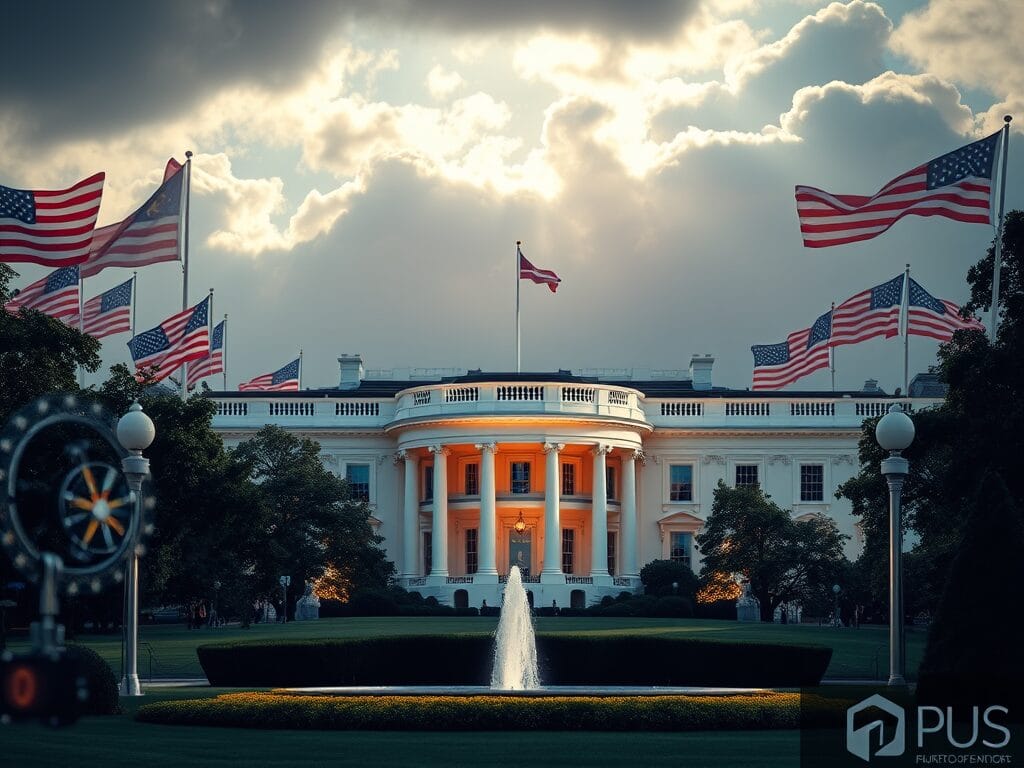
The White House released a new National AI Framework that’s designed to do one thing above all: push Congress toward a single, uniform set of AI rules for the entire United States — and override the growing patchwork of state regulations.
It’s a high-stakes bet that the U.S. can’t win global AI dominance if every state writes its own rulebook. The administration’s message is blunt: one national framework, not 50 different regimes.
The core goal: pre-empt state rules
The framework urges Congress to pass legislation that would pre-empt state AI laws and replace them with a nationwide standard. The argument is that businesses need certainty to innovate, deploy, and scale AI systems without getting trapped in compliance whiplash.
This follows earlier White House pressure tactics — including a warning that federal broadband funding could be withheld from states whose AI rules are seen as slowing “American dominance” in AI.
A major emphasis: kids’ online safety
The document leans heavily into protecting children, positioning this as the clearest area of bipartisan agreement.
Key ideas include:
- more parental control over kids’ accounts and devices
- stronger privacy protections for minors
- platform features aimed at reducing risks like sexual exploitation and self-harm
- a broader push to treat children’s online safety as a core design requirement, not an optional add-on
The strategy is political as much as it is policy: child safety is the easiest place to build a coalition around AI regulation.
The surprise focus: energy costs and data centers
One of the most practical parts of the plan is also one of the most revealing: it targets the energy footprint of AI.
The framework calls on Congress to streamline permitting so that power-hungry AI data centers can more easily:
- build faster
- expand more predictably
- and in many cases generate power on-site
This is a quiet admission of what the AI boom is turning into: not just a software revolution, but a power infrastructure race. The government is signaling that the U.S. can’t lead AI while its grid, permitting systems, and energy prices become bottlenecks.
“Remove barriers to innovation” — the pro-growth spine of the plan
The framework is built around acceleration. It pushes for:
- fewer regulatory hurdles to AI deployment across industries
- easier construction of top-tier AI systems
- a national posture aimed at keeping the U.S. ahead globally
You can read the document as a pro-innovation blueprint that’s trying to keep the AI buildout moving faster than the legal and regulatory backlash.
A big cultural signal: “free speech” and “anti-censorship”
The framework also wades into the culture-war zone by emphasizing:
- preventing censorship
- protecting free speech
- policies that steer AI systems away from ideological gatekeeping (as the White House frames it)
This is the administration saying that AI governance won’t just be about safety and economics — it’s also about who controls what AI is allowed to say.
Intellectual property and the workforce: two unavoidable battlegrounds
The plan includes provisions around intellectual property, implicitly acknowledging the rising conflict between AI companies and creators.
It also calls for building an AI-proficient workforce, emphasizing education and training so Americans can work with — and compete in — an AI-driven economy.
That’s the “soft power” side of competitiveness: even with the best models, a country needs people who can deploy them effectively.
The glaring gap: national security gets surprisingly little space
One of the most striking elements is what the framework barely addresses: national security.
At a time when China hawks in Washington are warning that AI chip exports could strengthen a strategic rival, the framework gives limited attention to defense and security risks — even as the administration has allowed certain advanced chip exports to China under licensing conditions.
This omission will likely become a major point of criticism, especially from lawmakers who want a harder line on chip controls and AI military implications.
What happens next
This framework isn’t law. It’s a political blueprint — a starting gun for Congress.
The next phase will hinge on three questions:
- Will Congress actually pass a pre-emption law?
That would reshape the entire U.S. AI regulatory landscape overnight. - How will states respond?
States with active AI bills may fight back, especially if they view federal action as stripping consumer protections. - What gets traded to build a coalition?
Kids’ safety and scam prevention are likely the “bridge issues.” Free speech, IP, and national security could be the fault lines.
Bottom line
The White House’s National AI Framework is a clear attempt to centralize AI governance, speed up AI infrastructure buildout, and keep America’s tech sector from being boxed in by state-level rules.