


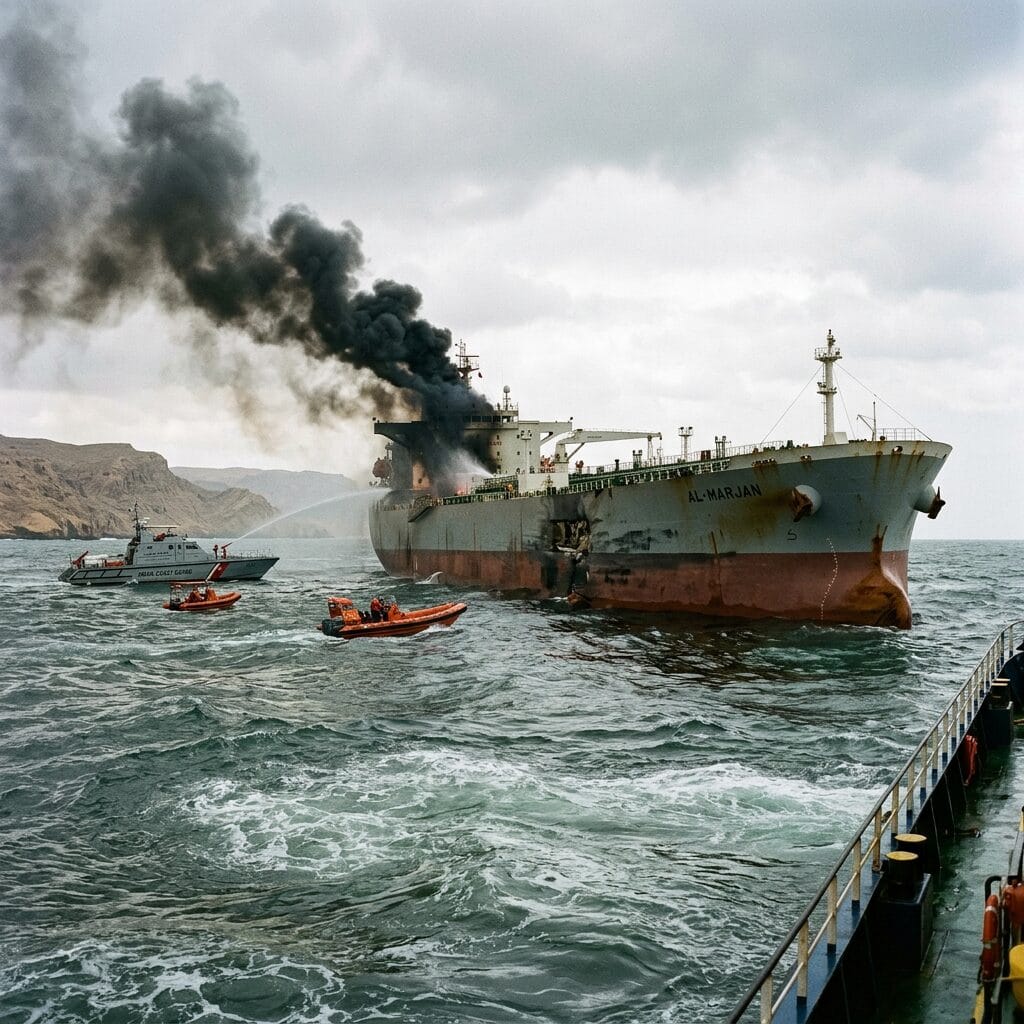
The crew is safe. The ship is stable. The fuel spill has been contained.
That is the good news.
The bad news is that a tanker just reported an external explosion near the waterline off Oman’s coast, in a region already living under the shadow of war, disrupted shipping, and deep anxiety around the Strait of Hormuz. Even when nobody is killed, even when the damage appears limited, an incident like this lands heavily because of where it happened.
In the Gulf, location is never just geography.
It is risk.
The Water Is Still Not Normal
The tanker incident happened about 60 nautical miles off Muscat, a key area near the routes linking the Gulf of Oman with the wider energy trade.
That matters because this is not happening in a calm maritime environment. It is happening after months of pressure on shipping, repeated fears around Hormuz, and a regional war that has turned energy corridors into geopolitical flashpoints. A single external explosion on a tanker may not prove a wider attack pattern by itself, but it immediately reminds shipowners, insurers, traders, and governments that the sea remains dangerous.
That is how fragile confidence is right now.
One blast is enough to make everyone look again.
Safe Crew Does Not Mean Small Consequence
It is important that the crew survived and the vessel remained operational.
But maritime security is not only measured by casualties. It is measured by confidence. Can commercial ships move without fear? Can tankers pass through the region without special risk calculations? Can insurers price routes normally? Can crews trust that they are not being sent into a conflict zone disguised as a trade lane?
Those questions remain open.
A tanker can stay afloat while trust sinks.
The Explosion Near the Waterline Is the Detail That Matters
An external explosion close to the port side near the waterline is exactly the kind of detail that raises concern.
It suggests the vessel was affected from outside, not by some routine mechanical issue deep inside the ship. The cause remains unknown, and that uncertainty is part of the problem. In a tense maritime zone, unknown causes do not calm anyone. They invite speculation about mines, drones, sabotage, hostile objects, or miscalculation.
That does not mean anyone should jump to conclusions.
But it does mean the incident cannot be shrugged off as ordinary.
The Fuel Spill Is a Warning Too
The tanker reportedly discharged bunker fuel into the sea after damage to one of its bunker tanks, though the spill was later contained.
That detail matters because tanker incidents are never only about security. They are also environmental events waiting to happen. Even a contained sheen in the water is a reminder that a more serious strike, collision, or explosion could create a much larger spill with consequences for coastal waters, fisheries, marine life, and nearby economies.
In the Gulf, the environmental risk and the energy risk travel together.
A damaged tanker threatens both.
This Is Why Shipping Markets Stay Nervous
Shipping companies do not need certainty of attack to change behavior.
They only need enough uncertainty to make risk feel expensive.
That is why incidents like this matter so much. A stable and operational tanker is still a warning if the event convinces operators that the route remains unpredictable. Insurance premiums can rise. Crews can become harder to assign. Owners can hesitate. Charterers can demand compensation for added danger. Oil traders can build extra risk into prices.
Fear is not a side effect in maritime trade.
Fear becomes a cost.
Oman’s Waters Sit Beside the World’s Energy Anxiety
Oman has often been seen as a calmer actor in a turbulent region, but its geography places it beside one of the world’s most sensitive maritime corridors.
That is why an explosion off Muscat carries more weight than a similar incident in a less strategic area. Ships moving past Oman are not just local traffic. They are part of the broader system that connects Gulf energy to global markets. When trouble appears there, the story quickly becomes bigger than one tanker.
The world is watching the entire route.
Not just Hormuz itself.
The Unknown Cause Is the Most Dangerous Part
In a tense region, uncertainty can be almost as destabilizing as confirmation.
If the cause is unknown, every side begins filling the silence with its own fears. Shipping firms assume danger. Markets price risk. Governments watch for escalation. Regional actors deny, accuse, or stay quiet. Rumor travels faster than evidence.
That is the problem now.
Until the cause is clearly identified, the incident sits inside the region’s larger anxiety machine.
The Gulf Cannot Afford Maritime Normalization of Violence
The danger is not only one explosion.
The danger is that incidents like this become normal. A blast here. A seized vessel there. A damaged tanker. A drone warning. A temporary traffic halt. A spill. A statement saying the crew is safe. Then everyone moves on until the next incident.
That is how maritime insecurity becomes baked into the system.
And once that happens, the global economy quietly adjusts to a more dangerous world.
The Meaning of the Moment
The tanker explosion off Oman is not yet proof of a new major escalation.
But it is proof that the maritime environment around the Gulf remains dangerously fragile. The crew survived. The ship remained stable. The spill was contained. Those facts matter.
But the bigger message is still unsettling.
A vital energy corridor cannot return to normal while tankers are reporting external explosions and the cause remains unknown. Trade depends on routine. Energy markets depend on confidence. Crews depend on safety. Right now, the Gulf is still struggling to provide all three.
That is why this incident matters.
Not because it was the worst-case scenario.
Because it shows how close the region remains to one.