


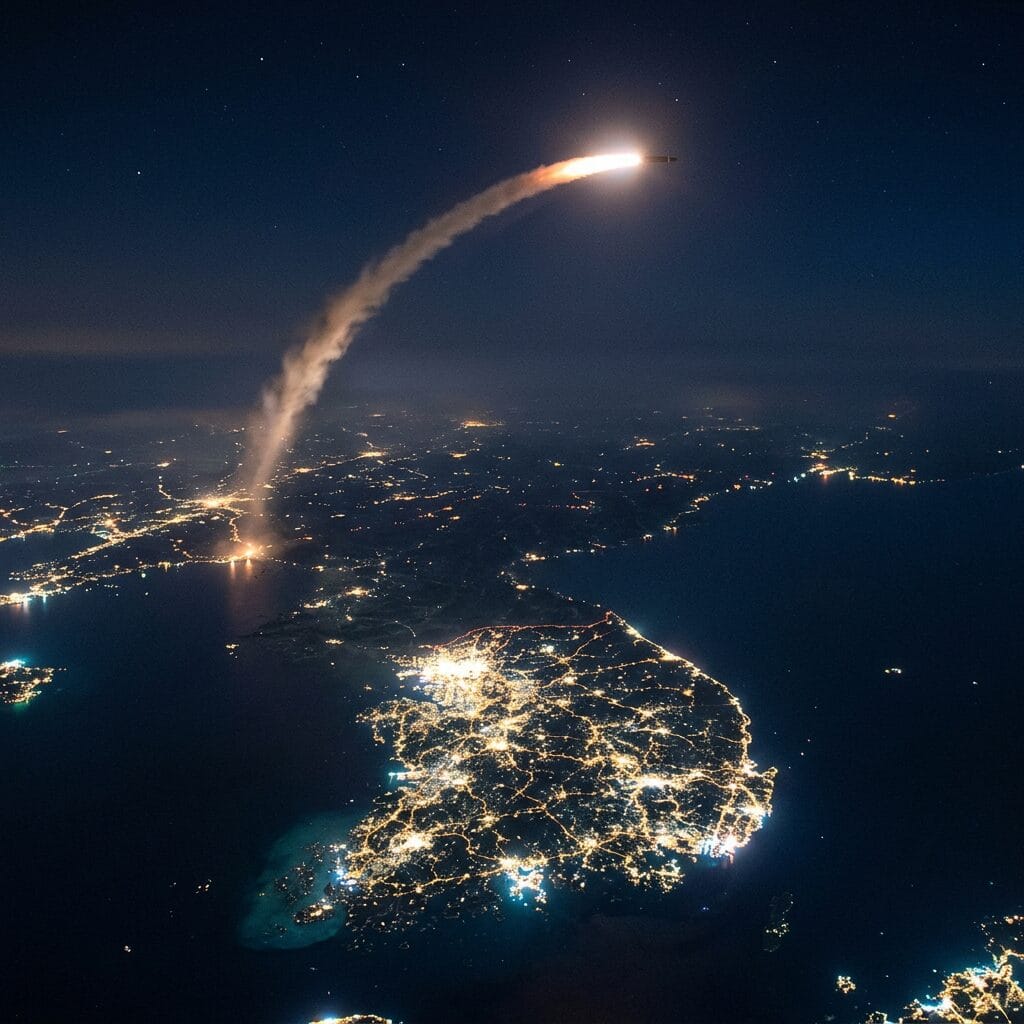
North Korea’s latest missile launch was short-range.
That does not make it harmless.
A missile flying roughly 50 miles toward the sea may not sound like a major escalation compared with intercontinental missile tests or nuclear threats. But that is the wrong way to read it. North Korea’s weapons launches are rarely just about distance. They are about signaling, timing, pressure, and reminding South Korea, the United States, and the wider region that Pyongyang still has the ability to disrupt the security mood whenever it chooses.
This was not just a projectile.
It was a message.
The Timing Is the Point
The launch came days after Russia and China voiced opposition to Western pressure on North Korea.
That timing matters.
Pyongyang is operating in a very different diplomatic environment than it did years ago. It is not isolated in the same way. Russia and China are no longer simply background players. They are shielding, encouraging, or at minimum complicating international efforts to pressure North Korea over its weapons program.
That gives Kim Jong Un more room to move.
When Beijing and Moscow signal resistance to sanctions and military pressure, North Korea hears something useful: the old international front against its weapons program is weaker than Washington would like.
North Korea Is Testing More Than Weapons
The missile itself reportedly flew only about 80 kilometers, but South Korean media said other weapons systems may also have been used, including multiple rocket launchers.
That suggests the launch was not merely a simple missile test.
It may have been designed to test mixed launches, saturation tactics, or the ability to complicate South Korean and U.S. defenses. That is where the real danger sits. North Korea does not need every launch to be spectacular. It needs its forces to become harder to predict, harder to intercept, and harder to dismiss.
That is how deterrence pressure builds.
One short-range missile is a signal. Multiple systems launched together are a rehearsal.
Seoul Cannot Treat This as Routine
South Korea has lived with North Korean threats for decades.
That creates a dangerous temptation to normalize them. Another launch. Another statement. Another readiness alert. Another round of analysis. But normalization is exactly what Pyongyang benefits from. If each weapons test becomes background noise, North Korea can keep improving its arsenal while the world learns to shrug.
South Korea’s military response — close monitoring, readiness, and emphasis on the U.S. alliance — is necessary.
But the harder challenge is political: staying alert without letting North Korea control the national mood every time it fires into the sea.
Kim Is Building a More Dangerous Military Posture
Kim Jong Un has spent years modernizing North Korea’s nuclear and missile programs since diplomacy with Trump collapsed in 2019.
That failure still shapes the present.
Instead of returning to denuclearization talks, North Korea has hardened its position. It now insists Washington drop demands for nuclear disarmament as a precondition for talks. It has deepened ties with Russia, supported Moscow’s war in Ukraine with troops and conventional arms, and worked to preserve China as its economic lifeline.
This is not a regime preparing to bargain away its weapons.
It is a regime embedding those weapons deeper into its national survival strategy.
The Russia-China Shield Is Changing the Game
The most important shift may be at the United Nations and in great-power politics.
Russia and China, both veto-wielding members of the U.N. Security Council, have repeatedly frustrated efforts to tighten sanctions on North Korea. That weakens the old pressure model. Washington can still condemn. Seoul can still prepare. Tokyo can still coordinate. But without unified great-power pressure, North Korea has more breathing room.
That is the strategic reality.
Kim does not need full support from Moscow and Beijing for every launch. He only needs them to keep blocking the kind of coordinated punishment that would truly hurt.
South Korea Is Thinking Harder About Its Own Military Future
South Korean President Lee Jae Myung’s remarks about strengthening the military, including AI, drones, and possibly a nuclear-powered submarine, show how the threat is reshaping Seoul’s defense thinking.
That matters because North Korea’s provocations do not only strengthen Pyongyang’s posture. They also push South Korea toward more advanced military capabilities. Every test gives Seoul another argument for modernization. Every launch makes the case for stronger surveillance, faster response systems, drone warfare capacity, and deeper integration with U.S. defense planning.
That is the arms-race logic of the peninsula.
North Korea fires. South Korea upgrades. North Korea responds again.
The Peninsula Is Moving Further From Reconciliation
Kim’s recent hard-line stance toward South Korea is especially alarming.
He has called the South his country’s most hostile enemy and moved to cut ties. He has reportedly discussed turning the border into an “impregnable fortress.” That language matters because it abandons even the symbolic idea of shared national reconciliation. The old fiction of eventual Korean unity, however distant, is being replaced by open hostility.
That is a major psychological shift.
The two Koreas are no longer just divided. They are being politically redefined as permanent enemies.
Trump’s Desire for Talks Is Not Enough
Trump has repeatedly expressed interest in resuming talks with Kim.
But desire is not strategy.
North Korea has already made clear that it will not return to talks on Washington’s old terms. It does not want denuclearization as the entry point. It wants recognition, concessions, and a negotiation framework that treats its nuclear arsenal as a reality rather than a temporary bargaining chip.
That is a much harder conversation.
If Washington refuses to accept that, talks may never restart. If Washington does accept it, it risks legitimizing North Korea’s nuclear status.
That is the trap.
The Real Danger Is Drift
The most dangerous outcome may not be immediate war.
It may be drift.
A region where North Korea keeps testing, South Korea keeps arming, the U.S. keeps signaling, China and Russia keep shielding, and diplomacy remains frozen. That kind of environment can look stable for long stretches — until one mistake, one misread exercise, one launch failure, or one border incident breaks the pattern.
That is why even a short-range launch deserves attention.
Not because it guarantees war, but because it shows the machinery of confrontation is still running.
The Meaning of the Moment
North Korea’s latest launch was not the biggest test it could have carried out.
But it was still significant.
It showed Pyongyang is willing to keep demonstrating force while Russia and China push back against Western pressure. It reminded Seoul that mixed weapons systems and short-range threats remain central to North Korea’s military posture. It underscored how far diplomacy has fallen since the Trump-Kim talks collapsed. And it exposed the deeper reality of the Korean Peninsula in 2026: heavily armed, diplomatically frozen, and increasingly shaped by great-power rivalry.
The missile flew only about 50 miles.
The message traveled much farther.