

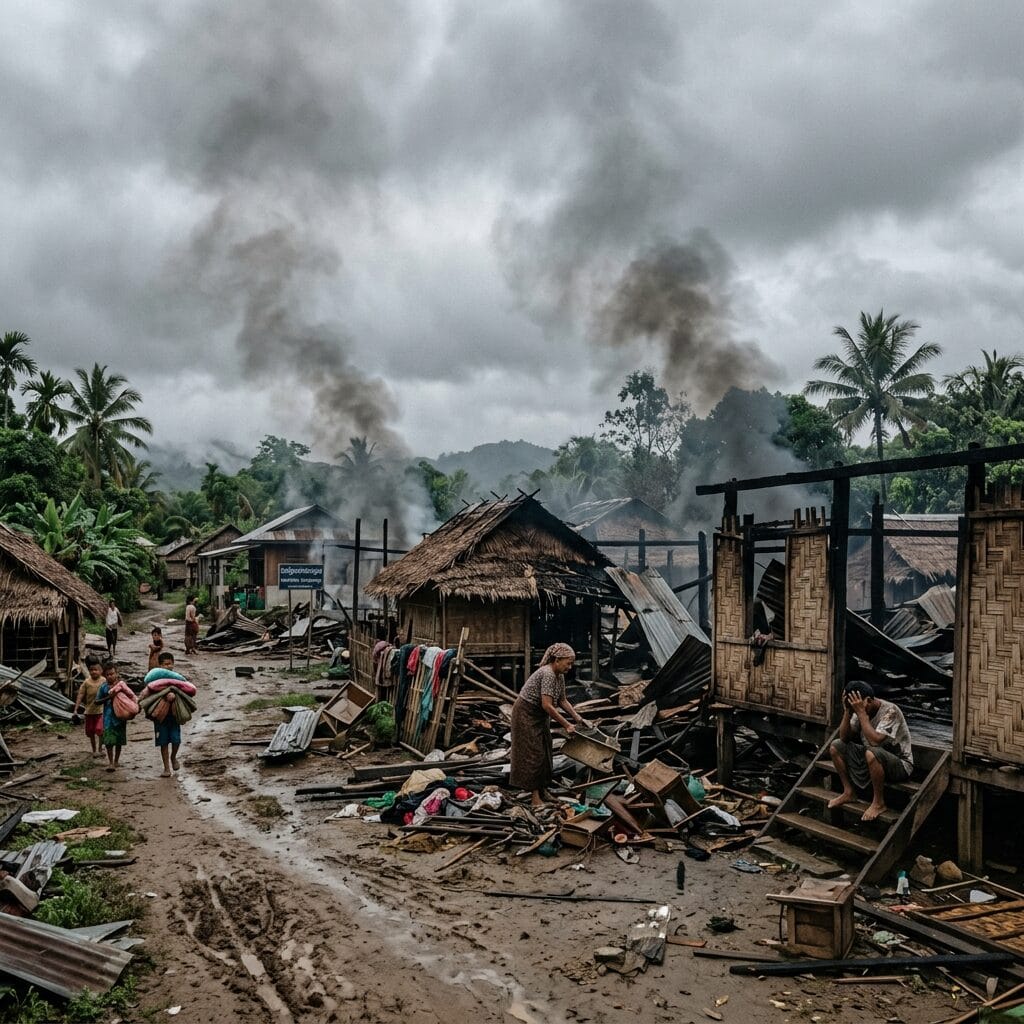
A building storing explosives blew up in northeastern Myanmar.
More than 45 people are dead. Dozens more are injured. Homes were damaged. Rescue workers searched through debris. Families lost children. A village near the Chinese border was suddenly turned into a disaster zone.
This was not just an accident in a remote corner of Myanmar.
It was a warning about what happens when explosives, mining interests, armed groups, weak oversight, and civil war conditions collide in civilian space.
Explosives Do Not Belong Near Homes
The basic horror is simple.
Large quantities of explosive material were reportedly stored in or around a village area. When that material detonated, it did what explosives do: it destroyed life around it. The blast killed adults and children, damaged more than 100 houses, and left the community scrambling through smoke, wreckage, and fear.
That is the first failure.
No civilian community should be living beside a hidden bomb waiting for one mistake, one fire, one spark, one storage failure, or one act of negligence to turn into mass death.
Mining Explosives Are Still Explosives
The material was reportedly gelignite, used in mining and stone quarrying.
That may sound industrial, but it does not make it safe. Mining explosives are designed to break rock. If poorly stored, mishandled, aged, or concentrated in unsafe conditions, they can become catastrophic. The fact that the explosives were for economic use does not reduce the danger.
It may actually make the danger more invisible.
People often fear weapons but underestimate industrial explosives. Yet for the families in Kaungtup village, the distinction does not matter. The blast still killed. The buildings still came down. The children still died.
Armed Control Makes Accountability Harder
The area is controlled by the Ta’ang National Liberation Army, an ethnic armed group active in Myanmar’s conflict.
That matters because accountability in armed territory is always complicated. Who regulates storage? Who inspects the site? Who keeps explosives away from residential areas? Who answers to the dead? Who compensates families? Who prevents the next explosion?
In a functioning state, there should be clear rules, enforcement, and liability.
In a conflict zone, those lines blur.
And when lines blur, ordinary people are the ones buried under the consequences.
Myanmar’s Civil War Keeps Turning Daily Life Into Risk
Myanmar has been trapped in violent instability since the military seized power in 2021.
The country’s conflict has fractured authority across regions. Armed groups control territory. The junta controls other areas. Civilians live between military forces, ethnic armies, resistance groups, checkpoints, airstrikes, displacement, and economic desperation.
In that environment, danger spreads into everything.
A road can become a front line. A school can become a shelter. A village can become a storage site. A mining depot can become a mass casualty event.
That is the reality of prolonged internal war: it does not only kill through bullets and bombs. It destroys the ordinary safety systems that keep people alive.
Border Communities Carry Extra Risk
Kaungtup village lies only a few kilometers from the Chinese border.
Border regions often carry layered danger. They are economically important, politically contested, and harder to govern. They can become corridors for trade, mining, armed movement, illicit networks, displaced people, and military competition. In such places, civilians may live beside forces and materials they have little power to control.
That makes them vulnerable twice over.
They are close enough to economic activity to bear the risk, but often too politically powerless to demand safety.
The Death of Children Makes the Failure Unforgivable
Rescue workers said children were among the dead.
That should stop the conversation from becoming too technical.
This is not only about storage regulations, armed group management, mining supply chains, or conflict control. It is about children living near explosive material they never chose to live beside. It is about families who woke up in a village and ended the day planning funerals.
When children die this way, the usual language of “incident” and “investigation” feels too small.
This was preventable danger allowed to sit too close to human life.
The Investigation Cannot Be a Ritual
The TNLA says it is investigating the cause of the explosion.
That investigation must not become another empty procedure.
The questions are obvious. Why were large quantities of explosives stored there? Who authorized it? Were civilians informed? Were there safety measures? Was the material old or unstable? Was it properly guarded? Were mining operations prioritized over public safety? Who will be held responsible?
If those questions are not answered honestly, then the blast becomes one more tragedy absorbed by Myanmar’s endless crisis.
And that would be another form of injustice.
The World Barely Notices Myanmar’s Slow Collapse
Part of the tragedy is that disasters in Myanmar often struggle to break through global attention.
The country has endured coup, civil war, displacement, airstrikes, economic breakdown, repression, and fragmented control. Yet much of the world treats Myanmar as background suffering. The headlines appear briefly, then disappear.
That silence matters.
When the international spotlight fades, accountability fades with it. Armed actors operate with less scrutiny. Civilians become statistics. Explosions like this are treated as local disasters rather than symptoms of a country being broken in slow motion.
This Is What Failed Governance Looks Like
A functioning political order protects civilians from predictable danger.
Myanmar does not have that functioning order right now.
That is the larger meaning of the explosion. It shows a society where dangerous materials can sit near homes, where armed groups control territory, where mining and conflict overlap, and where civilians have little protection from decisions made above them.
This is not just a blast.
It is the sound of failed governance.
The Meaning of the Moment
The explosion in Kaungtup village should not be dismissed as an isolated accident.
It is part of a bigger story about Myanmar’s collapse into fragmented armed authority, unsafe economic activity, and civilian exposure to lethal risk. More than 45 people did not die because fate randomly chose their village. They died because explosive material was stored in a place where ordinary people could be killed if something went wrong.
Something did go wrong.
Now families are burying the cost.
The lesson is blunt: when war and weak oversight turn civilian areas into storage sites for dangerous materials, tragedy is not a surprise.
It is only a matter of time.